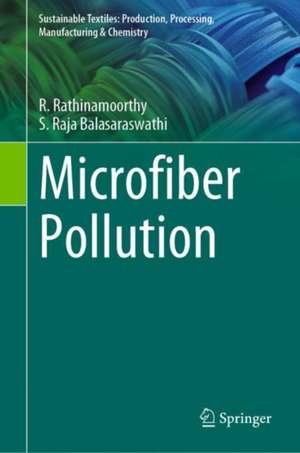
Microfiber Pollution: Sustainable Textiles: Production, Processing, Manufacturing & Chemistry
Autor R. Rathinamoorthy, S. Raja Balasaraswathien Limba Engleză Hardback – 14 aug 2022
Din seria Sustainable Textiles: Production, Processing, Manufacturing & Chemistry
- 18%
 Preț: 819.72 lei
- 18%
 Preț: 932.18 lei
- 18%
 Preț: 984.91 lei
- 18%
 Preț: 752.10 lei
- 18%
 Preț: 984.66 lei
- 24%
 Preț: 845.15 lei
- 18%
 Preț: 1040.67 lei
- 18%
 Preț: 1147.21 lei
- 18%
 Preț: 1038.28 lei
- 18%
 Preț: 808.79 lei
- 18%
 Preț: 927.53 lei
- 18%
 Preț: 757.26 lei
- 15%
 Preț: 620.10 lei
- 15%
 Preț: 556.30 lei
- 15%
 Preț: 610.12 lei
- 15%
 Preț: 700.04 lei
- 15%
 Preț: 587.03 lei
- 15%
 Preț: 613.18 lei
- 15%
 Preț: 616.63 lei
- 15%
 Preț: 559.15 lei
- 15%
 Preț: 556.72 lei
- 15%
 Preț: 640.49 lei
- 15%
 Preț: 670.90 lei
- 15%
 Preț: 560.16 lei
Preț: 982.96 lei
Preț vechi: 1198.73 lei
-18%
Puncte Express: 1474
Carte tipărită la comandă
Livrare economică 08-22 decembrie
Livrare prin curier în România Termenul estimat este afișat lângă disponibilitate.
Transport gratuit pentru acest produs Plată online sau ramburs, în funcție de opțiunile comenzii.
Retur gratuit în 14 zile Comandă securizată și suport în română.
Specificații
ISBN-13: 9789811941849
ISBN-10: 981194184X
Pagini: 260
Ilustrații: XV, 243 p. 53 illus., 48 illus. in color.
Dimensiuni: 160 x 241 x 20 mm
Greutate: 0.51 kg
Ediția:1st ed. 2022
Editura: Springer
Colecția Sustainable Textiles: Production, Processing, Manufacturing & Chemistry
Seria Sustainable Textiles: Production, Processing, Manufacturing & Chemistry
Locul publicării:Singapore, Singapore
Cuprins
Microfiber Pollution – A Sustainability Issue.- Microfiber Shedding of Textile Materials – Mechanism and Analysis Techniques.- Factors Influencing Microfiber Shedding – Role of Textile and Apparel Characteristics.- Domestic Laundry – A major cause of microfiber shedding.- Impact of microfiber/Microplastic pollution.- Microfiber Pollution Prevention - Mitigation Strategies and Challenges.
Notă biografică
Dr. Subramanian Senthilkannan Muthu currently works for SgT Group as Head of Sustainability, and is based out of Hong Kong. He earned his PhD from The Hong Kong Polytechnic University, and is a renowned expert in the areas of Environmental Sustainability in Textiles & Clothing Supply Chain, Product Life Cycle Assessment (LCA) and Product Carbon Footprint Assessment (PCF) in various industrial sectors. He has five years of industrial experience in textile manufacturing, research and development and textile testing and seven years of experience in life cycle assessment (LCA), carbon and ecological footprints assessment of various consumer products. He has published more than 75 research publications, written numerous book chapters and authored/edited multiple books in the areas of Carbon Footprint, Recycling, Environmental Assessment and Environmental Sustainability.
Dr.R.Rathinamoorthy, working as an Associate Professor in the Department of Fashion Technology, PSG College of Technology, Coimbatore, India from 2009. He had completed his Ph.D. on "Medical Textiles" in 2016. Recently he received the "Young Achiever Award" for the year 2019 by the Institute of Engineers India (IEI), coimbatore chapter. In 2017, He also received a national-level "Young Engineer award for the year 2016-17" in Textile Engineering domain, by Institute of Engineers India (IEI), Kolkata, West Bengal, India. He is having a google H index of 11 and a Scopus H index of 7 with more than 400 citations. He had published 19 national and 53 international research articles in various refereed and non-refereed journals. He had presented three international conference papers and two national seminars. He authored 5 technical books in the area of Apparel and fashion technology field and 19 book chapters with various international publishers like Woodhead Publisher, Springer Verlag, Springer Nature, Springer Singapore, Taylor & Francis and Elsevier publishers to his credit. In 2011,he had sanctioned a research project from University Grants Commission for the tune of Rs.10.15 Lakhs and successfully completed it in 2013. He also sanctioned a minor project to the worth of rupees 0.15 lakhs under PSG STEP, an Initiative by DST, NSTEDB, Govt of India.
He has eleven years of teaching experience in the area of Textile and Fashion discipline. He also has one year industrial experience as an industrial engineer. His research interest is on sustainable material for textile and fashion industries. He is currently working on bacterial cellulose and other biomaterials to identify their potential in the fashion industry as a sustainable alternative to existing conventional materials.
Textul de pe ultima copertă
This book provides insights into microfiber pollution in textile industries that would help researchers and professionals to work from the textile point of view to mitigate the problem, and create a green sustainable future. Microplastic pollution has received great importance due to its adverse environmental and health impact. Microplastic particles are found to contaminate the ecosystem. Research has reported microplastics on seashores, in deep seas, freshwater systems including rivers and lakes, and most importantly in the air. Various land-based and water-based organisms are also contaminated with microplastics. The most serious issue is when these particles are found in the food chain and air which can reach the human system. It has been estimated that human beings can intake up to 1,21,000 microplastic particles in a year through food and inhalation. Being one of the most polluting industries, the contribution of Textile industries in microplastic pollution is extremely higher (around 35%). This book addresses the issue of microfiber/microplastic pollution cause by various techniques including home laundry and the ways to alleviate it.
Caracteristici
Addresses impact of textile and apparel industry in contributing to microplastic pollution in the form of microfibers Presents the mitigation strategy from the textile and apparel industries Highlights the microfiber shedding mechanism of textile materials in different phases of their lifecycle