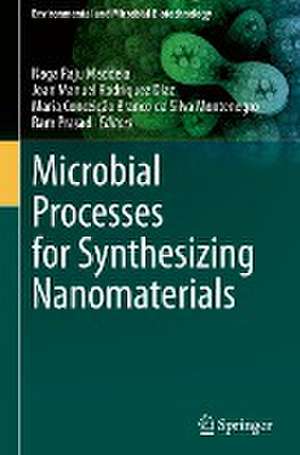
Microbial Processes for Synthesizing Nanomaterials: Environmental and Microbial Biotechnology
Editat de Naga Raju Maddela, Joan Manuel Rodríguez Díaz, Maria Conceição Branco Da Silva Montenegro, Ram Prasaden Limba Engleză Hardback – 5 sep 2023
Diferența fundamentală dintre acest volum și documentația tehnică standard rezidă în abordarea integrată a sustenabilității; Microbial Processes for Synthesizing Nanomaterials nu se rezumă la protocoale de laborator, ci fundamentează tranziția de la sinteza chimică poluantă la metode biologice verzi. Reținem o structură riguroasă, organizată în trei piloni: procesele de sinteză (cu accent pe aur, fungi și biofilme), tehnicile de caracterizare și aplicațiile practice în sectoare critice. Descoperim aici o progresie logică, de la mecanismele enzimatice detaliate în primele capitole, până la soluții complexe de nanodiagnostic și sisteme inteligente de livrare a medicamentelor (smart-drug nanoparticles). Ca și Ram Prasad în Microbial Nanobionics, editorii acestui volum distilează experiența reală în principii acționabile, însă pun un accent mai pronunțat pe diversitatea matricelor biologice, incluzând studii despre cristale pleocroice și compozite pentru electronică. Putem afirma că lucrarea completează organic opera anterioară a editorilor, cum este Marine Microbial Products, extinzând explorarea resurselor biologice de la mediul marin către aplicații nanotehnologice universale. Dacă lucrările precedente se concentrau pe bioprospecție și economie albastră, volumul de față rafinează tehnologia la scară nanometrică, oferind soluții concrete pentru combaterea agenților patogeni multirezistenți prin nanomedicină de ultimă generație. Această ediție 2023 publicată de Springer servește drept punte între microbiologia fundamentală și ingineria materialelor, fiind esențială pentru înțelegerea rolului microorganismelor în viitorul biotehnologiei industriale.
Din seria Environmental and Microbial Biotechnology
- 18%
 Preț: 1573.66 lei
 - 18%
 Preț: 1336.71 lei
 - 24%
 Preț: 1058.22 lei
 - 24%
 Preț: 1339.73 lei
 - 18%
 Preț: 910.58 lei
 - 18%
 Preț: 1389.92 lei
 - 18%
 Preț: 1121.78 lei
 - 24%
 Preț: 1017.44 lei
 - 18%
 Preț: 1223.03 lei
 - 18%
 Preț: 1135.03 lei
 - 18%
 Preț: 956.11 lei
 - 18%
 Preț: 1602.85 lei
 - 18%
 Preț: 1510.04 lei
 - 18%
 Preț: 1393.99 lei
 - 18%
 Preț: 1668.46 lei
 - 18%
 Preț: 948.36 lei
Preț: 1203.02 lei
Preț vechi: 1467.10 lei
-18%
Carte disponibilă
Livrare economică 29 octombrie-12 noiembrie
Specificații
ISBN-10: 9819928079
Pagini: 416
Ilustrații: XXII, 394 p. 1 illus.
Dimensiuni: 160 x 241 x 27 mm
Greutate: 0.86 kg
Ediția:1st ed. 2023
Editura: Springer
Colecția Environmental and Microbial Biotechnology
Seria Environmental and Microbial Biotechnology
Locul publicării:Singapore, Singapore
V-ar putea interesa
-
 -32%Preț: 995.13 lei1458.74 lei
 -
 Advances in Materials Science and TechnologySrikari Srinivasan-15%Preț: 506.89 lei596.35 lei
 -
 Nanoparticles in Biology and Medicine: Methods and ProtocolsEnrico Ferrari-18%Preț: 749.09 lei913.53 lei
 -
 Microbial NutraceuticalsSudhir Pratap Singh-23%Preț: 1061.68 lei1378.81 lei
 -
 Nanoparticles in Anti-Microbial MaterialsFiona Regan-14%Preț: 1153.07 lei1340.78 lei
 -
 Nanotoxicology and Nanoecotoxicology Vol. 1Vineet Kumar-24%Preț: 944.31 lei1242.51 lei
 -
 Bio-manufactured NanomaterialsKaushik Pal-18%Preț: 1064.79 lei1298.52 lei
 -
 Biogenic Wastes-Enabled Nanomaterial Synthesis: Applications in Environmental SustainabilityAbhishek Kumar Bhardwaj-18%Preț: 921.64 lei1123.95 lei
 -
 -18%Preț: 1031.94 lei1258.47 lei
 -
 NanobiostimulantsVandana Singh-18%Preț: 1024.32 lei1249.17 lei
 -
 Synthesis of Nanoparticles and NanomaterialsZhypargul Abdullaeva-18%Preț: 978.49 lei1193.27 lei
 -
 -14%Preț: 829.86 lei964.95 lei
 -
 Bio-Nanomaterials in Environmental RemediationNarendra K. Sharma-23%Preț: 806.55 lei1047.46 lei
 -
 -9%Preț: 965.82 lei1061.34 lei
 -
 Microbial Diversity, Interventions and ScopeShiwani Guleria Sharma-18%Preț: 1175.66 lei1433.73 lei
 -
 Microbial Nanotechnology: Green Synthesis and ApplicationsMohammad Azam Ansari-5%Preț: 805.54 lei847.93 lei
 -
 Microbial Products for Health, Environment and AgriculturePankaj Kumar Arora-24%Preț: 1175.52 lei1546.74 lei
 -
 Sustainable NanomaterialsImran Uddin-18%Preț: 1502.53 lei1832.35 lei
De ce să citești această carte
Această carte este o resursă tehnică esențială pentru cercetătorii și studenții din nanobiotehnologie care caută alternative sustenabile la sinteza chimică. Cititorul câștigă o viziune aplicată asupra modului în care bacteriile, fungii și enzimele pot produce nanomateriale cu proprietăți controlate. Este un ghid practic pentru dezvoltarea de noi antimicrobiene și sisteme de diagnostic rapid, oferind protocoale clare și studii de caz relevante pentru industria farmaceutică și electronică.
Despre autor
Echipa editorială este condusă de experți recunoscuți în biotehnologia mediului și microbiană. Naga Raju Maddela și Ram Prasad au o activitate vastă în documentarea resurselor biologice pentru aplicații industriale. Ram Prasad este un nume de referință în seria Environmental and Microbial Biotechnology, contribuind anterior cu lucrări fundamentale despre nanobionică. Expertiza colectivă a editorilor, care include specialiști precum Joan Manuel Rodríguez Díaz și Maria Conceição Branco da Silva Montenegro, acoperă întreg spectrul de la chimie analitică la inginerie biochimică, asigurând o abordare multidisciplinară necesară în studiul proceselor microbiene complexe.
Descriere scurtă
Cuprins
Notă biografică
Caracteristici
Descriere
This contributed volume compiles the latest improvements in the field of nanobiotechnology, with a special emphasis on microbial-synthesized nanoparticles.