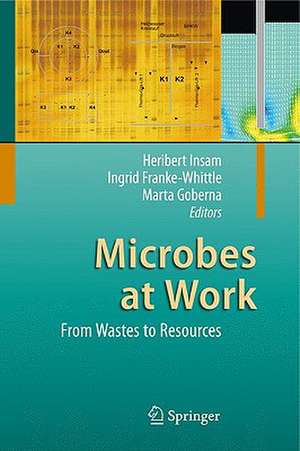
Microbes at Work
Editat de Heribert Insam, Ingrid Franke-Whittle, Marta Gobernaen Limba Engleză Hardback – 17 dec 2009
The sixteen chapters of this book summarize the advantages and disadvantages of treatment processes, whether they are aerobic like composting or work without oxygen like anaerobic digestion for biogas (methane) production. These chapters show the potential of microorganisms to create valuable resources from otherwise wasted materials. These resources include profitable organic, humus-like soil conditioners or fertilizer components which are often suppressive to plant diseases. Composts may thus improve soil carbon sequestration, or support sustainable agriculture by reducing the need for mineral fertilizers or pesticides. If anaerobic digestion is used, the biogas produced may replace fossil fuels. Thus, proper biological waste treatment with the help of microorganisms should contribute to a reduction of anthropogenic greenhouse gas production.
Preț: 1194.33 lei
Preț vechi: 1571.48 lei
-24%
Puncte Express: 1791
Carte tipărită la comandă
Livrare economică 21-27 noiembrie
Livrare prin curier în România Termenul estimat este afișat lângă disponibilitate.
Transport gratuit pentru acest produs Plată online sau ramburs, în funcție de opțiunile comenzii.
Retur gratuit în 14 zile Comandă securizată și suport în română.
Specificații
ISBN-13: 9783642040429
ISBN-10: 364204042X
Pagini: 340
Ilustrații: VIII, 329 p.
Dimensiuni: 160 x 241 x 26 mm
Greutate: 0.69 kg
Ediția:2010
Editura: Springer
Locul publicării:Berlin, Heidelberg, Germany
ISBN-10: 364204042X
Pagini: 340
Ilustrații: VIII, 329 p.
Dimensiuni: 160 x 241 x 26 mm
Greutate: 0.69 kg
Ediția:2010
Editura: Springer
Locul publicării:Berlin, Heidelberg, Germany
V-ar putea interesa
-
 Microbiology DeMYSTiFieD, 2nd EditionTom Betsy-38%Preț: 148.37 lei239.92 lei
 -
 MicrocosmCarl ZimmerPreț: 109.62 lei
 -
 BIOS Instant Notes in MicrobiologySimon BakerPreț: 268.65 lei
 -
 The Viral Storm: The Dawn of a New Pandemic AgeNathan WolfePreț: 122.79 lei
 -
 Parasites: Ecology, Diseases & ManagementGilmar S Erzinger-23%Preț: 1276.11 lei1662.72 lei
 -
 Computing for Comparative Microbial GenomicsDavid Wayne UsseryPreț: 408.44 lei
 -
 Bacterial Gene Regulation and Transcriptional NetworksM. Madan Babu-9%Preț: 1327.25 lei1458.52 lei
 -
 Oral Microbial Ecology: Current Research and New PerspectivesNicholas S. Jakubovics-9%Preț: 1323.02 lei1453.87 lei
Public țintă
ResearchDescriere
Among the goals of environmentally sound waste treatment is the recycling of organic wastes. The most practiced options are composting and anaerobic digestion, both processes being carried out by microorganisms. This book provides an overview of the various ways microbes are doing their job and gives the reader an impression of their potential.
The sixteen chapters of this book summarize the advantages and disadvantages of treatment processes, whether they are aerobic like composting or work without oxygen like anaerobic digestion for biogas (methane) production. These chapters show the potential of microorganisms to create valuable resources from otherwise wasted materials. These resources include profitable organic, humus-like soil conditioners or fertilizer components which are often suppressive to plant diseases. Composts may thus improve soil carbon sequestration, or support sustainable agriculture by reducing the need for mineral fertilizers or pesticides. If anaerobic digestion is used, the biogas produced may replace fossil fuels. Thus, proper biological waste treatment with the help of microorganisms should contribute to a reduction of anthropogenic greenhouse gas production.
The sixteen chapters of this book summarize the advantages and disadvantages of treatment processes, whether they are aerobic like composting or work without oxygen like anaerobic digestion for biogas (methane) production. These chapters show the potential of microorganisms to create valuable resources from otherwise wasted materials. These resources include profitable organic, humus-like soil conditioners or fertilizer components which are often suppressive to plant diseases. Composts may thus improve soil carbon sequestration, or support sustainable agriculture by reducing the need for mineral fertilizers or pesticides. If anaerobic digestion is used, the biogas produced may replace fossil fuels. Thus, proper biological waste treatment with the help of microorganisms should contribute to a reduction of anthropogenic greenhouse gas production.
Cuprins
Microbes in Aerobic and Anaerobic Waste Treatment.- Recent Developments in Bio-Energy Recovery Through Fermentation.- Syntrophic Communities in Methane Formation from High Strength Wastewaters.- Biogas Technology – Controlled Gas Flow for Enhanced Mixing, Heating, and Desulfurization.- Vermicomposting: Earthworms Enhance the Work of Microbes.- Compost Microbial Activity Related to Compost Stability.- Utility of Molecular Tools in Monitoring Large Scale Composting.- Production and Utilization of Suppressive Compost: Environmental, Food and Health Benefits.- Sanitation by Composting.- Microbial Antagonists in Animal Health Promotion and Plant Protection.- Interactions Between Beneficial and Harmful Microorganisms: From the Composting Process to Compost Application.- Compost Microbial Populations and Interactions with Plants.- Soil Degradation and Rehabilitation: Microorganisms and Functionality.- Do Composts Affect the Soil Microbial Community?.- Production and Application of Bioorganic Fertilizers for Organic Farming Systems in Thailand: A Case Study.- Challenges, Options and Future Research Needs.
Recenzii
From the reviews:
“The work highlights different aspects of microbial composting and anaerobic digestion of organic waste materials. Each of the 16 chapters, contributed by experts in the field, is well written with numerous excellent references and cutting-edge information. … The figures and tables aid in the understanding of the material. Though the work is geared toward researchers in the field, it can be used in graduate-level courses on the topic. Summing Up: Recommended. Graduate students through professionals/practitioners.” (M. E. Lenczewski, Choice, Vol. 48 (1), September, 2010)
“The work highlights different aspects of microbial composting and anaerobic digestion of organic waste materials. Each of the 16 chapters, contributed by experts in the field, is well written with numerous excellent references and cutting-edge information. … The figures and tables aid in the understanding of the material. Though the work is geared toward researchers in the field, it can be used in graduate-level courses on the topic. Summing Up: Recommended. Graduate students through professionals/practitioners.” (M. E. Lenczewski, Choice, Vol. 48 (1), September, 2010)
Caracteristici
The reader is informed about the state of the art of biological waste treatment and how to exploit the potential that microorganisms are offering for this purpose
Includes supplementary material: sn.pub/extras
Includes supplementary material: sn.pub/extras