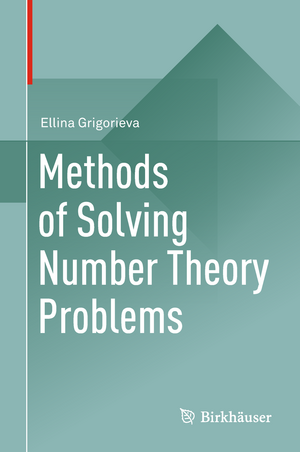
Methods of Solving Number Theory Problems
Autor Ellina Grigorievaen Limba Engleză Hardback – 18 iul 2018
O descoperim pe Ellina Grigorieva, o matematiciană cu o experiență vastă în pedagogia de performanță, a cărei autoritate în domeniu este consolidată de o serie întreagă de lucrări dedicate metodologiilor de rezolvare a problemelor. Methods of Solving Number Theory Problems fundamentează învățarea teoriei numerelor nu pe memorarea aridă a unor formule, ci pe o abordare euristică și sistematică, unde fiecare teoremă este imediat aplicată în probleme cu grad ridicat de complexitate. Remarcăm o structură progresivă riguroasă. Primul capitol pornește de la noțiuni elementare de divizibilitate și numere prime, conducând rapid cititorul către probleme de tip olimpiadă. Al doilea capitol explorează algoritmul lui Euclid și fracțiile continue, în timp ce capitolul al treilea se concentrează pe ecuațiile diofantice liniare și neliniare, inclusiv ecuațiile lui Pell. Ultimul capitol realizează o conexiune fascinantă între tripletele pitagoreice și geometrie sau trigonometrie. Comparabil cu Number Theory de Titu Andreescu în ceea ce privește rigurozitatea și orientarea către competiții, volumul de față se distinge prin accentul pus pe interpretarea vizuală și validarea experimentală a rezultatelor abstracte. Această lucrare completează seria autoarei, care include titluri precum Methods of Solving Complex Geometry Problems sau Methods of Solving Sequence and Series Problems. Dacă în lucrările anterioare accentul cădea pe convergență sau gândire geometrică, aici Ellina Grigorieva utilizează teoria numerelor pentru a ascuți gândirea analitică a cititorului. Manualul este actualizat pentru cerințele moderne ale programelor de matematică, oferind soluții detaliate și indicii care încurajează un proces de învățare activ.
Preț: 474.25 lei
Carte tipărită la comandă
Livrare economică 28 noiembrie-04 decembrie
Specificații
ISBN-10: 3319909142
Pagini: 416
Ilustrații: XXI, 391 p. 16 illus., 12 illus. in color.
Dimensiuni: 160 x 241 x 28 mm
Greutate: 0.74 kg
Ediția:1st edition 2018
Editura: birkhäuser
Locul publicării:Cham, Switzerland
De ce să citești această carte
Recomandăm această carte oricărui student sau elev de liceu care dorește să stăpânească teoria numerelor dincolo de nivelul algoritmic. Este un instrument esențial pentru pregătirea olimpiadelor matematice, oferind metode creative pentru abordarea ecuațiilor diofantice și a proprietăților numerelor întregi. Cititorul câștigă nu doar tehnici de calcul, ci o capacitate superioară de a construi demonstrații matematice ireproșabile.
Despre autor
Ellina Grigorieva este o matematiciană de prestigiu și profesor universitar, cunoscută pentru contribuțiile sale în domeniul educației matematice și al rezolvării problemelor non-standard. Lucrările sale publicate la editura birkhäuser acoperă arii diverse, de la geometrie solidă și plană până la șiruri, serii și teoria numerelor. Abordarea sa pedagogică se concentrează pe dezvoltarea intuiției și a gândirii critice, transformând concepte abstracte dificile în lecții accesibile și captivante pentru studenții din întreaga lume.
Cuprins
Preface.- Numbers: Problems Involving Integers.- Further Study of Integers.- Diophantine Equations and More.- Pythagorean Triples, Additive Problems, and More.- Homework.
Notă biografică
Ellina Grigorieva, PhD, is Professor of Mathematics at Texas Women's University, Denton, TX, USA.
Caracteristici
Descriere
Through its engaging and unusual problems, this book demonstrates methods of reasoning necessary for learning number theory. Every technique is followed by problems (as well as detailed hints and solutions) that apply theorems immediately, so readers can solve a variety of abstract problems in a systematic, creative manner. New solutions often require the ingenious use of earlier mathematical concepts - not the memorization of formulas and facts. Questions also often permit experimental numeric validation or visual interpretation to encourage the combined use of deductive and intuitive thinking.