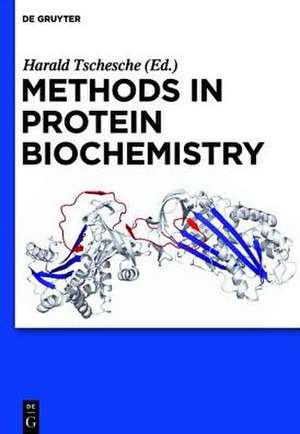
Methods in Protein Biochemistry
Editat de Harald Tschescheen Limba Engleză Hardback – 23 dec 2011
Preț: 1346.64 lei
Preț vechi: 1479.83 lei
-9%
Puncte Express: 2020
Carte tipărită la comandă
Livrare economică 25 noiembrie-01 decembrie
Livrare prin curier în România Termenul estimat este afișat lângă disponibilitate.
Transport gratuit pentru acest produs Plată online sau ramburs, în funcție de opțiunile comenzii.
Retur gratuit în 14 zile Comandă securizată și suport în română.
Specificații
ISBN-13: 9783110252330
ISBN-10: 3110252333
Pagini: 380
Ilustrații: 150 farb. Abb.
Dimensiuni: 175 x 246 x 32 mm
Greutate: 0.84 kg
Ediția:1. Auflage
Editura: De Gruyter
Locul publicării:Berlin/Boston
ISBN-10: 3110252333
Pagini: 380
Ilustrații: 150 farb. Abb.
Dimensiuni: 175 x 246 x 32 mm
Greutate: 0.84 kg
Ediția:1. Auflage
Editura: De Gruyter
Locul publicării:Berlin/Boston
V-ar putea interesa
-
 -13%Preț: 288.17 lei330.15 lei
 -
 Preț: 267.49 lei
 -
 BIOS Instant Notes in Molecular BiologyAlexander McLennanPreț: 292.06 lei
 -
 -18%Preț: 1269.57 lei1548.26 lei
 -
 Nitrate: Occurrence, Characteristics & Health ConsiderationsSilvia Antonia Brandan-27%Preț: 1250.05 lei1702.91 lei
 -
 Introduction protein DNA InteractionsGary D. StormoPreț: 173.65 lei
 -
 Antioxidant power of some medicinal plant extractsHassanien Mohamed Fawzy RamadanPreț: 311.78 lei
Notă biografică
AD>
Cuprins
AD>
- Membrane protein folding in detergents, Deber
- Three phase partitioning (TPP), Dennison
- Protein import into the intermembrane space of mitochondria, Herrmann
- A novel PVDF membrane for on-membrane identification of gel-resolved proteins by MALDI-MS, Hirano
- Molecular mechanisms of chaperone action, Hoehfeld
- Proteomics of Duchenne muscle dystrophy, Kamp
- Analysis of protein complexes using chemical cross-linking and mass spectrometry, Leitner
- Determining the small molecule binding site of a protein by Capture Compound Mass Spectrometry (CCMS), Lenz
- Pathobiology of antitrypsin defiency and the serpinopathies, Lomas
- Wide-angle x-ray solution scattering method (WAXS), Makowski
- Bioaffinity-mass spectrometry: Molecular approaches and applications protein biochemistry, Przybylski
- Laser ablation electrospray ionization mass spectrometry (LAESI), Razunguzwa
- Design and applications of protein epitope mimetics, Robinson
- Probing protein dynamics in vivo: bacterial acyl carrier protein as a case study, Volkmann
- Target oriented peptide-arrays in a palliative approach to mucoviszidose, Volkmer
- Correlated single-crystal spectroscopy and x-ray crystallography, Orville
- Chemical modification of proteins in the living cell, Correa Jr.
- Relevance of peptide purity for the reproducibility of fibril formation, Glockshuber
- Proteome analysis of humen BAL by two-dimensional difference in gel-Electrophoresis (D-DIGE): COPD patients vs control subjects, Mileo, Beranova-Giorgianni, Giorgianni
- Dynamics of changes in conformation and folding processes in peptides and proteins, Kiefhaber, Reiner
- Glykoprotein folding within the endoplasmic reticulum, Parodi