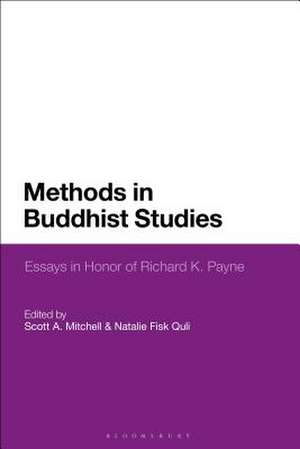
Methods in Buddhist Studies: Essays in Honor of Richard K. Payne
Editat de Scott A. Mitchell, Natalie Fisk Qulien Limba Engleză Hardback – 13 iun 2019
Methods in Buddhist Studies features new translations of Buddhist works as well as ethnographic studies on contemporary Buddhism in the United States and China. Topics discussed include Buddhist practices in relation to food, material culture, and imperial rituals; the development of modern Buddhist universities; the construction of the canon from the perspective of history, textual analysis, and ritual studies; and the ethical obligations of scholars toward the subject of Buddhism itself.
Chapters are drawn from Payne's students and his colleagues, demonstrating the breadth of his intellectual interests. Payne's scholarship has left a remarkable impact on the field, making this volume essential reading for students and scholars of contemporary Buddhism and Buddhist studies.
Preț: 731.13 lei
Preț vechi: 1072.17 lei
-32%
Puncte Express: 1097
Carte tipărită la comandă
Livrare economică 07-21 decembrie
Livrare prin curier în România Termenul estimat este afișat lângă disponibilitate.
Transport gratuit pentru acest produs Plată online sau ramburs, în funcție de opțiunile comenzii.
Retur gratuit în 14 zile Comandă securizată și suport în română.
Specificații
ISBN-13: 9781350046863
ISBN-10: 1350046868
Pagini: 256
Dimensiuni: 156 x 234 mm
Greutate: 0.53 kg
Editura: Bloomsbury Publishing
Colecția Bloomsbury Academic
Locul publicării:London, United Kingdom
ISBN-10: 1350046868
Pagini: 256
Dimensiuni: 156 x 234 mm
Greutate: 0.53 kg
Editura: Bloomsbury Publishing
Colecția Bloomsbury Academic
Locul publicării:London, United Kingdom
Cuprins
Notes On Contributors
Preface, Judith Berling (Graduate Theological Union, Berkeley, USA)
Introduction: On Maps, Elephants, and Buddhists, Scott A. Mitchell (Institute of Buddhist Studies, Berkeley, USA)
Part 1: Historical Studies
1. When Food Becomes Trespass: Buddhism and the Kami in Local Economies, Lisa Grumbach (Ryukoku University, Kyoto, Japan and the Institute of Buddhist Studies, Berkeley, USA)
2. Making the Modern Priest: The Otani Denomination's Proto-University and Debates about Clerical Education in the Early Meiji Period, Victoria R. Montrose (University of Southern California, USA)
3. Taking the Vajrayana to Sukhavati, Aaron P. Proffitt (, University at Albany-SUNY, USA)
Part 2: Textual Studies
4. Yijing's Sciptural Text about Impermanence (T. 801), Charles Willemen (International Buddhist College, Thailand)
5. Dualistic and Bifunctional Spirits: A Translation of the Oni no Shikogusa, Takuya Hino (Komazawa University, Japan)
6. A Note Concerning Contemplation of the Marks of the Buddha, Charles D. Orzech (Colby College, Maine, USA)
Part 3: Ethnographic Studies
7. Buddhism, Consumerism, and the Chinese Millennial, Courtney Bruntz (Doane University, USA)
8. Describing the (Nonexistent?) Elephant: Ethnographic Methods in the Study of Asian American Buddhists, Chenxing Han (Graduate Theological Union, Berkeley, USA)
Part 4: Theoretical Concerns
9. Is a Dazang jing a Canon? On the Nature of Chinese Buddhist Textual Anthologies, Charles B. Jones (University of America, Washington, USA)
10. Our Buddhadharma, Our Buddhist Dharma, Franz Metcalf (California State University, USA)
11. On Authenticity: Scholarship, the Insight Movement, and White Authority, Natalie Fisk Quli (Institute of Buddhist Studies, Berkeley, USA
Notes
Bibliography
Index
Preface, Judith Berling (Graduate Theological Union, Berkeley, USA)
Introduction: On Maps, Elephants, and Buddhists, Scott A. Mitchell (Institute of Buddhist Studies, Berkeley, USA)
Part 1: Historical Studies
1. When Food Becomes Trespass: Buddhism and the Kami in Local Economies, Lisa Grumbach (Ryukoku University, Kyoto, Japan and the Institute of Buddhist Studies, Berkeley, USA)
2. Making the Modern Priest: The Otani Denomination's Proto-University and Debates about Clerical Education in the Early Meiji Period, Victoria R. Montrose (University of Southern California, USA)
3. Taking the Vajrayana to Sukhavati, Aaron P. Proffitt (, University at Albany-SUNY, USA)
Part 2: Textual Studies
4. Yijing's Sciptural Text about Impermanence (T. 801), Charles Willemen (International Buddhist College, Thailand)
5. Dualistic and Bifunctional Spirits: A Translation of the Oni no Shikogusa, Takuya Hino (Komazawa University, Japan)
6. A Note Concerning Contemplation of the Marks of the Buddha, Charles D. Orzech (Colby College, Maine, USA)
Part 3: Ethnographic Studies
7. Buddhism, Consumerism, and the Chinese Millennial, Courtney Bruntz (Doane University, USA)
8. Describing the (Nonexistent?) Elephant: Ethnographic Methods in the Study of Asian American Buddhists, Chenxing Han (Graduate Theological Union, Berkeley, USA)
Part 4: Theoretical Concerns
9. Is a Dazang jing a Canon? On the Nature of Chinese Buddhist Textual Anthologies, Charles B. Jones (University of America, Washington, USA)
10. Our Buddhadharma, Our Buddhist Dharma, Franz Metcalf (California State University, USA)
11. On Authenticity: Scholarship, the Insight Movement, and White Authority, Natalie Fisk Quli (Institute of Buddhist Studies, Berkeley, USA
Notes
Bibliography
Index
Recenzii
This remarkable collection is a worthy celebration of Richard K. Payne's academic career and the originality of his work, and at the same time a stimulating springboard for new research endeavors.
The rich quality and diversity of research in this volume attest to the incredible inspiration Richard K. Payne has played, not only among these authors, but among a much wider community of scholars. As clearly shown in this collection, his influence will lay its mark for future generations to come.
In displaying the interconnections in Richard K. Payne's work, this text compliments the variety of worldviews articulated across Buddhisms and reflects diversity in their beauty and challenge to Buddhists and scholars of Buddhism.
The rich quality and diversity of research in this volume attest to the incredible inspiration Richard K. Payne has played, not only among these authors, but among a much wider community of scholars. As clearly shown in this collection, his influence will lay its mark for future generations to come.
In displaying the interconnections in Richard K. Payne's work, this text compliments the variety of worldviews articulated across Buddhisms and reflects diversity in their beauty and challenge to Buddhists and scholars of Buddhism.