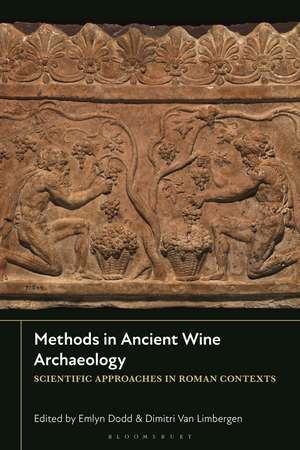
Methods in Ancient Wine Archaeology: Scientific Approaches in Roman Contexts
Editat de Dr Emlyn Dodd, Dr Dimitri Van Limbergenen Limba Engleză Hardback – 8 feb 2024
Sub coordonarea editorilor Dr Emlyn Dodd și Dr Dimitri Van Limbergen, ambii cercetători cu o autoritate recunoscută în cadrul unor instituții precum Institute of Classical Studies din Londra și Universitatea din Ghent, Methods in Ancient Wine Archaeology reprezintă un punct de cotitură în studiul viticulturii antice. Ne-a atras atenția modul în care acest volum reușește să fundamenteze cercetarea istorică pe date științifice riguroase, depășind analizele tradiționale bazate strict pe tipologia amforelor sau a instalațiilor de presare. Suntem de părere că această lucrare este esențială pentru înțelegerea nuanțată a cultivării viței-de-vie și a consumului de vin în bazinul mediteranean.
Cititorii familiarizați cu abordările generale din Archaeological Science de Michael P. Richards vor aprecia aici focalizarea extrem de specifică și aplicată pe contextul roman. Dacă volumul lui Richards oferă o privire de ansamblu asupra metodologiilor științifice în arheologie, lucrarea editată de Dodd și Van Limbergen aduce un plus de profunzime prin studii de caz ce utilizează tehnici avansate, cum ar fi analiza ADN-ului vechi (aDNA) și prospecțiunile geofizice aplicate peisajelor viticole.
Structura volumului reflectă o progresie logică de la baze teoretice la aplicații practice complexe. Cuprinsul este organizat în secțiuni tematice ce acoperă arheologia biomoleculară, analizele chimice și arheobotanica, oferind o perspectivă holistică asupra conceptului de „palaeo-terroir”. Această abordare permite cercetătorului să treacă dincolo de simpla identificare a siturilor, oferind instrumente pentru reconstituirea gustului, calității și dinamicii comerciale a vinului în antichitate. Tonul este unul academic, precis, integrând date de laborator într-un discurs istoric coerent, facilitat de experiența vastă a contributorilor.
Preț: 585.94 lei
Preț vechi: 913.01 lei
-36%
Carte disponibilă
Livrare economică 30 octombrie-13 noiembrie
Specificații
ISBN-10: 1350346640
Pagini: 336
Ilustrații: 74 colour illus
Dimensiuni: 158 x 236 x 24 mm
Greutate: 0.66 kg
Editura: Bloomsbury Publishing
Colecția Bloomsbury Academic
Locul publicării:London, United Kingdom
De ce să citești această carte
Recomandăm această carte profesioniștilor și studenților la arheologie care doresc să stăpânească noile metode de analiză științifică. Cititorul câștigă acces la tehnici de ultimă oră, precum analiza reziduurilor organice și modelarea climatică, esențiale pentru a înțelege nu doar cum se producea vinul în epoca romană, ci și cum era acesta comercializat și consumat la nivel regional.
Descriere
The study of ancient Roman wine has been dominated until recently by traditional archaeological analyses focused upon production facilities and ceramic evidence related to transport. While such architecture and artefact-focussed approaches provide a fundamental foundation for our understanding of this topic, they fail to provide the requisite nuance to answer other questions regarding grape cultivation and wine production, consumption, use and trade. As the first compendium of its kind, this book supports the embedding of modern scientific and experimental techniques into archaeological fieldwork, research and laboratory analysis, pushing the boundaries of what questions can be explored, and serving as a launching point for future avenues of interdisciplinary research.
Cuprins
List of Tables
List of Contributors
Acknowledgements
List of Abbreviations
1. Scientific Approaches to Ancient Wine: Developments, Challenges, and Future Perspectives, Emlyn Dodd (Institute of Classical Studies, University of London, UK/British School at Rome, Italy), and Dimitri Van Limbergen (Ghent University, Belgium)
2. Ancient Viniculture: A Multidisciplinary Holistic Perspective, Patrick E. McGovern (University of Pennsylvania, USA)
3. Approaching Palaeo-terroir: Thoughts on How to Study the Geography of Wine in the Roman World, Dimitri Van Limbergen (Ghent University, Belgium) and Pieter Gurdebeke (Ghent University, Belgium)
Part I. Biomolecular Archaeology and Chemical Analysis
4. Archaeology and Grape aDNA, Andrea Zifferero (University of Siena, Italy)
5. Wine Production, Trade, and Consumption in the Roman World: The Potential of Organic Residue Analysis, Alessandra Pecci (University of Barcelona, Spain)
6. A Case Study in the Importance of Residue Analysis for the Interpretation of the Estate Economy: The Villa of Santa Marina (Istria, Croatia), Corinne Rousse (Aix-Marseille University, France), Nicolas Garnier (Independent Scholar), Gaetano Bencic (Independent Scholar) and Davor Munda (Independent Scholar)
Part II. Archaeobotany and Palynology
7. Archaeobotany in the Archaeology of Wine: Current Approaches and Future Possibilites, Patrizia Basso (University of Verona, Italy) and Diana Dobreva (University of Verona, Italy)
8. Applicability and Use of Archaeobotany for the Study of Vine Cultivation and Winemaking in the Roman Period, Marco Marchesini (Independent Scholar), Silvia Marvelli (C.A.A. Giorgio Nicoli, Italy), Anna Chiara Muscogiuri (C.A.A. Giorgio Nicoli, Italy) and Elisabetta Rizzoli (C.A.A. Giorgio Nicoli, Italy)
9. Grapevines Under the Lens: A Methodological Approach to the Study of Seed Assemblage from Villamagna (Urbisaglia, Marche, Italy), Riccardo Carmenati (University of Macerata, Italy), Francesco Breglia (University of Salento, Italy) Roberto Perna (University of Macerata, Italy) and Girolamo Fiorentino (University of Salento, Italy)
10. Roman Viticulture from Palynology: A Review and New Data in the British Isles, Antony G. Brown (University of Southampton, UK), Ian Meadows (Independent Scholar) and Simon D. Turner (University College London, UK)
Part III. Vineyard and Landscape Archaeology
11. Studying Roman Viticulture in Baetica with GIS Modelling and Geophysical Survey, Pedro Trapero Fernández (University of Cádiz, Spain), Isabel Rondán Sevilla (University of Cádiz, Spain) and Lázaro Lagóstena Barrios (Univeristy of Cádiz, Spain)
12. New High-Resolution Approaches for Vineyard Archaeology: Evidence from the Region of Pompeii, Florian Seiler (German Archaeological Institute, Berlin)
13. Employing Remote Sensing and Multispectral Satellite Data to Measure the Extent of Grapevine and Olive Vegetation: A Case Study in the Landscape of Western Rough Cilicia, Turkey, Christopher D. Dore (University of Arizona, USA) and Nicholas K. Rauh (Purdue University, USA)
Part IV. Modelling and Experimental Archaeology
14. Quantifying Roman Wine Production: New Approaches to Vineyard Sizes and Wine Yields in the Ager Barcinonensis, Antoni Martín i Oliveras (University of Barcelona, Spain)
15. Reconstructing Vineyard Geography, Yields and the Profitability of Wine Production in the Roman Empire: New Insights from Spatial-Analysis, and Agent-Based and Climate-Vegetation Modelling, Nicolas Bernigaud (Independent Scholar), Alberte Bondeau (Aix-Marseille University, France), Joël Guiot (Aix-Marseille University, France), Laurent Bouby (Institute of Evolutionary Science of Montpellier, France), Frédérique Bertoncello ( University Côte d'Azur, France) and Marie-Jeanne Ouriachi (University of Côte d'Azur, France)
16. Modelling Viticulture in the Adriatic Region: A Quantification of Agricultural Suitability, Andrew McLean (University of Edinburgh, UK)
17. Linking Experimental Archaeology and Winemaking: From the Dig to the Winery, Mkrtich Harutyunyan (University of Lisbon, Portugal), Manuel Malfeito Ferreira (Univeristy of Lisbon, Portugal) and Mario Indelicato (University of Catania, Italy)
Notes
Index
Bibliography
Recenzii
This volume gathers the latest research on grape growing and wine production in the Roman Mediterranean. While the approaches are cutting edge, the methods and case studies are explained well for the non-expert. Bringing together the work of both established scholars as well as more junior newcomers also means that this volume serves as an essential state of the field collection.
The greatest achievement of the volume is to bring together all the relevant scientific subdisciplines into one place in order to give readers an easily accessible but highly informative brief on the extraordinary diversity of approaches being used today to study questions surrounding ancient wine.