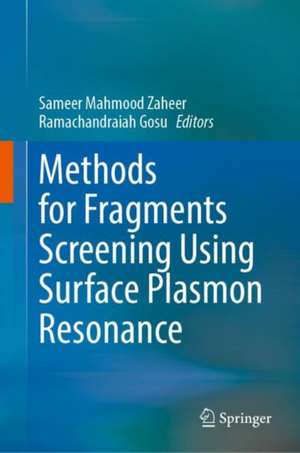
Methods for Fragments Screening Using Surface Plasmon Resonance
Editat de Sameer Mahmood Zaheer, Ramachandraiah Gosuen Limba Engleză Hardback – 16 sep 2021
Preț: 1258.58 lei
Preț vechi: 1534.85 lei
-18%
Puncte Express: 1888
Carte tipărită la comandă
Livrare economică 04-18 decembrie
Livrare prin curier în România Termenul estimat este afișat lângă disponibilitate.
Transport gratuit pentru acest produs Plată online sau ramburs, în funcție de opțiunile comenzii.
Retur gratuit în 14 zile Comandă securizată și suport în română.
Specificații
ISBN-13: 9789811615351
ISBN-10: 9811615357
Pagini: 132
Ilustrații: XVI, 113 p. 52 illus., 37 illus. in color.
Dimensiuni: 160 x 241 x 13 mm
Greutate: 0.32 kg
Ediția:1st ed. 2021
Editura: Springer
Locul publicării:Singapore, Singapore
ISBN-10: 9811615357
Pagini: 132
Ilustrații: XVI, 113 p. 52 illus., 37 illus. in color.
Dimensiuni: 160 x 241 x 13 mm
Greutate: 0.32 kg
Ediția:1st ed. 2021
Editura: Springer
Locul publicării:Singapore, Singapore
Cuprins
Chapter 1_Introduction to SPR.- Chapter 2_ Principle of SPR (OneStep).- Chapter 3_Identification of Fragment library.- Chapter 4_Preparation of protein with Histidine Tag.- Chapter 5_Preparation of protein with Biotin Tag.- Chapter 6_Protein stability using Thermal Shift Assay (TSA) - pH.- Chapter 7_Protein stability using Thermal Shift Assay (TSA) – DMSO.- Chapter 8_Preparation of Sensor.- Chapter 9_ Optimization and validation of Amine coupling.- Chapter 10_ Optimization and validation of Biotin-strepavidin coupling.- Chapter 11_ Preparation of Fragment for Screening in SPR.- Chapter 12_ Screening of Fragment in SPR.- Chapter 13_ Analysis of Data.- Chapter 14_ Identification and arraying of HITS.- Chapter 15_ Confirmation of Hits – Kinetics (kon, koff, KD, LE).
Notă biografică
Dr. Ramachandraiah Gosu is Associate Director, Discovery Biology & Head of Structural Biology Department at Jubilant Biosys Ltd, Bengaluru. His research interests are protein engineering, macromolecular X-ray crystallography and methods for biophysical screening. Before joining Jubilant Biosys, he worked as a post-doctoral fellow at the University of Minnesota, Minneapolis in the Structural Genomics Project- Pathogenic Island Proteins from Staphylococcus aureus. He has obtained his Ph.D. in, Structural Biology from Molecular Biophysics Unit at the Indian Institute of Science, Bangalore, India. He has co-authored several articles in peer-reviewed international journals.
Dr. Sameer Mahmood. Z is Group Leader at the Jubilant Biosys Ltd, Bengaluru, India. He has earlier served as Associate Principal Scientist in the Department of invitro biology at GVK Bioscience Ltd, Hyderabad, India, and Principal Scientist I in the Department of Molecular and Cell Biology, Advinus Therapeutics Ltd, Pune. He also did postdoctoral training in the Department of Stem Cell and Molecular Biology at Joslin Diabetes Center (Harvard University), Boston, USA. His research interest is in the high throughput screening of proteins using robotics with specialization in protein-drug (Fragments and Small molecules) interactions. He has been accolade with several awards in Stem cell research, Jackson Laboratory (USA), Asia ARVO (Singapore), Research Achievement Award (USA), CEO award for Excellence in Project Management (India).
He has published several research articles in peer-reviewed international journals and co-authored a book chapter.
Dr. Sameer Mahmood. Z is Group Leader at the Jubilant Biosys Ltd, Bengaluru, India. He has earlier served as Associate Principal Scientist in the Department of invitro biology at GVK Bioscience Ltd, Hyderabad, India, and Principal Scientist I in the Department of Molecular and Cell Biology, Advinus Therapeutics Ltd, Pune. He also did postdoctoral training in the Department of Stem Cell and Molecular Biology at Joslin Diabetes Center (Harvard University), Boston, USA. His research interest is in the high throughput screening of proteins using robotics with specialization in protein-drug (Fragments and Small molecules) interactions. He has been accolade with several awards in Stem cell research, Jackson Laboratory (USA), Asia ARVO (Singapore), Research Achievement Award (USA), CEO award for Excellence in Project Management (India).
He has published several research articles in peer-reviewed international journals and co-authored a book chapter.
Textul de pe ultima copertă
This volume describes methods and protocols for the fragment-based screening of proteins using Surface Plasmon Resonance (SPR). The initial chapter of the book discusses the principle of SPR for the identification of biomolecular interactions, while the subsequent chapters introduce methods for labelling proteins with different tags including, histidine and biotin tags. It also discusses techniques and factors that affect the amine and biotin-streptavidin coupling and methods to optimize the interactions. Next, it describes fragment preparation for screening in SPR and presents methods to calculate equilibrium dissociation constant (KD) and ligand efficiency (LE). It reviews techniques of next-generation injections that improve the efficiency of the characterization process over traditional SPR by determining the kinetics and affinity in a single step. Finally, the book elucidates a comprehensive yet representative description of challenges associated with the molecular interaction of proteins using SPR.
Caracteristici
Discusses real-time and label-free measurement of biomolecular interaction
Present protocols to calculate kinetics and affinities with single analyte concentration
Examines techniques for the optimum amine and biotin-streptavidin coupling
Describes methods to calculate equilibrium dissociation constant (KD) and ligand efficiency (LE)
Present protocols to calculate kinetics and affinities with single analyte concentration
Examines techniques for the optimum amine and biotin-streptavidin coupling
Describes methods to calculate equilibrium dissociation constant (KD) and ligand efficiency (LE)