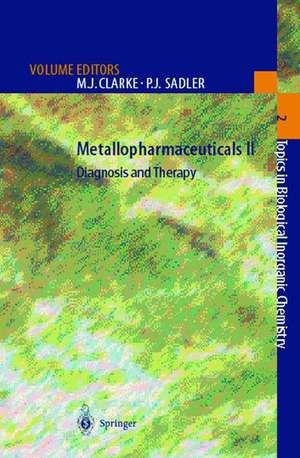
Metallopharmaceuticals II: Topics in Biological Inorganic Chemistry, cartea 2
Editat de Michael J. Clarke, Peter J. Sadleren Limba Engleză Hardback – 13 aug 1999
Preț: 1263.54 lei
Preț vechi: 1540.90 lei
-18%
Puncte Express: 1895
Carte tipărită la comandă
Livrare economică 23 noiembrie-07 decembrie
Livrare prin curier în România Termenul estimat este afișat lângă disponibilitate.
Transport gratuit pentru acest produs Plată online sau ramburs, în funcție de opțiunile comenzii.
Retur gratuit în 14 zile Comandă securizată și suport în română.
Specificații
ISBN-13: 9783540653080
ISBN-10: 3540653082
Pagini: 232
Ilustrații: X, 216 p.
Dimensiuni: 160 x 241 x 18 mm
Greutate: 0.47 kg
Ediția:1999
Editura: Springer
Colecția Topics in Biological Inorganic Chemistry
Seria Topics in Biological Inorganic Chemistry
Locul publicării:Berlin, Heidelberg, Germany
ISBN-10: 3540653082
Pagini: 232
Ilustrații: X, 216 p.
Dimensiuni: 160 x 241 x 18 mm
Greutate: 0.47 kg
Ediția:1999
Editura: Springer
Colecția Topics in Biological Inorganic Chemistry
Seria Topics in Biological Inorganic Chemistry
Locul publicării:Berlin, Heidelberg, Germany
V-ar putea interesa
-
 -9%Preț: 968.03 lei1063.77 lei
 -
 An Introduction to High Content ScreeningSteven A Haney-9%Preț: 818.46 lei899.41 lei
 -
 Bioanalytical Chemistry 2eSR Mikkelsen-27%Preț: 753.46 lei1032.13 lei
 -
 Progress in Inorganic Chemistry, Volume 59Kenneth D. Karlin-9%Preț: 1168.65 lei1284.24 lei
 -
 Micelles: Structural Biochemistry, Formation & Functions & UsageDanielle Bradburn-26%Preț: 1223.76 lei1663.65 lei
 -
 BiochemistryTerry BrownPreț: 386.39 lei
 -
 cGMP: Generators, Effectors and Therapeutic ImplicationsHarald H. H. W. Schmidt-18%Preț: 1904.62 lei2322.71 lei
 -
 Essentials of BiochemistryHerbert J. FrommPreț: 414.64 lei
Public țintă
ResearchCuprins
Magnetic Resonance Imaging (MRI) Contrast Agents.- Metalloradiopharmaceuticals.- Polyoxometalates and Fullerenes as Anti-HIV Agents.- Vanadium-Containing Insulin Drugs.- Bismuth Antiulcer Complexes.- Chrysotherapy: Gold-Drug Metabolism and Immunochemistry.
Textul de pe ultima copertă
Inorganic compounds offer much scope for the design of novel and therapeutic agents. The widespread use of paramagnetic metal complexes as effective contrast agents for magentic resonsance imaging (e.g. Gd) demonstrates that the toxicity of metals can be finely controlled via the approriate choice of ligands. The succcessful targeting of radioisotopes again depends on ligand design and metal oxidation state. Bismuth and gold complexes have long been used in medicine but only recently have advances been made in understanding the molecular basis of their mechanism of action. New areas with clinical potential include the use of polyoxometallates and fullerenes as antiviral agents and vanadium complexes as insulin mimetics.
Caracteristici
The companion book series to the Journal of Biological Inorganic Chemistry. Includes supplementary material: sn.pub/extras