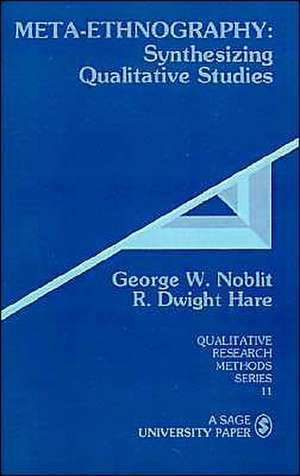
Meta-Ethnography
Autor George W. Noblit, R. Dwight Hareen Limba Engleză Paperback – 1988
Preț: 327.25 lei
Puncte Express: 491
Carte tipărită la comandă
Livrare economică 28 noiembrie-12 decembrie
Livrare express 24-30 octombrie pentru 52.76 lei
Livrare prin curier în România Termenul estimat este afișat lângă disponibilitate.
Transport gratuit de la 400.00 lei Plată online sau ramburs, în funcție de opțiunile comenzii.
Retur gratuit în 14 zile Comandă securizată și suport în română.
Specificații
ISBN-13: 9780803930230
ISBN-10: 0803930232
Pagini: 108
Ilustrații: black & white illustrations
Dimensiuni: 140 x 216 x 7 mm
Greutate: 0.15 kg
Ediția:Will Be Reissue.
Editura: SAGE Publications
Locul publicării:Thousand Oaks, United States
ISBN-10: 0803930232
Pagini: 108
Ilustrații: black & white illustrations
Dimensiuni: 140 x 216 x 7 mm
Greutate: 0.15 kg
Ediția:Will Be Reissue.
Editura: SAGE Publications
Locul publicării:Thousand Oaks, United States
V-ar putea interesa
-
 Ethnographic MethodsKaren O'ReillyPreț: 447.34 lei
 -
 -15%Preț: 420.21 lei494.37 lei
 -
 -8%Preț: 453.14 lei492.54 lei
 -
 Preț: 477.73 lei
 -
 Essentials of Utilization-Focused EvaluationMichael Quinn Patton-9%Preț: 941.25 lei1034.33 lei
 -
 Applications of Case Study ResearchRobert K. Yin-15%Preț: 619.49 lei728.81 lei
 -
 Visualizing Social Science ResearchJohannes Wheeldon-15%Preț: 446.34 lei525.11 lei
 -
 Flash Programming for the Social & Behavioral SciencesYana Weinstein-15%Preț: 443.73 lei522.03 lei
 -
 Qualitative Research in EducationLiz AtkinsPreț: 398.06 lei
 -
 A Student's Guide to MethodologyPeter CloughPreț: 440.65 lei
Cuprins
PART ONE: INTRODUCTION
The Idea of a Meta-Ethnography
A Meta-Ethnographic Approach
PART TWO: CONSTRUCTING META-ETHNOGRAPHIES
Reciprocal Translations as Synthesis
Refutational Synthesis
Lines-of-Argument Synthesis
Inscribing Meta-Ethnographies
The Idea of a Meta-Ethnography
A Meta-Ethnographic Approach
PART TWO: CONSTRUCTING META-ETHNOGRAPHIES
Reciprocal Translations as Synthesis
Refutational Synthesis
Lines-of-Argument Synthesis
Inscribing Meta-Ethnographies
Notă biografică
George W. Noblit became a sociologist in the 1970s, a time of turbulent social change. Research on crime, delinquency and deviance led to a focus on schooling in the lives and futures of youth. Through a study of school desegregation, he began a program of research on the social construction of race, using ethnographic research to study schools and other educational scenes. Noblit is intrigued with how knowledge--often taken as good in its own right--is implicated in creating the very problems it is asked to solve. Noblit studies the various ways knowledge is constructed and how the competition over which knowledge counts construct powers and difference. This process means exploring both the highest reaches of theory and the everyday lives of people as they struggle to make sense of the world. To Noblit, "there is not a theory-practice gap, only a failure of imagination." Noblit conducts funded evaluation projects, most recently on A+ (arts-enhanced) schools (the subject of his 2009 book), charter schools and prison education for youth adult offenders in North Carolina. "For me, evaluation and policy studies are a way to be part of larger political processes in our society," he says, "and to help shape the agendas of important innovations."
Descriere
This provocative volume deals with one of the chief criticisms of ethnographic studies, a criticism which centres on their particularism or their insistence on context -- the question is asked: How can these studies be generalized beyond the individual case? Noblit and Hare propose a method -- meta-ethnography -- for synthesizing from qualitative, interpretive studies. They show that ethnographies themselves are interpretive acts, and demonstrate that by translating metaphors and key concepts between ethnographic studies, it is possible to develop a broader interpretive synthesis. Using examples from numerous studies, the authors illuminate how meta-ethnography works, isolate several types of meta-ethnographic study and provide a theoretica