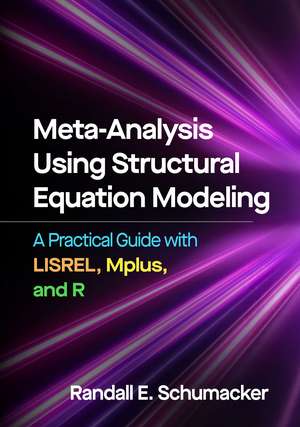
Meta-Analysis Using Structural Equation Modeling: A Practical Guide with LISREL, Mplus, and R
Autor Randall E. Schumackeren Limba Engleză Hardback – 28 dec 2026
Preț: 587.26 lei
Preț vechi: 725.01 lei
-19% Precomandă
Puncte Express: 881
Carte nepublicată încă
Livrare prin curier în România Precomanda se expediază când titlul devine disponibil.
Transport gratuit pentru acest produs Plată online sau ramburs, în funcție de opțiunile comenzii.
Retur gratuit în 14 zile Comandă securizată și suport în română.
Doresc să fiu notificat când acest titlu va fi disponibil:
Se trimite...
Specificații
ISBN-13: 9781462564934
ISBN-10: 1462564933
Pagini: 168
Dimensiuni: 178 x 254 mm
Greutate: 0.66 kg
Ediția:1
Editura: Guilford Publications
Colecția Guilford Press
ISBN-10: 1462564933
Pagini: 168
Dimensiuni: 178 x 254 mm
Greutate: 0.66 kg
Ediția:1
Editura: Guilford Publications
Colecția Guilford Press
Notă biografică
Randall E. Schumacker, PhD, is Professor of Educational Research at The University of Alabama, where he teaches courses in multiple regression, multivariate statistics, and structural equation modeling. He is past president of the Southwest Educational Research Association and Editor Emeritus of Structural Equation Modeling: A Multidisciplinary Journal. Dr. Schumacker has written or edited several books and numerous journal articles. He founded the Structural Equation Modeling Special Interest Group of the American Educational Research Association, and is a recipient of the association's Structural Equation Modeling Service Award.
Cuprins
Preface
1. Historical Overview
2. Literature Search Review
3. Meta-Analysis Software
4. Basic Meta-Analysis Statistics
5. Basic Structural Equation Modeling
6. Meta-Analysis Assumptions, Steps, and Model Types
7. Path Model MASEM
8. Factor Model MASEM
9. Structural Equation Model MASEM
10. Multi-Level Analysis in Meta-Analysis
11. SEM and MASEM Issues
12. Afterword
References
Author Index
Subject Index
About the Author
1. Historical Overview
2. Literature Search Review
3. Meta-Analysis Software
4. Basic Meta-Analysis Statistics
5. Basic Structural Equation Modeling
6. Meta-Analysis Assumptions, Steps, and Model Types
7. Path Model MASEM
8. Factor Model MASEM
9. Structural Equation Model MASEM
10. Multi-Level Analysis in Meta-Analysis
11. SEM and MASEM Issues
12. Afterword
References
Author Index
Subject Index
About the Author
Recenzii
“This book represents an important integration of meta-analysis and SEM. Dr. Schumacker describes the cutting edge of meta-analytic SEM in a way that is understandable to virtually all social science researchers or doctoral students. The multiple examples and extensive sample syntax allow readers to adapt and apply these techniques to their own data. After reading this book, you will have the knowledge and tools to fit complex--and more realistic--multivariate models to your meta-analytic data.--Noel A. Card, PhD, Director, Quantitative Methods in Family and Social Sciences, University of Georgia
“This exceptional book outlines the history of research synthesis procedures and provides a practical and easy-to-follow guide to conducting meta-analyses using SEM. Many concrete examples with computer programs using LISREL, Mplus, and R guide the researcher through the steps of conducting meta-analyses. This book is a gem!--Bradley T. Erford, PhD, Department of Human and Organizational Development, Vanderbilt University
“Schumacker thoroughly reviews all topics needed to effectively conduct meta-analyses using SEM, from the historical background to clear explanations of the various types of literature reviews, available software packages, and step-by-step methods. The book's examples include effective explanatory notes that facilitate understanding and translation to one's own projects. An excellent text for the beginning meta-analyst!â€--Marie S. Hammond, PhD, Professor and Distinguished Researcher, Department of Psychological Sciences and Counseling, Tennessee State University
-
“This exceptional book outlines the history of research synthesis procedures and provides a practical and easy-to-follow guide to conducting meta-analyses using SEM. Many concrete examples with computer programs using LISREL, Mplus, and R guide the researcher through the steps of conducting meta-analyses. This book is a gem!--Bradley T. Erford, PhD, Department of Human and Organizational Development, Vanderbilt University
“Schumacker thoroughly reviews all topics needed to effectively conduct meta-analyses using SEM, from the historical background to clear explanations of the various types of literature reviews, available software packages, and step-by-step methods. The book's examples include effective explanatory notes that facilitate understanding and translation to one's own projects. An excellent text for the beginning meta-analyst!â€--Marie S. Hammond, PhD, Professor and Distinguished Researcher, Department of Psychological Sciences and Counseling, Tennessee State University
-
Descriere
This guide demonstrates how structural equation modeling (SEM) analyzes results from multiple studies. Randall E. Schumacker uses LISREL, Mplus, and R software with examples, steps, and annotated code. It covers meta-analysis basics, path models, confirmatory factor models, and MASEM, with full code available on a companion website.