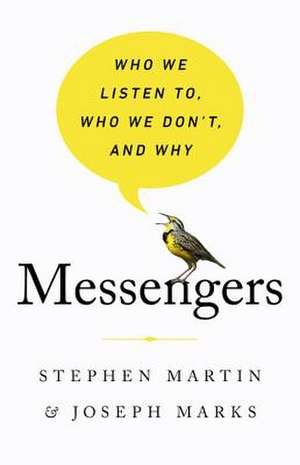
Messengers
Autor Stephen Martin, Joseph Marksen Limba Engleză Hardback – 15 oct 2019
În ediția curentă a lucrării Messengers, remarcăm o schimbare de paradigmă în analiza comunicării interpersonale: accentul se mută de la calitatea argumentului la caracteristicile celui care îl livrează. Autorii Stephen Martin și Joseph Marks investighează de ce aceleași idei sunt acceptate sau respinse în funcție de emițător, oferind o structură riguroasă bazată pe opt trăsături esențiale care conferă autoritate. Apreciem modul în care volumul decodifică semnalele non-verbale și contextuale — de la trăsăturile faciale până la bunurile materiale posedate — demonstrând cum acestea pot genera încredere instantanee, chiar și atunci când nu este fundamentată pe competență. Spre deosebire de abordările axate strict pe tehnici de vorbire, Messengers explorează psihologia din spatele percepției. Cititorii familiarizați cu Cues de Vanessa Van Edwards vor aprecia modul în care acest volum extinde analiza semnalelor subtile, plasându-le într-un context societal mai larg, marcat de incertitudine și de fenomenul „fake news”. Dacă alte lucrări se concentrează pe mecanismele persuasiunii, Stephen Martin și Joseph Marks explică de ce, în prezent, mesagerul tinde să devină mesajul în sine. Remarcăm totodată rigoarea științifică a cercetării, care transformă o temă adesea tratată anecdotic într-un studiu esențial de psihologie colectivă. Cartea nu se limitează la sfaturi practice, ci oferă o radiografie a modului în care statutul și vulnerabilitatea dictează ierarhiile de influență în orice grup social.
Preț: 245.61 lei
Carte disponibilă
Livrare economică 03-17 noiembrie
Specificații
ISBN-10: 1541724380
Pagini: 352
Dimensiuni: 167 x 244 x 32 mm
Greutate: 0.54 kg
Editura: PublicAffairs
V-ar putea interesa
-
 Made to StickChip Heath-31%Preț: 64.35 lei93.15 lei
 -
 CuesVanessa Van EdwardsPreț: 122.85 lei
 -
 When Everyone Knows That Everyone Knows...Steven PinkerPreț: 136.05 lei
 -
 Preț: 89.60 lei
 -
 BlinkMalcolm GladwellPreț: 77.19 lei
 -
 -26%Preț: 58.71 lei79.32 lei
 -
 -27%Preț: 68.09 lei93.14 lei
 -
 Why We ClickKate MurphyPreț: 178.42 lei
 -
 You Have More Influence Than You ThinkVanessa BohnsPreț: 181.15 lei
 -
 Start With Why (15th Anniversary Edition)Simon SinekPreț: 85.75 lei
 -
 -19%Preț: 58.32 lei71.82 lei
 -
 -28%Preț: 76.42 lei106.82 lei
 -
 All Marketers Are LiarsSeth GodinPreț: 96.05 lei
 -
 -24%Preț: 155.69 lei205.79 lei
 -
 When Everyone Knows That Everyone Knows . . .Steven PinkerPreț: 184.79 lei
 -
 -19%Preț: 64.02 lei78.92 lei
 -
 Hacking the Human MindMichaelaaron FlickerPreț: 109.67 lei
 -
 -26%Preț: 80.55 lei108.60 lei
 -
 -26%Preț: 100.19 lei135.45 lei
De ce să citești această carte
Recomandăm această carte oricărui profesionist care dorește să înțeleagă de ce ideile sale nu primesc întotdeauna validarea meritată. Cititorul câștigă o perspectivă clară asupra celor 8 factori care determină credibilitatea, învățând să gestioneze semnalele periferice care îi influențează succesul. Este o lectură esențială pentru a naviga într-o lume unde percepția precede adesea realitatea, fiind utilă atât în mediul corporate, cât și în viața socială cotidiană.
Despre autor
Stephen Martin și Joseph Marks sunt cercetători de renume în domeniul științelor comportamentale. Stephen Martin este expert în influență și persuasiune, fiind recunoscut pentru colaborările sale extinse în aplicarea psihologiei în politici publice și afaceri. Joseph Marks este cercetător la University College London, specializat în modul în care mediul social și caracteristicile individuale modelează procesul de luare a deciziilor. Împreună, cei doi combină rigoarea academică cu o scriitură accesibilă, fiind citați frecvent în publicații precum The Economist și Financial Times pentru analizele lor asupra comportamentului uman.
Descriere scurtă
We live in a world where proven facts, verifiable data, and actual truths are freely and widely available. Why, then, are self-confident ignoramuses so often believed? Why are thoughtful experts frequently given the cold shoulder? And why do irrelevant details such as a person's height, relative wealth, or Facebook photo influence whether or not we trust what they are saying?
In this ground breaking forensic look into influence, Stephen Martin and Joseph Marks brilliantly demonstrate that we increasingly fail to separate the idea being communicated from the person conveying it. The messenger-who we believe either because of their socio-economic position/dominance/physical attractiveness or their trustworthiness/vulnerability/charisma-becomes more important than the message itself.
With fascinating accounts from business, politics, medicine, the arts, and popular entertainment, Martin and Marks establish key traits and features of the world's messengers, who not only have an enormous influence on what we think and believe, but ultimately influence who we are and who we are becoming.
Notă biografică
Descriere
Why can some people effortlessly command the attention of everyone in the room? What makes some individuals seem immediately credible and others appear inherently untrustworthy? And how is it that precisely the same idea can be enthusiastically embraced or roundly rejected depending on who has put it forward? When we talk to others, we assume that they are carefully weighing our words and arguments. But these are far from being the only factors that hold sway. In this groundbreaking new book, bestselling behavioural scientists Stephen Martin and Joseph Marks explore the eight powerful human traits that help determine whether what we have to say gets heard or lands on deaf ears.
They show how seemingly irrelevant details about our demeanour influence others' responses. They explain how trust is won, even when it may not be deserved. They show how the most trivial of signals - like the shape of our face, the shoes we wear or the car we drive - can influence how people respond to us.
And in a world of uncertainty and fake news they demonstrate how, increasingly, the Messenger is the Message. 'Some books make us better citizens. Others make us better at our jobs.
This amazing book does both!' Dan Pink, author of When, Drive and To Sell is Human
A tour de force. Timely and thoroughly researched. 'Professor Robert Cialdini, author of Influence and Pre-suasion'
Messengers is engaging, informative and entertaining. It will change the way you think about who you follow and take advice from. But why would you listen to me? Read their book to find out.' Professor Tali Sharot, author of The Optimism Bias and The Influential Mind
'A powerful, profoundly illuminating exploration of one of the most important subjects of our time. Martin and Marks have a terrific talent for combining evidence and research with lively and vivid writing. Trust these messengers!' Cass R. Sunstein, Robert Walmsley University Professor, Harvard University, and author of Conformity
'Fascinating' The Economist
'Zeitgeisty' Financial Times, Business Book of the Month
'Messengers is a crucial reminder that the messenger is as important as the message. Superficial indicators count.' PR Week