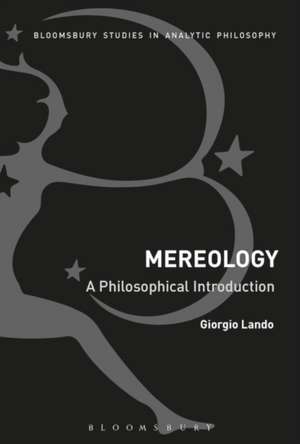
Mereology: A Philosophical Introduction
Autor Dr Giorgio Landoen Limba Engleză Hardback – 29 iun 2017
Mereology: A Philosophical Introduction addresses the multifaceted and lively philosophical debates surrounding these questions, and defends the idea that classical mereology is indeed the general and exhaustive theory of parthood and composition in the domain of concrete entities.
Several examples of parthood and composition, involving entities of different kinds, are scrutinised in depth. Incidentally, mereology is shown to interact in a surprising way with metaontology. Presenting a well-organized and comprehensive discussion of parthood and related notions, Mereology: A Philosophical Introduction contributes to a better understanding of a subject central to contemporary metaphysics.
Preț: 849.76 lei
Preț vechi: 1345.97 lei
-37%
Puncte Express: 1275
Carte tipărită la comandă
Livrare economică 08-22 decembrie
Livrare prin curier în România Termenul estimat este afișat lângă disponibilitate.
Transport gratuit pentru acest produs Plată online sau ramburs, în funcție de opțiunile comenzii.
Retur gratuit în 14 zile Comandă securizată și suport în română.
Specificații
ISBN-13: 9781472583666
ISBN-10: 1472583663
Pagini: 248
Dimensiuni: 164 x 236 x 20 mm
Greutate: 1.24 kg
Editura: Bloomsbury Publishing
Colecția Bloomsbury Academic
Locul publicării:London, United Kingdom
ISBN-10: 1472583663
Pagini: 248
Dimensiuni: 164 x 236 x 20 mm
Greutate: 1.24 kg
Editura: Bloomsbury Publishing
Colecția Bloomsbury Academic
Locul publicării:London, United Kingdom
V-ar putea interesa
-
 Meditations and Other Metaphysical WritingsRené Descartes-37%Preț: 58.30 lei92.60 lei
 -
 The Body in Pain: The Making and Unmaking of the WorldElaine Scarry-19%Preț: 116.11 lei142.64 lei
 -
 Elbow Room: The Varieties of Free Will Worth WantingDaniel C. Dennett-12%Preț: 311.62 lei352.30 lei
 -
 An Essay on Free WillPeter Van Inwagen-11%Preț: 314.11 lei353.58 lei
 -
 Subject, Thought, and ContextPhilip Pettit-27%Preț: 341.85 lei467.22 lei
 -
 Time, Tense, and CausationMichael Tooley-28%Preț: 427.35 lei595.18 lei
 -
 Powers: A Study in MetaphysicsGeorge Molnar-27%Preț: 383.33 lei527.79 lei
 -
 -27%Preț: 431.69 lei594.37 lei
 -
 Facing FactsNeale-32%Preț: 749.23 lei1095.85 lei
 -
 How Free Are You?: The Determinism ProblemTed Honderich-10%Preț: 368.16 lei411.18 lei
 -
 The Comprehensibility of the Universe: A New Conception of ScienceNicholas Maxwell-19%Preț: 314.41 lei388.00 lei
 -
 -17%Preț: 346.88 lei418.78 lei
 -
 -32%Preț: 828.86 lei1215.12 lei
 -
 Identity and ModalityFraser MacBride-31%Preț: 875.51 lei1261.23 lei
 -
 Models, Truth, and RealismBarry Taylor-32%Preț: 779.60 lei1142.68 lei
 -
 -32%Preț: 748.66 lei1095.53 lei
 -
 Symbol and the SymbolicR A Schwaller de LubiczPreț: 67.68 lei
 -
 The Science of MindErnest HolmesPreț: 112.53 lei
 -
 Bridging Science and SpiritNorman FriedmanPreț: 141.25 lei
Cuprins
Introduction
Part I: The Methodology of Mereological Monism
1. Natural Language, Literal Parthood, and Philosophical Mereology
2. Mereological Monism: A Desirable Philosophical Thesis
3. Is Mereology Formal?
4. Transitivity and Other Features
Part II: Extensionalism
5. Hyperextensionality and Nominalism about Structure
6. What Extensionalism Says
7. Extensionalism and Concrete Entities
8. Extensionalism and Abstract Entities
9. The Alternatives to Extensionalism
Part III: Unrestricted Composition
10. Mereological Fusion and Plural Logic
11. The Definition of Fusion
12. Allegedly Counterintuitive Entities
13. The Argument from Vagueness
14. Unrestricted Composition and Metaontology
Appendix: Mereological Monism, Without Composition as Identity
References
Index
Part I: The Methodology of Mereological Monism
1. Natural Language, Literal Parthood, and Philosophical Mereology
2. Mereological Monism: A Desirable Philosophical Thesis
3. Is Mereology Formal?
4. Transitivity and Other Features
Part II: Extensionalism
5. Hyperextensionality and Nominalism about Structure
6. What Extensionalism Says
7. Extensionalism and Concrete Entities
8. Extensionalism and Abstract Entities
9. The Alternatives to Extensionalism
Part III: Unrestricted Composition
10. Mereological Fusion and Plural Logic
11. The Definition of Fusion
12. Allegedly Counterintuitive Entities
13. The Argument from Vagueness
14. Unrestricted Composition and Metaontology
Appendix: Mereological Monism, Without Composition as Identity
References
Index
Recenzii
The book is carefully and clearly written, and the arguments are presented in a fair and even-handed way . [It] is certainly suitable for use as a textbook in graduate seminars on the metaphysics of parts and wholes, but it is also accessible enough that it could also be used in upper-division undergraduate metaphysics classes. Philosophers who are curious to see what some of the main issues in the metaphysics of parts and wholes are would also profit from reading this book.
Lando should be congratulated for writing an original, very accessible and thought-provoking book on Classical Extensional Mereology that engages such methodological considerations while always keeping track of the main arguments.
A fundamental addition to the extant literature on mereology ... I warmly recommend this book ... to a graduate student or philosopher with metaphysical commitments, who wants to deepen his or her understanding of CEM.
This is simply a superb book in metaphysics. It is the first thorough, fully-fledged book-length discussion, development and defense of Mereological Monism, roughly the view that classical extensional mereology is the general, and exhaustive theory of parthood and composition (and cognate notions). Lando offers a clear characterization of what Mereological Monism is and what it is not and suggests a new overall methodology for it. The latter is both highly valuable in itself and pivotal in providing new epistemological arguments to the point that Mereological Monism is a metaphysically desirable thesis that outweighs its costs. He sets forth an impressive defense of its basic tenets and carefully considers potential objections and shortcomings. Both friends and foes of Mereological Monism will have to address the arguments in this book for the foreseeable future.
Lando should be congratulated for writing an original, very accessible and thought-provoking book on Classical Extensional Mereology that engages such methodological considerations while always keeping track of the main arguments.
A fundamental addition to the extant literature on mereology ... I warmly recommend this book ... to a graduate student or philosopher with metaphysical commitments, who wants to deepen his or her understanding of CEM.
This is simply a superb book in metaphysics. It is the first thorough, fully-fledged book-length discussion, development and defense of Mereological Monism, roughly the view that classical extensional mereology is the general, and exhaustive theory of parthood and composition (and cognate notions). Lando offers a clear characterization of what Mereological Monism is and what it is not and suggests a new overall methodology for it. The latter is both highly valuable in itself and pivotal in providing new epistemological arguments to the point that Mereological Monism is a metaphysically desirable thesis that outweighs its costs. He sets forth an impressive defense of its basic tenets and carefully considers potential objections and shortcomings. Both friends and foes of Mereological Monism will have to address the arguments in this book for the foreseeable future.