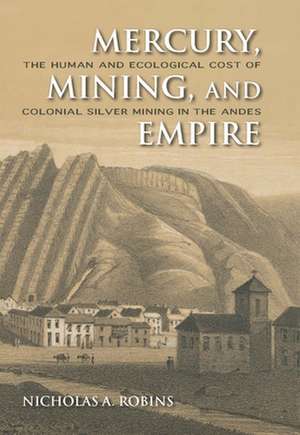
Mercury, Mining, and Empire: Indiana University Press
Autor Nicholas A. Robinsen Limba Engleză Hardback – 25 iul 2011
Bazându-ne pe arhivele coloniale ale producției de argint și mercur, Mercury, Mining, and Empire oferă o perspectivă riguroasă asupra costurilor umane și ecologice ale ambițiilor imperiale spaniole. Remarcăm modul în care Nicholas A. Robins depășește simpla istorie economică pentru a propune o analiză socio-ecologică a regiunilor Huancavelica și Potosí. Autorul documentează modul în care tehnologia amalgamării cu mercur, esențială pentru extracția argintului, a transformat comunitățile indigene în ceea ce el numește „soldații de rând ai proto-globalismului”.
Subliniem structura logică a volumului, care ghidează cititorul prin mecanismele de funcționare ale imperiului (capitolul „Amalgamating an Empire”), detaliind apoi condițiile brutale de muncă în minele de mercur („Toxic Travails”) și impactul devastator asupra structurilor sociale native („From Corrosion to Collapse”). Cartea este comparabilă cu A History of Mining in Latin America de Kendall W. Brown în ceea ce privește rigurozitatea documentării sistemului de muncă forțată (mita), dar aduce o actualizare necesară prin focalizarea pe amprenta toxică persistentă a mercurului, o temă explorată de autor și în lucrarea sa anterioară, Santa Bárbara's Legacy. Spre deosebire de Mercury and the Making of California, care analizează industrializarea în context nord-american, volumul de față se concentrează pe intersecția dintre rasă, clasă și poluarea de stat în contextul colonial andin. Descoperim aici o lucrare ce transformă datele tehnice despre minerit într-o narațiune despre supraviețuire și rezistență în fața unei mașinării imperiale extractive.
Din seria Indiana University Press
-
 Preț: 150.69 lei
 -
 Preț: 122.37 lei
 -
 Preț: 256.53 lei
 -
 Preț: 155.14 lei
 -
 Preț: 498.20 lei
 - 8%
 Preț: 502.05 lei
 -
 Preț: 131.08 lei
 -
 Preț: 192.76 lei
 -
 Preț: 128.32 lei
 -
 Preț: 220.35 lei
 -
 Preț: 344.36 lei
 -
 Preț: 216.27 lei
 -
 Preț: 221.01 lei
 -
 Preț: 170.91 lei
 -
 Preț: 391.52 lei
 -
 Preț: 157.24 lei
 -
 Preț: 317.27 lei
 -
 Preț: 95.87 lei
 - 8%
 Preț: 431.14 lei
 -
 Preț: 183.44 lei
 -
 Preț: 307.97 lei
 -
 Preț: 141.39 lei
 -
 Preț: 235.15 lei
 -
 Preț: 220.88 lei
 -
 Preț: 197.84 lei
 -
 Preț: 316.42 lei
 -
 Preț: 138.26 lei
 - 8%
 Preț: 527.66 lei
 -
 Preț: 281.97 lei
 -
 Preț: 263.18 lei
 -
 Preț: 127.13 lei
 - 19%
 Preț: 560.16 lei
 -
 Preț: 125.25 lei
 -
 Preț: 281.66 lei
 -
 Preț: 125.17 lei
 - 19%
 Preț: 419.60 lei
 -
 Preț: 103.74 lei
 -
 Preț: 197.29 lei
 -
 Preț: 165.17 lei
 -
 Preț: 332.29 lei
 -
 Preț: 134.67 lei
 - 8%
 Preț: 529.48 lei
 -
 Preț: 157.40 lei
 -
 Preț: 216.34 lei
 -
 Preț: 131.08 lei
 -
 Preț: 191.81 lei
 -
 Preț: 302.99 lei
 -
 Preț: 216.71 lei
 -
 Preț: 288.86 lei
 -
 Preț: 383.22 lei
Preț: 284.75 lei
Carte tipărită la comandă
Livrare economică 09-23 noiembrie
Specificații
ISBN-10: 0253356512
Pagini: 316
Ilustrații: 14 maps
Dimensiuni: 164 x 243 x 28 mm
Greutate: 0.57 kg
Editura: Indiana University Press
Colecția Indiana University Press
Seria Indiana University Press
V-ar putea interesa
-
 Tropical Forests and Global Atmospheric ChangeYadvinder Malhi-33%Preț: 520.53 lei780.71 lei
 -
 TimberPeter DauvergnePreț: 159.64 lei
 -
 DiamondsIan SmilliePreț: 187.38 lei
 -
 At the Coalface: My life as a miner's wifeCatherine Paton BlackPreț: 92.22 lei
 -
 The Developmental Challenges of Mining and OilRosemary Thorp-15%Preț: 639.60 lei752.47 lei
 -
 -11%Preț: 173.62 lei194.39 lei
De ce să citești această carte
Această carte este esențială pentru cercetătorii istoriei Americii Latine și ai ecologiei politice. Cititorul va înțelege cum bazele economiei globale moderne au fost puse pe seama unui dezastru ecologic și uman ale cărui efecte se resimt și astăzi în Anzi. Este o lectură fundamentală pentru a înțelege rădăcinile inechității sociale și de mediu, oferind un context istoric crucial pentru problemele contemporane de sănătate publică din Peru și Bolivia.
Despre autor
Nicholas A. Robins este cercetător asociat la Centrul pentru Studii Latino-Americane și Caraibiene din cadrul Universității Duke și director executiv al Fundației Amistad. Expertiza sa vastă în spațiul andin este consolidată de lucrările sale anterioare despre mișcările mesianice și rebeliunile indigene ale lui Tupac Amaru. Prin scrieri precum The Shining Path in Huancavelica, Peru și Landscapes of Inequity, Robins s-a impus ca o voce autoritară în analiza relației dintre exploatarea resurselor naturale, politicile coloniale și reziliența comunităților Quechua în fața opresiunii sistemice.
Descriere scurtă
Cuprins
Recenzii
"Overall, this is a fantastic book that brings together environmental, labor, and colonial history, confirming the contributions of environmental studies to understanding the past. ... Highly recommended." Choice, March 2012
"The book itself is a distinguished contribution to the polemic on mining, colonialism, and socio-environmental degradation. It will make for a strong addition to undergraduate and graduate lists. Robins's synthetic skills, the descriptive richness of the historical source work, the verve of the writing, and the passion of the argument, all combine to make Mercury, Mining, and Empire a book to be reckoned with." Daviken Studnicki-Gizbert, H-Environment, August 2012
In Mercury, Mining and Empire, Nicholas Robins provides a superbly researched piece of interdisciplinary history that argues that the post-Conquest genocide of the indigenous population of what is now Bolivia and Peru occurred as a result of a highly exploitative system of silver and mercury mining. Thus Robins analyzes a double genocide that initially entailed the death of up to ninety percent of the indigenous peoples due to illnesses brought to the Americas by the Spanish, and continued with the subsequent genocidal destruction wrought by the toxic effects of the emerging mining industry. - Journal of Genocide Research, 2012
"This is interdisciplinary history at its best. A path-breaking study that... Will certainly be a 'must-read' book." David Cahill, University of New South Wales "Overall, this is a fantastic book that brings together environmental, labor, and colonial history, confirming the contributions of environmental studies to understanding the past. ... Highly recommended." Choice, March 2012 "The book itself is a distinguished contribution to the polemic on mining, colonialism, and socio-environmental degradation. It will make for a strong addition to undergraduate and graduate lists. Robins's synthetic skills, the descriptive richness of the historical source work, the verve of the writing, and the passion of the argument, all combine to make Mercury, Mining, and Empire a book to be reckoned with." Daviken Studnicki-Gizbert, H-Environment, August 2012 "In Mercury, Mining and Empire, Nicholas Robins provides a superbly researched piece of interdisciplinary history that argues that the post-Conquest genocide of the indigenous population of what is now Bolivia and Peru occurred as a result of a highly exploitative system of silver and mercury mining. Thus Robins analyzes a 'double genocide' that initially entailed the death of up to ninety percent of the indigenous peoples due to illnesses brought to the Americas by the Spanish, and continued with the subsequent genocidal destruction wrought by the toxic effects of the emerging mining industry." - Journal of Genocide Research, 2012