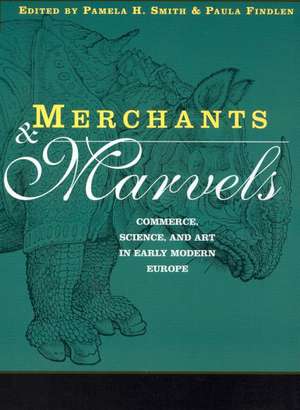
Merchants and Marvels: Commerce, Science, and Art in Early Modern Europe
Editat de Pamela Smith, Paula Findlenen Limba Engleză Paperback – 12 oct 2001
Preț: 458.72 lei
Preț vechi: 539.67 lei
-15%
Puncte Express: 688
Carte tipărită la comandă
Livrare economică 21 noiembrie-05 decembrie
Livrare prin curier în România Termenul estimat este afișat lângă disponibilitate.
Transport gratuit pentru acest produs Plată online sau ramburs, în funcție de opțiunile comenzii.
Retur gratuit în 14 zile Comandă securizată și suport în română.
Specificații
ISBN-13: 9780415928168
ISBN-10: 0415928168
Pagini: 450
Ilustrații: 40 Illustrations, color
Dimensiuni: 152 x 229 x 26 mm
Greutate: 0.66 kg
Ediția:1
Editura: Taylor & Francis
Colecția Routledge
Locul publicării:Oxford, United Kingdom
ISBN-10: 0415928168
Pagini: 450
Ilustrații: 40 Illustrations, color
Dimensiuni: 152 x 229 x 26 mm
Greutate: 0.66 kg
Ediția:1
Editura: Taylor & Francis
Colecția Routledge
Locul publicării:Oxford, United Kingdom
V-ar putea interesa
-
 Women's Worlds in Seventeenth Century England: A SourcebookPatricia CrawfordPreț: 393.11 lei
 -
 In Their Time: A History of Feminism in Western SocietyMarlene LeGatesPreț: 401.89 lei
 -
 A Book of BurlesquesH. L. MenckenPreț: 131.89 lei
 -
![Exercises on the Elementary Principles of Latin Prose Composition. [with] a Key](https://i3.books-express.ro/bt/9780649579532/exercises-on-the-elementary-principles-of-latin-prose-composition-with-a-key.jpg) Preț: 116.68 lei
Preț: 116.68 lei -
 ExpiationOctave ThanetPreț: 127.41 lei
 -
 French Organ Music Past and PresentHarvey GracePreț: 127.02 lei
 -
 Fruit and Bread: A Scientific DietGustav SchlickeysenPreț: 127.72 lei
 -
 The Geometrical Lectures of Isaac BarrowIsaac BarrowPreț: 128.12 lei
 -
 The German and English InterpreterSchaefer And KoradiPreț: 122.52 lei
 -
 Glimpses Through Life's Windows: Selections from the Writings of J. R. MillerJames Russell MillerPreț: 117.03 lei
 -
 The History of Babylonia. Ed. by A.H. SayceGeorge SmithPreț: 121.25 lei
 -
 Preț: 128.12 lei
 -
 India and Tiger-HuntingJulius BarrasPreț: 132.21 lei
 -
 Preț: 126.71 lei
 -
 The InfernoAugust StrindbergPreț: 127.96 lei
 -
 John Calvin, the StatesmanRichard Taylor StevensonPreț: 123.59 lei
 -
 Laboratory Exercises in Physics for Secondary SchoolsGeorge R. TwissPreț: 123.79 lei
 -
 The Meditations of Marcus AureliusMarcus AureliusPreț: 127.41 lei
 -
 SonnetsCharles TomlinsonPreț: 117.48 lei
 -
 Yule and Christmas: Their Place in the Germanic YearAlexander TillePreț: 127.72 lei
 -
 -15%Preț: 453.18 lei533.16 lei
 -
 Preț: 423.20 lei
Recenzii
"This beautifully-illustrated book explores the relations between the accumulations of profitable commodities and the production of enlightening knowledge in Europeans' relations with their external worlds, opening a new way of expressing the historical relation between the arts of depicting the world and the techniques for knowing it." -- Simon Schaffer, Department of History and Philosophy of Science, University of Cambridge
"Merchants and Marvels traces the paths by which many wonderful commodities were traded and collected in early-modern Europe. The editors and their contributors have produced a marvelous collection-a true Wunderkammer-to delight the mind." -- Jan Golinski, Department of History, University of New Hampshire
"A terrific collection, which gives the reader both wonderful new stories, and a vivid sense of how historians are beginning to study the material side of cultural history. These well-presented original essays deserve a wide public." -- Tony Grafton, Department of History, Princeton University
"Merchants and Marvels is wide-ranging and thought-provoking." -- Canadian Journal of History
"Merchants and Marvels traces the paths by which many wonderful commodities were traded and collected in early-modern Europe. The editors and their contributors have produced a marvelous collection-a true Wunderkammer-to delight the mind." -- Jan Golinski, Department of History, University of New Hampshire
"A terrific collection, which gives the reader both wonderful new stories, and a vivid sense of how historians are beginning to study the material side of cultural history. These well-presented original essays deserve a wide public." -- Tony Grafton, Department of History, Princeton University
"Merchants and Marvels is wide-ranging and thought-provoking." -- Canadian Journal of History
Notă biografică
Pamela H. Smith is Associate Professor of History at Pomona College and the Claremont Graduate University. She is the author of The Business of Alchemy: Science and Culture in the Holy Roman Empire, winner of the 1995 Pfizer Prize in the History of Science. Paula Findlen is Professor of History and Director of the Science, Technology and Society Program at Stanford University. She is the author of Possessing Nature: Museums, Collecting, and Scientific Culture in Early Modern Italy, winner of the 1995 Marroro Prize in Italian History and 1996 Pfizer Prize in the History of Science.
Cuprins
Acknowledgments Introduction:Commerce and the Representation of Nature in Art and Science Pamela H. Smith and Paula Findlen Part 1. STRUGGLING WITH REALITY: Visualizing Nature and Producing Knowledge 1. Splendor in the Grass: The Powers of Nature and Art in the Age of Durer Larry Silver and Pamela H. Smith 2. Objects of Art/Objects of Nature: Visual Representation and the Investigation of Nature Pamela O. Long 3. Mirroring the World: Sea Charts: Navigation and Territorial Claims Alison Sandman 4. From Blowfish to Flower Still Life Paintings: Classification and Its Images, circa 1600 Claudia Swan 5. Strange Ideas and English Knowledge: Natural Science Exchange in Elizabethan London Deborah E. Harkness Part 2. NETWORKS OF KNOWLEDGE: Commerce and the Representation of Nature 6. Local Herbs, Global Medicines: Commerce, Knowledge and Commodities in Spanish America Antonio Barrera 7. Merchants and Marvels: Hans Jacob Fugger and the Origins of the Wunderkammer Mark A. Meadow 8. Practical Alchemy and Commercial Exchange in the Holy Roman Empire Tara E. Nummedal 9. Time's Bodies: Crafting the Preparation and Preservation of Naturalia Harold J. Cook 10. Cartography, Entrepreneurialism and Power in the Reign of Louis XIV: The Case of the Canal du Midi Chandra Mukerji 11. 'Cornelius Meijer inventor et fecit': On the Representation of Science in Late Seventeenth-Century Rome Klass van Berkel Part 3. CONSUMPTION, ART AND SCIENCE 12. Inventing Nature: Commerce, Art and Science in the Early Modern Cabinet of Curiosities Paula Findlen 13. Nature as Art: The Case of the Tulip Anne Goldgar 14. Inventing Exoticism: The Project of Dutch Geography and the Marketing of the World, circa 1700 Benjamin Schmidt 15. Shopping for Instruments in Paris and London James A. Bennett EPILOGUES A World of Wonders, A World of One Lissa Roberts Questions of Representation Thomas DaCosta Kaufmann Contributors Index