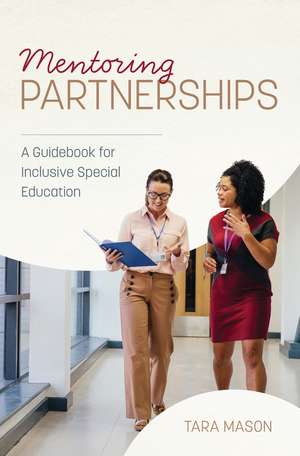
Mentoring Partnerships: A Guidebook for Inclusive Special Education
Autor Tara Masonen Limba Engleză Paperback – 6 aug 2024
| Toate formatele și edițiile | Preț | Express |
|---|---|---|
| Paperback (1) | 214.53 lei 6-8 săpt. | |
| Bloomsbury Publishing – 6 aug 2024 | 214.53 lei 6-8 săpt. | |
| Hardback (1) | 504.61 lei 6-8 săpt. | |
| Bloomsbury Publishing – 6 aug 2024 | 504.61 lei 6-8 săpt. |
Preț: 214.53 lei
Preț vechi: 286.65 lei
-25%
Puncte Express: 322
Preț estimativ în valută:
37.93€ • 44.69$ • 33.07£
37.93€ • 44.69$ • 33.07£
Carte tipărită la comandă
Livrare economică 10-24 aprilie
Specificații
ISBN-13: 9781538177334
ISBN-10: 1538177331
Pagini: 264
Ilustrații: 50 BW Illustrations, 47 Tables
Dimensiuni: 178 x 254 x 19 mm
Greutate: 0.54 kg
Editura: Bloomsbury Publishing
Colecția Rowman & Littlefield
Locul publicării:New York, United States
ISBN-10: 1538177331
Pagini: 264
Ilustrații: 50 BW Illustrations, 47 Tables
Dimensiuni: 178 x 254 x 19 mm
Greutate: 0.54 kg
Editura: Bloomsbury Publishing
Colecția Rowman & Littlefield
Locul publicării:New York, United States
Cuprins
Acknowledgments
Introduction
SECTION I: LAYING A FOUNDATION
August
Key Learning Goals
Part I: Getting Started in Your Mentoring Partnership?
Part II: The First-Year Special Education Teacher
Suggested Resources
September
Key Learning Goals
Part I: Evidence-Based Practices-Why Align with Evidence Based Instruction?
Part II: Evidence-Based Practices-How Can I Implement
Evidence-Based Practices in My Program?
Part III: Evidence-Based Practices-Part II
Suggested Resources
October
Key Learning Goals
Part I: A Brief History of Special Education
Part II: The Individualized Education Program (IEP)
Suggested Resources
SECTION II: GETTING INTO IT
November
Key Learning Goals
Part I: Universal Design for Learning (UDL)
Part II: Assistive Technology (AT) and Curriculum Planning
Suggested Resources
December
Key Learning Goals
Part I: Understanding Special Education Systems
Part II: Bias, Disproportionality, and Evaluation
Suggested Resources
January
Key Learning Goals
Part I: Working With Your Related Service Special Education
Teams
Part II: Working With Your General Education Teams and
Co-Teaching Configurations.
Suggested Resources
SECTION III: DIGGING OUT OF DISILLUSIONMENT
February
Key Learning Goals
Part I: Person-First Language and Disability Frameworks
Part II: What Are Disability Studies? (Medical, Social, and
Cultural Models)
Suggested Resources
March
Key Learning Goals
Part I: Understanding Least Restrictive Environment (LRE) and
Special Education Program Models
Part II: Creating a Strength-Based Special Education Program
Suggested Resources
April
Key Learning Goals
Part I: We Work as Collaborative Professionals
Part II: Build Up Your Team! How Can Special Education Teams
Amplify the Support Paraprofessionals Can Provide?
Suggested Resources
SECTION IV: REFLECTION, REVITALIZATION, REGROWTH
May
Key Learning Goals
Part I: Transition Planning
Part II: Transition Planning Systems versus Person Planning
Suggested Resources
June
Key Learning Goals
Part I: Early Intervention in Special Education
Part II: Map Out a Curriculum Goal for Next Year
Suggested Resources
July
Key Learning Goals
Part I: Making a Plan for Year Two, Leadership, and Professional
Organizations
Part II: Learning Leaders
Suggested Resources
SECTION V: RESOURCES
Resource 1: Who Is Who
Resource 2: Intensive Lesson Plan Template
Resource 3: Annual IEP Calendar
Resource 4: IEP Sections Template
Resource 5: Case Law Review Template
Resource 6: Student One-Pager Template
Resource 7: AT Evaluation and Template
Resource 8: Bias Self-Reflection Guide
Resource 9: Coming Down the Ladder
Resource 10: Co-Teaching Modalities and Guide
Resource 11: Evaluation Template
Resource 12: Intensify Intervention Taxonomy
Resource 13: Paraprofessional Schedule
Resource14: Transition Plan Template
Resource 15: Curriculum Planning Template
Index
About the Author
Introduction
SECTION I: LAYING A FOUNDATION
August
Key Learning Goals
Part I: Getting Started in Your Mentoring Partnership?
Part II: The First-Year Special Education Teacher
Suggested Resources
September
Key Learning Goals
Part I: Evidence-Based Practices-Why Align with Evidence Based Instruction?
Part II: Evidence-Based Practices-How Can I Implement
Evidence-Based Practices in My Program?
Part III: Evidence-Based Practices-Part II
Suggested Resources
October
Key Learning Goals
Part I: A Brief History of Special Education
Part II: The Individualized Education Program (IEP)
Suggested Resources
SECTION II: GETTING INTO IT
November
Key Learning Goals
Part I: Universal Design for Learning (UDL)
Part II: Assistive Technology (AT) and Curriculum Planning
Suggested Resources
December
Key Learning Goals
Part I: Understanding Special Education Systems
Part II: Bias, Disproportionality, and Evaluation
Suggested Resources
January
Key Learning Goals
Part I: Working With Your Related Service Special Education
Teams
Part II: Working With Your General Education Teams and
Co-Teaching Configurations.
Suggested Resources
SECTION III: DIGGING OUT OF DISILLUSIONMENT
February
Key Learning Goals
Part I: Person-First Language and Disability Frameworks
Part II: What Are Disability Studies? (Medical, Social, and
Cultural Models)
Suggested Resources
March
Key Learning Goals
Part I: Understanding Least Restrictive Environment (LRE) and
Special Education Program Models
Part II: Creating a Strength-Based Special Education Program
Suggested Resources
April
Key Learning Goals
Part I: We Work as Collaborative Professionals
Part II: Build Up Your Team! How Can Special Education Teams
Amplify the Support Paraprofessionals Can Provide?
Suggested Resources
SECTION IV: REFLECTION, REVITALIZATION, REGROWTH
May
Key Learning Goals
Part I: Transition Planning
Part II: Transition Planning Systems versus Person Planning
Suggested Resources
June
Key Learning Goals
Part I: Early Intervention in Special Education
Part II: Map Out a Curriculum Goal for Next Year
Suggested Resources
July
Key Learning Goals
Part I: Making a Plan for Year Two, Leadership, and Professional
Organizations
Part II: Learning Leaders
Suggested Resources
SECTION V: RESOURCES
Resource 1: Who Is Who
Resource 2: Intensive Lesson Plan Template
Resource 3: Annual IEP Calendar
Resource 4: IEP Sections Template
Resource 5: Case Law Review Template
Resource 6: Student One-Pager Template
Resource 7: AT Evaluation and Template
Resource 8: Bias Self-Reflection Guide
Resource 9: Coming Down the Ladder
Resource 10: Co-Teaching Modalities and Guide
Resource 11: Evaluation Template
Resource 12: Intensify Intervention Taxonomy
Resource 13: Paraprofessional Schedule
Resource14: Transition Plan Template
Resource 15: Curriculum Planning Template
Index
About the Author
Recenzii
This book is a great resource for any level special educator but especially for those just entering the field. It provides detailed descriptions and strategies for collaboration and creating environments where all students are supported. Tara's knowledge on what works in the classroom is extensive and it shows in this great resource. I would highly recommend teaching teams to use this and help guide discussions and the creation of routines and instruction! It will provide a great foundation for ALL students.
I was thrilled to hear of Dr. Mason's release of the Mentoring Partnerships Guidebook. I worked closely with Tara for years in Colorado and her passion for special education is unparalleled. Engaging and dedicated, Dr. Mason brings a wealth of knowledge and experience to the field. Beginning her career as a paraprofessional and eventually earning her PhD, Dr. Mason has walked the walk and has an in depth, practical knowledge of students with exceptionalities and public education. Dr. Mason piloted an innovative grant where mentors and mentees worked side by side to implement technology in the special education classroom. Tara has dedicated her life to advocacy, innovation, policy and theory in the field of special services. Her expertise is an asset to everything she is a part of. This guidebook will undoubtedly be an accessible text filled with researched, actionable steps that can lead to better outcomes for students and teachers!
I was thrilled to hear of Dr. Mason's release of the Mentoring Partnerships Guidebook. I worked closely with Tara for years in Colorado and her passion for special education is unparalleled. Engaging and dedicated, Dr. Mason brings a wealth of knowledge and experience to the field. Beginning her career as a paraprofessional and eventually earning her PhD, Dr. Mason has walked the walk and has an in depth, practical knowledge of students with exceptionalities and public education. Dr. Mason piloted an innovative grant where mentors and mentees worked side by side to implement technology in the special education classroom. Tara has dedicated her life to advocacy, innovation, policy and theory in the field of special services. Her expertise is an asset to everything she is a part of. This guidebook will undoubtedly be an accessible text filled with researched, actionable steps that can lead to better outcomes for students and teachers!