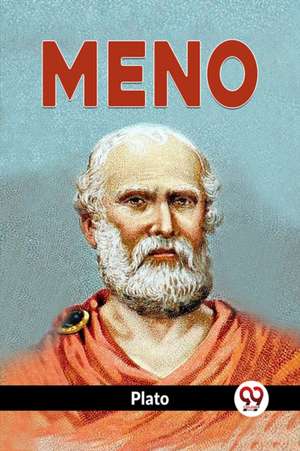
Meno
Autor Platoen Paperback – 2023
Preț: 77.40 lei
Puncte Express: 116
Carte disponibilă
Livrare economică 08-22 decembrie
Livrare express 21-27 noiembrie pentru 14.02 lei
Livrare prin curier în România Termenul estimat este afișat lângă disponibilitate.
Transport gratuit de la 400.00 lei Plată online sau ramburs, în funcție de opțiunile comenzii.
Retur gratuit în 14 zile Comandă securizată și suport în română.
Specificații
ISBN-13: 9789358590005
ISBN-10: 9358590009
Pagini: 61
Dimensiuni: 140 x 216 x 4 mm
Greutate: 0.09 kg
Editura: Double 9 Books
ISBN-10: 9358590009
Pagini: 61
Dimensiuni: 140 x 216 x 4 mm
Greutate: 0.09 kg
Editura: Double 9 Books
V-ar putea interesa
-
 RepublicPlatoPreț: 30.76 lei
-
 Protagoras and MenoPlato-31%Preț: 63.95 lei92.30 lei
-
 Plato: A Very Short IntroductionJulia Annas-19%Preț: 57.48 lei70.88 lei
-
 -23%Preț: 227.04 lei296.10 lei
-
 -18%Preț: 53.36 lei64.76 lei
-
 MeditationsMarcus AureliusPreț: 34.43 lei
-
 Preț: 233.34 lei
-
 Preț: 225.46 lei
-
 -14%Preț: 522.41 lei607.45 lei
-
 The Pocket Book of PlatoMichael MoorePreț: 72.66 lei
-
 Preț: 66.00 lei
-
 Socratic DialoguesPlatoPreț: 70.93 lei
-
 The RepublicPlato Plato-27%Preț: 52.79 lei71.95 lei
-
 Plato: A Complete Introduction: Teach YourselfRoy Jackson-26%Preț: 78.85 lei106.97 lei
-
 The Dialogues of PlatoPlatoPreț: 50.06 lei
-
 ParmenidesPlatoPreț: 43.40 lei
-
 ProtagorasPlatoPreț: 39.22 lei
-
 Nicomachean EthicsAristotlePreț: 44.60 lei
-
 Preț: 58.13 lei
Descriere
Descriere de la o altă ediție sau format:
This is an English translation of Plato’s Socratic dialogue attempting to achieve a definition of virtue that applies equally to all particular virtues and serves as a great introduction to Socratic dialogues. It contains a short introduction, notes, standard Stephanus numbers, speech numbers, and an appendix containing a unique gallery of step-by-step geometrical diagrams. It also includes illustrations, a bibliography, and a glossary.
Focus Philosophical Library translations are close to and are non-interpretative of the original text, with the notes and a glossary intending to provide the reader with some sense of the terms and the concepts as they were understood by Plato’s immediate audience.
Recenzii
This new translation of the Meno by Anastaplo and Berns has several distinctive features that make it useful for teaching and studying the dialogue. Generally achieving a balance between clarity and faithfulness, it includes valuable annotation, two appendices...and an innovative division of the text through the provision of numbers for each of it's speeches... the overall result is a text that would give a reader unschooled in Greek a fairly reliable sense of the flow of ideas in the original.
-- William A. Welton, Loyola College, Review of Metaphysic, Vol. LVIII, No. 4, June 200
This is an English translation of Plato’s Socratic dialogue attempting to achieve a definition of virtue that applies equally to all particular virtues and serves as a great introduction to Socratic dialogues. It contains a short introduction, notes, standard Stephanus numbers, speech numbers, and an appendix containing a unique gallery of step-by-step geometrical diagrams. It also includes illustrations, a bibliography, and a glossary.
Focus Philosophical Library translations are close to and are non-interpretative of the original text, with the notes and a glossary intending to provide the reader with some sense of the terms and the concepts as they were understood by Plato’s immediate audience.
Focus Philosophical Library translations are close to and are non-interpretative of the original text, with the notes and a glossary intending to provide the reader with some sense of the terms and the concepts as they were understood by Plato’s immediate audience.
Notă biografică
Plato (428/427 or 424/423 - 348/347 BC) was an Athenian philosopher during the Classical period in Ancient Greece, founder of the Platonist school of thought, and the Academy, the first institution of higher learning in the Western world. He is widely considered the pivotal figure in the history of Ancient Greek and Western philosophy, along with his teacher, Socrates, and his most famous student, Aristotle.[a] Plato has also often been cited as one of the founders of Western religion and spirituality.[4] The so-called Neoplatonism of philosophers like Plotinus and Porphyry influenced Saint Augustine and thus Christianity. Alfred North Whitehead once noted: "the safest general characterization of the European philosophical tradition is that it consists of a series of footnotes to Plato."[5] Plato was the innovator of the written dialogue and dialectic forms in philosophy. Plato is also considered the founder of Western political philosophy. His most famous contribution is the theory of Forms known by pure reason, in which Plato presents a solution to the problem of universals known as Platonism (also ambiguously called either Platonic realism or Platonic idealism). He is also the namesake of Platonic love and the Platonic solids. His own most decisive philosophical influences are usually thought to have been along with Socrates, the pre-Socratics Pythagoras, Heraclitus and Parmenides, although few of his predecessors' works remain extant and much of what we know about these figures today derives from Plato himself.[b] Unlike the work of nearly all of his contemporaries, Plato's entire body of work is believed to have survived intact for over 2,400 years.[7] Although their popularity has fluctuated over the years, the works of Plato have never been without readers since the time they were written