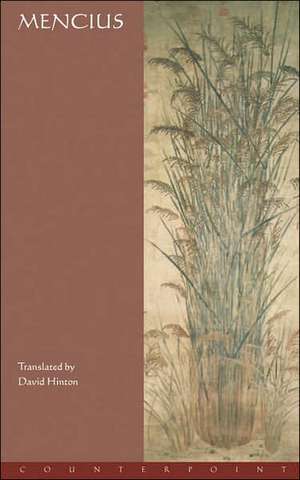
Mencius: Recollections
Autor Mencius Traducere de David Hintonen Limba Engleză Paperback – 17 iun 1999
This ancient text records the teachings of Mencius, China’s ya sheng, or "second sage." A philosopher who worked in the fourth century b.c., Mencius studied with the grandson of Confucius and is credited with the development of orthodox Confucianism. Divided into seven chapters, Mencius is composed largely of conversations between the great philosopher and the rulers he sought to guide. Sometimes mystical, sometimes poetic, these teachings are often unpredictable, with startling insights that bring the narrative to life. David Hinton’s Mencius reveals for the first time the literary vibrancy of this great philosopher and the earnestness behind his faith in humanity.
Preț: 74.15 lei
Puncte Express: 111
Carte tipărită la comandă
Livrare economică 04-18 decembrie
Livrare prin curier în România Termenul estimat este afișat lângă disponibilitate.
Transport gratuit de la 400.00 lei Plată online sau ramburs, în funcție de opțiunile comenzii.
Retur gratuit în 14 zile Comandă securizată și suport în română.
Specificații
ISBN-13: 9781582430201
ISBN-10: 1582430209
Pagini: 320
Dimensiuni: 128 x 204 x 22 mm
Greutate: 0.33 kg
Ediția:New ed.
Editura: Counterpoint Press
ISBN-10: 1582430209
Pagini: 320
Dimensiuni: 128 x 204 x 22 mm
Greutate: 0.33 kg
Ediția:New ed.
Editura: Counterpoint Press
Notă biografică
Mencius (372-298 BC) was one of the greatest Chinese philosophers, focusing on political theory and practice. Mencius, like Confucius, believed that rulers were divinely placed in order to guarantee peace and order among the people they rule. Unlike Confucius, Mencius believed that if a ruler failed to bring peace and order about, then the people could be absolved of all loyalty to that ruler and were justified to revolt.
D. C. Lau is a Professor at the University of Hong Kong.
D. C. Lau is a Professor at the University of Hong Kong.
Cuprins
MenciusIntroduction Further Reading Mencius
Book I·Part A Book I·Part B Book II·Part A Book II·Part B Book III·Part A Book III·Part B Book IV·Part A Book IV·Part B Book V·Part A Book V·Part B Book VI·Part A Book VI·Part B Book VII·Part A Book VII·Part B
Aooendix 1: The Dating of Events in the Life of Mencius Appendix 2: Early Traditions about Mencius Appendix 3: The Text of the Mencius Appendix 4: Ancient History as Understood by Mencius Appendix 5: On Mencius' Use of the Method of Analogy in Argument Textual Notes Glossary of Personal and Place Names
Book I·Part A Book I·Part B Book II·Part A Book II·Part B Book III·Part A Book III·Part B Book IV·Part A Book IV·Part B Book V·Part A Book V·Part B Book VI·Part A Book VI·Part B Book VII·Part A Book VII·Part B
Aooendix 1: The Dating of Events in the Life of Mencius Appendix 2: Early Traditions about Mencius Appendix 3: The Text of the Mencius Appendix 4: Ancient History as Understood by Mencius Appendix 5: On Mencius' Use of the Method of Analogy in Argument Textual Notes Glossary of Personal and Place Names
Descriere
Descriere de la o altă ediție sau format:
Mencius was one of the great philosophers of ancient China, second only in influence to Confucius, whose teachings he defended and expanded. The Mencius, in which he recounts his dialogues with kings, dukes and military men, as well as other philosophers, is one of the Four Books that make up the essential Confucian corpus.
Mencius was one of the great philosophers of ancient China, second only in influence to Confucius, whose teachings he defended and expanded. The Mencius, in which he recounts his dialogues with kings, dukes and military men, as well as other philosophers, is one of the Four Books that make up the essential Confucian corpus.