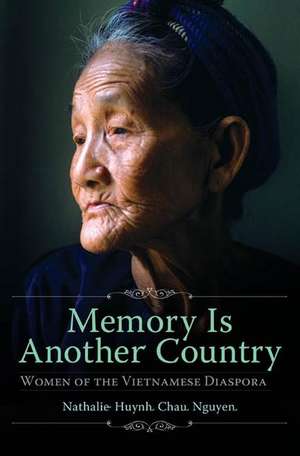
Memory Is Another Country: Women of the Vietnamese Diaspora
Autor Nathalie Huynh Chau Nguyenen Limba Engleză Hardback – 25 aug 2009
The act of remembering is a means of bringing the past alive and an imaginative way of dealing with loss. It has been the subject of much recent scholarship and is of particular relevance at a time of widespread transnational migration. This book is a valuable and original contribution to the field of diaspora studies. Based on in-depth oral narratives of forty Vietnamese women, it deals with themes both universal and specific to this diaspora: divergent memories in families, the significance of homeland, the return to Vietnam, cross-cultural relationships, intergenerational tensions, and the issues of silence and unspoken trauma among Vietnamese refugees. It is the first study to apply memory and trauma theories to a substantial base of oral narratives by Vietnamese women in the West. Nguyen argues that understanding of these narratives provides not only an insight into the way Vietnamese women have dealt with loss, but also illuminates the experience of the wider Vietnamese diaspora and other refugees.
Preț: 332.57 lei
Preț vechi: 400.09 lei
-17%
Puncte Express: 499
Carte tipărită la comandă
Livrare economică 02-16 decembrie
Livrare prin curier în România Termenul estimat este afișat lângă disponibilitate.
Transport gratuit de la 400.00 lei Plată online sau ramburs, în funcție de opțiunile comenzii.
Retur gratuit în 14 zile Comandă securizată și suport în română.
Specificații
ISBN-13: 9780313360275
ISBN-10: 0313360278
Pagini: 228
Ilustrații: plates, black & white plates
Dimensiuni: 156 x 235 x 23 mm
Greutate: 0.5 kg
Editura: Bloomsbury Publishing
Colecția Praeger
Locul publicării:New York, United States
ISBN-10: 0313360278
Pagini: 228
Ilustrații: plates, black & white plates
Dimensiuni: 156 x 235 x 23 mm
Greutate: 0.5 kg
Editura: Bloomsbury Publishing
Colecția Praeger
Locul publicării:New York, United States
V-ar putea interesa
-
 This Time TogetherCarol BurnettPreț: 97.28 lei
 -
 Women's Bodies in PsychoanalysisRosemary M BalsamPreț: 480.97 lei
 -
 Preț: 420.43 lei
 -
 Preț: 499.52 lei
 -
 Women of Babylon: Gender and Representation in MesopotamiaZainab BahraniPreț: 462.43 lei
 -
 -8%Preț: 428.67 lei465.94 lei
 -
 -15%Preț: 611.52 lei719.44 lei
 -
 Preț: 416.63 lei
 -
 The Female Romantics: Nineteenth-century Women Novelists and ByronismCaroline Franklin-24%Preț: 1133.24 lei1487.02 lei
 -
 Enduring Violence – Ladina Women′s Lives in GuatemalaCecilia MenjívarPreț: 264.40 lei
 -
 The Women’s InstituteSusan Cohen-31%Preț: 47.37 lei69.12 lei
 -
 Women and the Animal Rights MovementEmily GaarderPreț: 303.44 lei
 -
 Consumer Behavior: Women and ShoppingPatricia HuddlestonPreț: 109.70 lei
 -
 Dreamers of a New DaySheila RowbothamPreț: 173.00 lei
 -
 More to Life Than ShoesNadia FinerPreț: 98.41 lei
 -
 -38%Preț: 788.87 lei1263.20 lei
 -
 Amazons of Black SpartaStanley B. Alpern-16%Preț: 104.03 lei123.67 lei
Cuprins
List of Illustrations
Preface and Acknowledgments
Introduction
1. Lost Photographs
2. Sisters and Memories
3. Women in Uniform
4. Fragments of War
5. Love across Cultures
6. Return Journeys
Conclusion
Notes
Bibliography
Index
Preface and Acknowledgments
Introduction
1. Lost Photographs
2. Sisters and Memories
3. Women in Uniform
4. Fragments of War
5. Love across Cultures
6. Return Journeys
Conclusion
Notes
Bibliography
Index
Recenzii
Nguyen makes a brilliant contribution to the third wave of scholarship.Her focus on women is valuable.pathbreaking book.Essential. All levels/libraries.
Nathalie Huynh Chau Nguyen's book fills an important gap in current scholarship on South Vietnamese women's experiences during war and in diaspora. . . . The personal stories of the women interviewed are vividly narrated and rich in detail. . . . The stories recounted here are an important part of modern Vietnamese history. History often privileges victors. After the South's defeat in 1975, pro-South Vietnamese women's stories have been rarely heard, and they deserve to be. Nguyen's book fills the void and in so doing enriches the existing scholarship on memory, trauma, and diaspora.
The 'living history' that this book represents is a beautifully realized portrait of ordinary women who were forced into extraordinary lives.
Similar in style to Jung Chang's enthralling accounts of revolutionary China (Wild Swans: three daughters of China, 1991), this book revisits the final days of the American war through the eyes of Vietnamese women. The stories are deeply personal, compelling, and eloquently retold.
Nguyen's very accessible and engaging work will be of interest to both an academic audience of students and scholars and the broader audience with an interest in women's studies, ethnic studies, refugee studies, and Asian-American studies.
This is a poignant and beautifully presented work about a community most Australians have lived alongside for decades. Reading it should jolt us out of our complacency.
One of the strengths of this collection is that the women all had different experiences that they reacted to differently. Therefore, while loss, devastation and grief can't be escaped as a common theme, the women do not blend into archetypes. The chapters begin with loss, symbolized by the family photographs that were lost or destroyed. The difference in the recollections of two sisters who shared the same traumas is particularly interesting. Other chapters focus on female soldiers, war memories, intermarriage outside the culture, both before and after leaving Viet Nam and the reactions of those who returned to visit as well as those who refused to do so. The 'living history' that this book represents is a beautifully realized portrait of ordinary women who were forced into extraordinary lives.
.author Nathalie Huynh Chau Nguyen offers compelling first-person accounts by women who fled Vietnam in 1975.
This path-breaking study not only gives a public voice to Vietnamese women who fled their homeland following the fall of Saigon in 1975, but explores the extraordinary resilience of the human condition amid the disrupture of war and the displacement of migration. Leading cultural scholar Nathalie Huynh Chau Nguyen examines the histories of women of the Vietnamese diaspora with unusual empathy, and her analysis of their many experiences - as mothers, daughters, workers and even soldiers - is nuanced and rich. Nguyen reminds us that the act of remembering serves to keep the past in the present, mediating personal and collective loss and suffering and empowering Vietnamese women as they have forged their new lives in another country. Compelling and reflective, I recommend this important book as essential reading for anyone interested in the processes of migration and memory more broadly, and in the Vietnamese diaspora in particular.
A compelling and exquisitely written book. We learn from the narratives of Vietnamese women who recount memories of war and exodus about a collective vernacular history that is missing from official accounts. Women become custodians of suppressed and silenced stories in families and nations. Their personal narratives are eloquent and moving to read, bringing the past to life and supplying the detail and specificity that is a hallmark of narrative. Nguyen's meticulous research and literary gifts provide a model for future narrative scholars: she sensitively comments on moments where stories in families converge and diverge, examines the close relationship between content (what is said) and form (how a story is structured), and she charts a course for contemporary theory about memory, narrative and trauma. I loved every page of this stunning book.
Nathalie Huynh Chau Nguyen's book fills an important gap in current scholarship on South Vietnamese women's experiences during war and in diaspora. . . . The personal stories of the women interviewed are vividly narrated and rich in detail. . . . The stories recounted here are an important part of modern Vietnamese history. History often privileges victors. After the South's defeat in 1975, pro-South Vietnamese women's stories have been rarely heard, and they deserve to be. Nguyen's book fills the void and in so doing enriches the existing scholarship on memory, trauma, and diaspora.
The 'living history' that this book represents is a beautifully realized portrait of ordinary women who were forced into extraordinary lives.
Similar in style to Jung Chang's enthralling accounts of revolutionary China (Wild Swans: three daughters of China, 1991), this book revisits the final days of the American war through the eyes of Vietnamese women. The stories are deeply personal, compelling, and eloquently retold.
Nguyen's very accessible and engaging work will be of interest to both an academic audience of students and scholars and the broader audience with an interest in women's studies, ethnic studies, refugee studies, and Asian-American studies.
This is a poignant and beautifully presented work about a community most Australians have lived alongside for decades. Reading it should jolt us out of our complacency.
One of the strengths of this collection is that the women all had different experiences that they reacted to differently. Therefore, while loss, devastation and grief can't be escaped as a common theme, the women do not blend into archetypes. The chapters begin with loss, symbolized by the family photographs that were lost or destroyed. The difference in the recollections of two sisters who shared the same traumas is particularly interesting. Other chapters focus on female soldiers, war memories, intermarriage outside the culture, both before and after leaving Viet Nam and the reactions of those who returned to visit as well as those who refused to do so. The 'living history' that this book represents is a beautifully realized portrait of ordinary women who were forced into extraordinary lives.
.author Nathalie Huynh Chau Nguyen offers compelling first-person accounts by women who fled Vietnam in 1975.
This path-breaking study not only gives a public voice to Vietnamese women who fled their homeland following the fall of Saigon in 1975, but explores the extraordinary resilience of the human condition amid the disrupture of war and the displacement of migration. Leading cultural scholar Nathalie Huynh Chau Nguyen examines the histories of women of the Vietnamese diaspora with unusual empathy, and her analysis of their many experiences - as mothers, daughters, workers and even soldiers - is nuanced and rich. Nguyen reminds us that the act of remembering serves to keep the past in the present, mediating personal and collective loss and suffering and empowering Vietnamese women as they have forged their new lives in another country. Compelling and reflective, I recommend this important book as essential reading for anyone interested in the processes of migration and memory more broadly, and in the Vietnamese diaspora in particular.
A compelling and exquisitely written book. We learn from the narratives of Vietnamese women who recount memories of war and exodus about a collective vernacular history that is missing from official accounts. Women become custodians of suppressed and silenced stories in families and nations. Their personal narratives are eloquent and moving to read, bringing the past to life and supplying the detail and specificity that is a hallmark of narrative. Nguyen's meticulous research and literary gifts provide a model for future narrative scholars: she sensitively comments on moments where stories in families converge and diverge, examines the close relationship between content (what is said) and form (how a story is structured), and she charts a course for contemporary theory about memory, narrative and trauma. I loved every page of this stunning book.
Notă biografică
Nathalie Huynh Chau Nguyen is Professor of History at Monash University, Australia, and Fellow of the Academy of the Social Sciences in Australia (FASSA). A Commonwealth Scholar at the University of Oxford and former Australian Research Council Future Fellow, she is the author of four books including 2010 Choice Outstanding Academic Title Memory is Another Country: Women of the Vietnamese Diaspora (2009) and South Vietnamese Soldiers: Memories of the Vietnam War and After (2016) (both now with Bloomsbury) as well as editor of the Routledge Handbook of the Vietnamese Diaspora (2024).