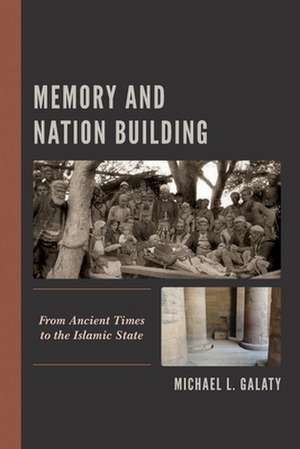
Memory and Nation Building: From Ancient Times to the Islamic State
Autor Michael L. Galatyen Limba Engleză Paperback – 6 mai 2021
Galaty builds a diachronic model of state formation and its relationship to memory and political control. Memory and Nation Building culminates in an analysis of modern collective memory systems and resistance to those systems, which are often framed as conflicts over "heritage". The formation and eventual fall of the short-lived Islamic State serves as an example of extreme memory work, with lessons for other modern nations.
Preț: 220.75 lei
Preț vechi: 306.93 lei
-28%
Puncte Express: 331
Carte tipărită la comandă
Livrare economică 30 noiembrie-14 decembrie
Livrare prin curier în România Termenul estimat este afișat lângă disponibilitate.
Transport gratuit de la 400.00 lei Plată online sau ramburs, în funcție de opțiunile comenzii.
Retur gratuit în 14 zile Comandă securizată și suport în română.
Specificații
ISBN-13: 9781538158388
ISBN-10: 1538158388
Pagini: 226
Ilustrații: 27 b/w photos; 3 tables;
Dimensiuni: 154 x 220 x 12 mm
Greutate: 0.34 kg
Editura: Bloomsbury Publishing
Colecția Rowman & Littlefield
Locul publicării:New York, United States
ISBN-10: 1538158388
Pagini: 226
Ilustrații: 27 b/w photos; 3 tables;
Dimensiuni: 154 x 220 x 12 mm
Greutate: 0.34 kg
Editura: Bloomsbury Publishing
Colecția Rowman & Littlefield
Locul publicării:New York, United States
Recenzii
In this lucid, sweeping monograph, Galaty (Univ. of Michigan) argues that collective memories are a necessary component of human cultural behavior, and, moreover, that they are the most crucial element of state formation and nation building.
What is most significant about Galaty's ambitious and highly readable book is that he takes a comparative and long-term diachronic approach to collective memory practices. . . . Memory and Nation Building is. . . a compelling book and an excellent example of how the archaeological study of memory has matured over time. It will be of interest to scholars involved in the study of memory, the relationship between memory practices and the longue durée, and comparative approaches to history.
Galaty (2018), moves the study of collective memory beyond a simplistic association between monuments and legitimacy, following Jonker (1995) and J. Assman (2011) to develop a model that explains how would-be leaders transformed individual memory (particularly from funerary contexts) into collective memory.
Galaty's aims are laudable, and I respect the breadth of the scholarship on display here. . . . Galaty is sincere about deploying the craft of archaeology to make sense of the violence and upheaval in our times. Colleagues of a processual bent who value large-scale comparative studies and who study the rise of states, nationalism and memory may well find much to interest them here.
Galaty closes his compelling volume with a defence of the importance of archaeology and its relevance to the modern political climate by reminding the reader that archaeology "is not a peripheral academic pursuit; rather, it is absolutely necessary if we are to make sense of world history, which is largely viewed, by most people, through the prism of memory" (p. 157).
Memory and Nation Building is a hugely ambitious and ultimately convincing narrative of the tight bonds between memory, social formation, and ultimately of state building. Few authors have attempted to connect deep prehistory to the present in a single region of the world, much less three. Beautifully written, deeply researched, and often surprising, scholars in many fields will find Galaty's new theorization of memory convincing and useful.
In Memory and Nation Building, Michael Galaty reveals the pervasiveness of memory work in society through a series of well researched diachronic case studies. His prose is both erudite and accessible, making this book essential reading for scholars and students in all walks of the Social Sciences and Humanities.
This ambitious book focuses on the collective memories and so-called counter-memories of three eastern Mediterranean societies-Egypt, Greece, and Albania.
What is most significant about Galaty's ambitious and highly readable book is that he takes a comparative and long-term diachronic approach to collective memory practices. . . . Memory and Nation Building is. . . a compelling book and an excellent example of how the archaeological study of memory has matured over time. It will be of interest to scholars involved in the study of memory, the relationship between memory practices and the longue durée, and comparative approaches to history.
Galaty (2018), moves the study of collective memory beyond a simplistic association between monuments and legitimacy, following Jonker (1995) and J. Assman (2011) to develop a model that explains how would-be leaders transformed individual memory (particularly from funerary contexts) into collective memory.
Galaty's aims are laudable, and I respect the breadth of the scholarship on display here. . . . Galaty is sincere about deploying the craft of archaeology to make sense of the violence and upheaval in our times. Colleagues of a processual bent who value large-scale comparative studies and who study the rise of states, nationalism and memory may well find much to interest them here.
Galaty closes his compelling volume with a defence of the importance of archaeology and its relevance to the modern political climate by reminding the reader that archaeology "is not a peripheral academic pursuit; rather, it is absolutely necessary if we are to make sense of world history, which is largely viewed, by most people, through the prism of memory" (p. 157).
Memory and Nation Building is a hugely ambitious and ultimately convincing narrative of the tight bonds between memory, social formation, and ultimately of state building. Few authors have attempted to connect deep prehistory to the present in a single region of the world, much less three. Beautifully written, deeply researched, and often surprising, scholars in many fields will find Galaty's new theorization of memory convincing and useful.
In Memory and Nation Building, Michael Galaty reveals the pervasiveness of memory work in society through a series of well researched diachronic case studies. His prose is both erudite and accessible, making this book essential reading for scholars and students in all walks of the Social Sciences and Humanities.
This ambitious book focuses on the collective memories and so-called counter-memories of three eastern Mediterranean societies-Egypt, Greece, and Albania.