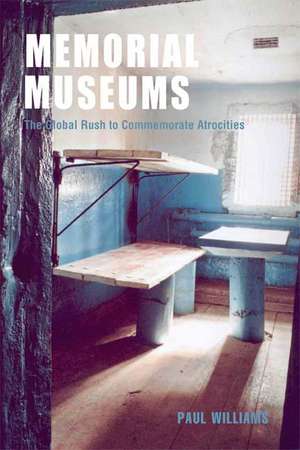
Memorial Museums: The Global Rush to Commemorate Atrocities
Autor Paul Williamsen Limba Engleză Paperback – dec 2007
This book is the first of its kind to "map" these new institutions and cultural spaces, which, although varying widely in size, style and political situation, are nonetheless united in their desire to promote peace, tolerance and the avoidance of future violence. Moving across nations and contexts, Memorial Museums critically analyzes the tactics of these institutions and gauges their wider public significance.
Preț: 236.67 lei
Preț vechi: 274.21 lei
-14%
Puncte Express: 355
Carte tipărită la comandă
Livrare economică 26 noiembrie-10 decembrie
Livrare prin curier în România Termenul estimat este afișat lângă disponibilitate.
Transport gratuit de la 400.00 lei Plată online sau ramburs, în funcție de opțiunile comenzii.
Retur gratuit în 14 zile Comandă securizată și suport în română.
Specificații
ISBN-13: 9781845204891
ISBN-10: 1845204891
Pagini: 240
Ilustrații: 30 b&w illustrations, bibliography, index
Dimensiuni: 168 x 242 x 18 mm
Greutate: 0.42 kg
Editura: Bloomsbury Publishing
Colecția Berg Publishers
Locul publicării:London, United Kingdom
ISBN-10: 1845204891
Pagini: 240
Ilustrații: 30 b&w illustrations, bibliography, index
Dimensiuni: 168 x 242 x 18 mm
Greutate: 0.42 kg
Editura: Bloomsbury Publishing
Colecția Berg Publishers
Locul publicării:London, United Kingdom
V-ar putea interesa
-
 Preț: 309.28 lei
 -
 -13%Preț: 300.82 lei345.94 lei
 -
 Amazon Town: A Study of Human Life in the TropicsCharles Wagley-16%Preț: 159.55 lei189.68 lei
 -
 -21%Preț: 280.33 lei352.64 lei
 -
 Paul GilroyPaul WilliamsPreț: 222.02 lei
 -
 Ma' Betisek Concepts of Living Things: Volume 54Wazir-Jahan Karim-18%Preț: 1112.48 lei1356.68 lei
 -
 The Real Politics of the Horn of AfricaAlex De WaalPreț: 169.03 lei
 -
 Preț: 241.50 lei
 -
 Buddhist Funeral Cultures of Southeast Asia and ChinaPaul WilliamsPreț: 394.15 lei
 -
 Living Language: An Introduction to Linguistic AnthropologyLaura M. AhearnPreț: 442.35 lei
 -
 Doing Ethnography TodayElizabeth CampbellPreț: 298.29 lei
 -
 Social Work with People with Learning DifficultiesPaul WilliamsPreț: 321.70 lei
 -
 -18%Preț: 1112.48 lei1356.68 lei
 -
 The SEND Code of Practice 0-25 YearsRona TuttPreț: 322.70 lei
 -
 Cooking Technology: Transformations in Culinary Practice in Mexico and Latin AmericaSteffan Igor Ayora-Diaz-34%Preț: 795.40 lei1203.83 lei
 -
 Haven of LibertyHoward B. RockPreț: 289.68 lei
 -
 Son Preference: Sex Selection, Gender and Culture in South AsiaNavtej K. PurewalPreț: 284.46 lei
 -
 Morality: An Anthropological PerspectiveJarrett ZigonPreț: 381.10 lei
 -
 The Anthropology of Alternative MedicineAnamaria Iosif RossPreț: 407.04 lei
 -
 Culinary Art and AnthropologyJoy Adapon-25%Preț: 770.05 lei1020.27 lei
 -
 A Cultural History of Animals in the Age of EmpireKathleen Kete-27%Preț: 211.09 lei290.41 lei
 -
 Unimaginable Storms: A Search for Meaning in PsychosisMurray Jackson-5%Preț: 460.31 lei484.54 lei
 -
 Visual Impact: Culture and the Meaning of ImagesTerence WrightPreț: 410.99 lei
Cuprins
1. A Very Different Proposition: Introducing the Memorial Museum
2. The Surviving Object: Presence and Absence in Memorial Museums
3. Photographic Memory: Commemorating Calamitous Events through Images
4. Rocks and Hard Places: Location and Spatiality in Memorial Museums
5. A Diplomatic Assignment: The Political Fortunes of Memorial Museums
6. The Memorial Museum Identity Complex: Victimhood, Culpability, and Responsibility
7. Looming Disaster: Memorial Museums and the Shaping of Historic Consciousness
8. Conclusion: Fighting the Forgetful Future
2. The Surviving Object: Presence and Absence in Memorial Museums
3. Photographic Memory: Commemorating Calamitous Events through Images
4. Rocks and Hard Places: Location and Spatiality in Memorial Museums
5. A Diplomatic Assignment: The Political Fortunes of Memorial Museums
6. The Memorial Museum Identity Complex: Victimhood, Culpability, and Responsibility
7. Looming Disaster: Memorial Museums and the Shaping of Historic Consciousness
8. Conclusion: Fighting the Forgetful Future
Recenzii
A significant study of contemporary museological practices, offering a wealth of insights into how objects, images and exhibition spaces contribute to the politically charged field of commemoration and remembrance.
Williams's book offers a rigorous analysis of the key issues and should be read by anyone involved in a memorial project.
This book provides a critical survey of issues on memorial museums: what they contain; why they have proliferated worldwide in this particular sociopolitical epoch; the basis of their appeal for visitors; the effect that their creation might have on other kinds of museums and heritage sites; and if they will become a permanent feature of the urban landscape and of public historical consciousness.
Williams's work is best suited to for a specialized audience of graduate students, professors, and museum professionals. These readers will find an intellectually stimulating treatise that lays the groundwork for furture research in an area of museum studies that has not yet received much scholarly attention. Highly recommended.
Williams should be applauded for his breadth of material ... His argument is an important one that I hope opens up further investigations into the sites he mentions.
Williams's book offers a rigorous analysis of the key issues and should be read by anyone involved in a memorial project.
This book provides a critical survey of issues on memorial museums: what they contain; why they have proliferated worldwide in this particular sociopolitical epoch; the basis of their appeal for visitors; the effect that their creation might have on other kinds of museums and heritage sites; and if they will become a permanent feature of the urban landscape and of public historical consciousness.
Williams's work is best suited to for a specialized audience of graduate students, professors, and museum professionals. These readers will find an intellectually stimulating treatise that lays the groundwork for furture research in an area of museum studies that has not yet received much scholarly attention. Highly recommended.
Williams should be applauded for his breadth of material ... His argument is an important one that I hope opens up further investigations into the sites he mentions.