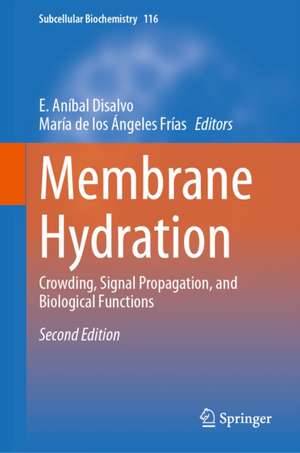
Membrane Hydration
en Limba Engleză Hardback – 14 oct 2026
The main topics include the analysis of the distribution of water populations at the membrane of different composition introducing and discussing the difference between interfaces and interphases on thermodynamic backgrounds.
The emergent thermodynamic and dynamic picture arising from these arrangements, the configuration of specific regions, such domains and defects, that may catalyze the binding of biologically relevant compounds, and the role of water in signal propagation are relevant topics in this edition.
Within this approach, the impact of cholesterol on the structuring of water in membranes, followed by advancd spectroscopic methodologies and molecular dynamics is also highlighted. Finally, the book examines the thermodynamic contributions of water to nerve impulses and the importance of hydrogen bonds in complex environments challenging the classical models of membranes. Bringing together experimental, computational, and theoretical perspectives, this book is an invaluable resource for understanding and evaluating how the properties of water shape essential biological functions, offering new insights for biophysicists and chemists interested in the molecular basis of life.
Preț: 1150.81 lei
Preț vechi: 1403.43 lei
-18% Nou
Puncte Express: 1726
Carte disponibilă
Livrare economică 12-26 noiembrie
Livrare prin curier în România Termenul estimat este afișat lângă disponibilitate.
Transport gratuit pentru acest produs Plată online sau ramburs, în funcție de opțiunile comenzii.
Retur gratuit în 14 zile Comandă securizată și suport în română.
Specificații
ISBN-13: 9783032241580
ISBN-10: 3032241588
Pagini: 205
Dimensiuni: 160 x 241 x 18 mm
Greutate: 0.46 kg
Ediția:Second Edition 2026
Editura: Springer Nature Switzerland AG
ISBN-10: 3032241588
Pagini: 205
Dimensiuni: 160 x 241 x 18 mm
Greutate: 0.46 kg
Ediția:Second Edition 2026
Editura: Springer Nature Switzerland AG
Notă biografică
Dr. E. Anibal Disalvo, is a researcher in the field of biophysical chemistry, specializing in the study of lipid membranes and biomimetic systems. His work focuses on analyzing the structural and dynamical properties of lipid interphases, particularly in relation to water distribution, membrane stability, and cell permeability under osmotic and hydric stress. He also investigates enzyme activity regulation using techniques like FTIR spectroscopy, cyclic voltammetry, dipole potential measurements, and molecular simulations, with an emphasis on understanding the biophysical mechanisms underlying these processes. Dr. Disalvo holds a Doctorate in Sciences (Physical Chemistry) from the National University of La Plata, Argentina (1974). He is currently an Emeritus Researcher at the National Research Council (CONICET) and Head of the Applied Biophysical Area at the Center of Applied Biophysical and Food Research in Santiago del Estero. With a long academic career, he has been an Associate Professor at the University of Buenos Aires since 1997 and a Full Professor at the National University of Santiago del Estero since 2015. Dr. Disalvo has also mentored over twenty PhD students in Chemistry and Biochemistry, contributing significantly to the development of the field.
Dr. Maria de los Angeles Frias, holds a Doctorate in Chemical Sciences and is a Professor of Chemistry, with a specialization in biophysical chemistry of biomembranes. She leads a consolidated line of research in biophysics of biomimetic systems, focused on the role of interfacial water as a structural and functional determinant in lipid membranes. Her research focuses on nano- heterogeneous systems of lipid vesicles using a combination of methodologies from infrared spectroscopy FTIR/ATR to surface chemistry
Her work lies at the intersection of biology, biochemistry, and biophysics and explores key topics such as nanoparticles, hydration, and the formulation of functional bioeffectors.
Using biophysical techniques, she investigates the structural and dynamic properties of these systems, aiming to enhance the stability and functionality of biomimetic system to encapsulate active compounds for therapies in pulmonary affections. Dr. Frias is currently the Head of the Laboratory of Biointerphases and Biomimetic systems at the Center for Applied Biophysics and Food Research (CIBAAL) - CONICET NOA SUR (South Scientific and Technological Center in Argentina). In this context, she has published in high recognize scientific journals and has supervised several doctoral thesis and postdoctoral fellows.
Through her research at these institutions, she contributes along the collaboration with private companies to the development of innovative technologies aimed at improving the administration of nanoparticle by air using natural polymers and nanoparticles.
Their work has provided experimental evidence and thermodynamic frameworks that contribute to the reformulation of classical concepts on membrane structure and interfacial dynamics. Her career integrates cutting-edge basic research with technological projection, generating knowledge with potential impact on biotechnology, food and biomedical systems.
Cuprins
Chapter 1: Water, the essential liquid in biophysics: From the scrutiny of the complex nature of its molecular interactions to the hydration properties of nanomaterials, proteins and membranes: the fingerprints of hydrophobicity.- Chapter 2: Aquaphotomics: A Novel Approach to Investigating Water’s Role in Cell Membrane Hydration.- Chapter 3: Water at lipid interfaces: domains and defects.- Chapter 4: The molecular interplay between lipids, cholesterol and membrane hydration layers.- Chapter 5: Spatial Extent and Heterogeneity of Water at Phospholipid Membranes Revealed by Molecular Dynamics.- Chapter 6: Confined Water Organization in the Fluid Phase of Phospholipid Self-Assemblies: The Three-Water Layer Model.- Chapter 7: Water Under Molecular Crowding: From Femtosecond H-Bond Network Dynamics to Biological Function.- Chapter 8: Biomolecular condensates, crowding, and membranes: the role of water revealed with advanced fluorescence microscopy and phasor analysis.- Chapter 9: Physics and Life at Interfaces: Momentum Conservation and Albert Einstein’s Thermodynamics in 2D.
Textul de pe ultima copertă
This book is about the importance of water in determining the structure, stability and responsive behavior of biological membranes. Water confers to lipid membranes unique features in terms of surface and mechanical properties. The analysis of the hydration forces, plasticiser effects, controlled hydration, formation of microdomains of confined water suggests that water is an active constituent in a water-lipid system.
The chapters describe water organization at the lipid membrane–water interphase, the water penetration, the long range water structure in the presence of lipid membranes by means of X-ray and neutron scattering, general polarization, fluorescent probes, ATR-FTIR and near infrared spectroscopies, piezo electric methods, computer simulation and surface thermodynamics.
Permeation, percolation, osmotic stress, polarization, protrusion, sorption, hydrophobicity, density fluctuations are treated in detail in self-assembled bilayers. Studies in lipid monolayers show the correlation of surface pressure with water activity and its role in peptide and enzyme interactions. The book concludes with a discussion on anhydrobiosis and the effect of water replacement in microdomains and its consequence for cell function.
New definitions of lipid/water interphases consider water not only as a structural-making solvent but as a mediator in signalling metabolic activity, modulating protein insertion and enzymatic activity, triggering oscillatory reactions and functioning of membrane bound receptors. Since these effects occur at the molecular level, membrane hydration appears fundamental to understand the behavior of nanosystems and confined environments mimicking biological systems.
These insights in structural, thermodynamical and mechanical water properties give a base for new paradigms in membrane structure and function for those interested in biophysics, physical chemistry, biology, bio and nanomedicine, biochemistry,
biotechnology and nanosciences searching for biotechnological inputs in human health, food industry, plant growing and energy conversion.
Caracteristici
Provides details in modern techniques in surface properties of lipid membranes Correlates several aspects of membrane studies in relation to water properties that are scattered in the current literature Gives an outstanding coverage of specific bibliography Opens a new window to understand membrane phenomena in relation to biological functions