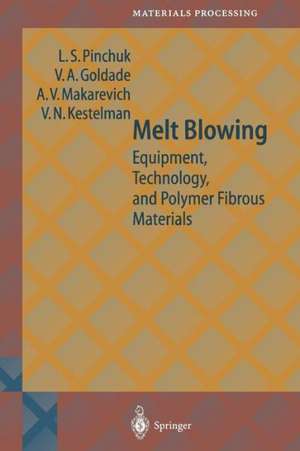
Melt Blowing: Springer Series in Materials Processing
Autor L. S. Pinchuk, Vi. A. Goldade, A. V. Makarevich, V. N. Kestelmanen Limba Engleză Paperback – 5 noi 2012
Preț: 386.76 lei
Puncte Express: 580
Carte tipărită la comandă
Livrare economică 01-15 decembrie
Livrare prin curier în România Termenul estimat este afișat lângă disponibilitate.
Transport gratuit de la 400.00 lei Plată online sau ramburs, în funcție de opțiunile comenzii.
Retur gratuit în 14 zile Comandă securizată și suport în română.
Specificații
ISBN-13: 9783642627859
ISBN-10: 3642627854
Pagini: 228
Ilustrații: XII, 212 p.
Dimensiuni: 155 x 235 x 13 mm
Greutate: 0.35 kg
Ediția:Softcover reprint of the original 1st ed. 2002
Editura: Springer
Colecția Springer Series in Materials Processing
Seria Springer Series in Materials Processing
Locul publicării:Berlin, Heidelberg, Germany
ISBN-10: 3642627854
Pagini: 228
Ilustrații: XII, 212 p.
Dimensiuni: 155 x 235 x 13 mm
Greutate: 0.35 kg
Ediția:Softcover reprint of the original 1st ed. 2002
Editura: Springer
Colecția Springer Series in Materials Processing
Seria Springer Series in Materials Processing
Locul publicării:Berlin, Heidelberg, Germany
V-ar putea interesa
-
 -31%Preț: 370.46 lei534.05 lei
 -
 NMR Imaging of MaterialsBernhard Blumich-33%Preț: 675.62 lei1011.80 lei
 -
 Micromanufacturing ProcessesV. K. Jain-18%Preț: 1266.82 lei1544.90 lei
 -
 Materials Science of Polymers for Engineers 3eTim A. Osswald-18%Preț: 701.99 lei856.08 lei
 -
 Nanometer-Scale Defect Detection Using Polarized LightPierre-Richard Dahoo-9%Preț: 1022.22 lei1123.32 lei
 -
 Technologie/Technik FormelsammlungAlfred BögePreț: 274.21 lei
 -
 Springer Handbook of Metrology and TestingHorst Czichos-18%Preț: 1924.34 lei2346.76 lei
 -
 Spiral Grain and Wave Phenomena in Wood FormationJohn M. Harris-15%Preț: 614.24 lei722.63 lei
 -
 Liquid ExplosivesJiping Liu-18%Preț: 988.04 lei1204.93 lei
Public țintă
ResearchCuprins
1. Introduction (Historical Review).- 2. Melt Blowing Techniques.- 2.1 Main Technological Procedures.- 2.2 Modern Trends in Melt mowing Techniques.- 3. Equipment.- 3.1 Spray Heads.- 3.2 Auxiliary Equipment.- 4. Structure of Melt-Blown Polymer Fibrous Materials (PFM).- 4.1 Major Structural Parameters.- 4.2 Effect of Different Technological Regimes on PFM Structure.- 5. Specific Properties of Melt-Blown PFM.- 5.1 Physicochemical Characteristics.- 5.2 Electret Charge in Melt-Blown Materials.- 6. Fibrous Materials in Filtration Systems.- 6.1 Efficiency of Filtration Systems.- 6.2 Filtration Mechanisms.- 7. Electret Filtering PFM.- 7.1 Mechanism of PFM Polarization.- 7.2 Capillary Phenomena.- 7.3 Production Process and Properties of Electret PFM.- 7.4 Applications.- 8. Magnetic Filtering PFM.- 8.1 Backgro.- 8.2 Simulation of Magnetic Deposition in PFM.- 8.3 Theory versus Experiment.- 8.4 Magnetization of PFM.- 8.5 Magnetic Coagulation of Particles in PFM.- 8.6 Magnetic Capillary Phenomena.- 8.7 Serviceability of Magnetic PFM-Based Filters.- 9. Adsorptive and Microbicidal PFM.- 9.1 PFM Modified by Porous Adsorbents.- 9.2 PFM as Adsorbents of Oil Product8.- 9.3 Complex-Forming PFM.- 9.4 Adsorptive-Microbicidal PFM.- 10. PFM as Carriers of Microorganisms.- 10.1 Biofilters with Polymer Fibrous Biomass Carriers.- 10.2 Effect of Magnetic Fields on the Growth Proce8ses of Microorganisms.- 11. Other Applications of PFM.- 11.1 Household Uses.- 11.2 Industry.- 11.3 Construction.- 11.4 Medicine.- 11.5 Packing.- 11.6 Protection of Products and Environment.- 12. Ecological and Social Problems.- 12.1 Solution of Ecological Problems.- 12.2 Regeneration, Utilization, and Burial.- 12.3 Economic Estimates.- 13. Conclusion.- References.
Textul de pe ultima copertă
This book is devoted to a nontraditional class of materials which are manufactured by the melt-blowing process - i.e. by extrusion of polymer melt followed by fiber stretching with a gas stream. For the first time extensive data on classical and modern modifications of this technology are generalized and a review is given of extrusion head dies and subsidiary equipment. The text examines the structure and main properties of melt-blown materials as conditioned by peculiarities of overheated polymer melt spraying in oxidizing medium. Information is given about filtering mechanisms and the main types of polymer fibrous filtering materials: electret, magnetic, adsorptional, bactericidic and about carriers of microorganisms in biofilters. Social and ecological aspects of the application of melt-blown materials are analyzed.
Caracteristici
This book introduces the basics of a new class of materials, expected to have wide-ranging applications in future, with important economic consequences