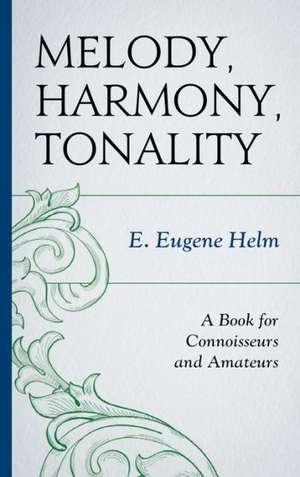
Melody, Harmony, Tonality: A Book for Connoisseurs and Amateurs
Autor E. Eugene Helmen Limba Engleză Hardback – 6 dec 2012
The answers to these seemingly complicated questions are not the sole province of music professors or orchestra conductors. In fact, as E. Eugene Helm demonstrates, they can just as easily be explained to amateurs, and their answers are important if we are to understand how Western music works. The full range of Western music is explored through 21 concise chapters on such topics as melody, harmony, counterpoint, texture, melody types, improvisation, music notation, free imitation, canon and fugue, vibration and its relation to harmony, tonality, and the place of music in architecture and astronomy. Intended for amateurs and professionals, concert-goers and conductors, Helm offers in down-to-earth language an explanation of the foundations of our Western music heritage, deepening our understanding and the listening experience of it for all.
Preț: 631.98 lei
Preț vechi: 842.42 lei
-25%
Puncte Express: 948
Carte tipărită la comandă
Livrare economică 14-28 noiembrie
Livrare prin curier în România Termenul estimat este afișat lângă disponibilitate.
Transport gratuit pentru acest produs Plată online sau ramburs, în funcție de opțiunile comenzii.
Retur gratuit în 14 zile Comandă securizată și suport în română.
Specificații
ISBN-13: 9780810886391
ISBN-10: 0810886391
Pagini: 198
Ilustrații: 1 BW Photo
Dimensiuni: 160 x 236 x 21 mm
Greutate: 0.43 kg
Editura: Bloomsbury Publishing
Colecția Scarecrow Press
Locul publicării:New York, United States
ISBN-10: 0810886391
Pagini: 198
Ilustrații: 1 BW Photo
Dimensiuni: 160 x 236 x 21 mm
Greutate: 0.43 kg
Editura: Bloomsbury Publishing
Colecția Scarecrow Press
Locul publicării:New York, United States
Cuprins
Preface
Chapter 1: Melody is Pure but Not So Simple
Chapter 2: Harmony, Unlike Melody, is Pure Only in Theory
Chapter 3: Our Usual Musical Menu is Melody with Subsidiary Accompaniment
Chapter 4: Counterpoint is a Harmonious Marriage of Independent Melodies
Chapter 5: Texture
Chapter 6: Special Mixtures of Texture
Chapter 7: East is East is Melody; West is West is Harmony
Chapter 8: The Universal Patterns of Melody: Melody Types
Chapter 9: Of the Earth, Earthy: Folk Music and its Role in Composition
Chapter 10: Improvisation Forever
Chapter 11: The Big Difference: Music Notation
Chapter 12: Canon, Free Imitation, Fugue: A Path to Musical Meaning
Chapter 13: Free Imitation: Canon with a Grain of Salt
Chapter 14: Fugue: The Whole Contrapuntal Bag of Tricks
Chapter 15: Harmony, the Governing Principle
Chapter 16: Music in Architecture
Chapter 17: Music in Astronomy
Chapter 18: Vibration, the New Paradigm
Chapter 19: The Harmonic Series
Chapter 20: Mapping the New Tonal Territory
Chapter 21: Tonality is Still Here
Notes
Suggest Further Reading
About the Author
Chapter 1: Melody is Pure but Not So Simple
Chapter 2: Harmony, Unlike Melody, is Pure Only in Theory
Chapter 3: Our Usual Musical Menu is Melody with Subsidiary Accompaniment
Chapter 4: Counterpoint is a Harmonious Marriage of Independent Melodies
Chapter 5: Texture
Chapter 6: Special Mixtures of Texture
Chapter 7: East is East is Melody; West is West is Harmony
Chapter 8: The Universal Patterns of Melody: Melody Types
Chapter 9: Of the Earth, Earthy: Folk Music and its Role in Composition
Chapter 10: Improvisation Forever
Chapter 11: The Big Difference: Music Notation
Chapter 12: Canon, Free Imitation, Fugue: A Path to Musical Meaning
Chapter 13: Free Imitation: Canon with a Grain of Salt
Chapter 14: Fugue: The Whole Contrapuntal Bag of Tricks
Chapter 15: Harmony, the Governing Principle
Chapter 16: Music in Architecture
Chapter 17: Music in Astronomy
Chapter 18: Vibration, the New Paradigm
Chapter 19: The Harmonic Series
Chapter 20: Mapping the New Tonal Territory
Chapter 21: Tonality is Still Here
Notes
Suggest Further Reading
About the Author