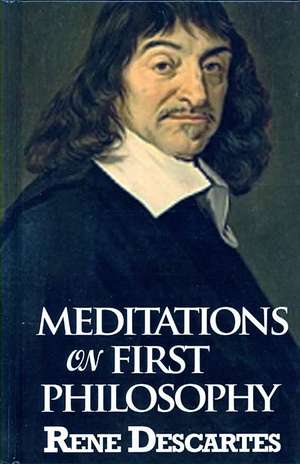
Meditations on First Philosophy
Autor Rene Descartesen Limba Engleză Hardback – 10 feb 2008
entity in the very exercise of doubt--in the famous formulation cogito, ergo sum--Descartes goes on to develop new conceptions of body and mind, capable of serving as foundations for a new science of nature. Subsequent philosophy has grappled with Descartes's ideas, but his arguments set the agenda
for many of the greatest philosophical thinkers, and their fascination endures. This new translation pays particular attention to Descartes's terminology and style, with its elaborate but beautifully lucid syntax, careful balancing, and rhetorical signposting. The wide-ranging introduction places
the work in the intellectual context of the time and discusses the nature of the work, its structure, key issues, and its influence on later thinkers. The book also includes notes, an up-to-date bibliography, a chronology, and an index.
Preț: 107.76 lei
Puncte Express: 162
Carte disponibilă
Livrare economică 29 octombrie-12 noiembrie
Livrare prin curier în România Termenul estimat este afișat lângă disponibilitate.
Transport gratuit de la 400.00 lei Plată online sau ramburs, în funcție de opțiunile comenzii.
Retur gratuit în 14 zile Comandă securizată și suport în română.
Specificații
ISBN-13: 9789562916189
ISBN-10: 9562916189
Pagini: 108
Dimensiuni: 145 x 222 x 10 mm
Greutate: 0.29 kg
Ediția:Revised
Editura: www.bnpublishing.com
ISBN-10: 9562916189
Pagini: 108
Dimensiuni: 145 x 222 x 10 mm
Greutate: 0.29 kg
Ediția:Revised
Editura: www.bnpublishing.com
V-ar putea interesa
-
 Discourse on Method and the MeditationsRene DescartesPreț: 90.50 lei
 -
 Meditations and Other Metaphysical WritingsRené Descartes-37%Preț: 57.89 lei92.44 lei
 -
 MeditationsRene Descartes-20%Preț: 44.30 lei55.70 lei
 -
 -18%Preț: 65.19 lei79.75 lei
 -
 Preț: 49.99 lei
 -
 MeditationsMarcus AureliusPreț: 33.79 lei
 -
 Descartes' Meditations on First PhilosophyKurt Brandhorst-14%Preț: 143.21 lei166.59 lei
 -
 Meditations on First PhilosophyRené Descartes-19%Preț: 71.33 lei87.98 lei
 -
 Meditations, Objections, and RepliesRené Descartes-18%Preț: 100.07 lei121.63 lei
 -
 Preț: 64.70 lei
 -
 The Great Philosophers: DescartesJohn Cottingham-29%Preț: 29.65 lei41.61 lei
 -
 Discourse on Method and Meditations on First PhilosophyRené Descartes-10%Preț: 93.71 lei104.04 lei
 -
 Discourse on MethodRene DescartesPreț: 61.76 lei
 -
 Descartes: The Renewal of PhilosophySteven Nadler-11%Preț: 129.84 lei146.44 lei
 -
 DescartesHarry M BrackenPreț: 78.90 lei
 -
 Key Philosophical WritingsRene DescartesPreț: 44.28 lei
 -
 An Analysis of Rene Descartes's Meditations on First PhilosophyAndreas VrahimisPreț: 56.61 lei
 -
 Descartes: The Story of a MindGianluca Mori-18%Preț: 683.44 lei833.45 lei
 -
 Discourse on Method and Meditations on First PhilosophyRene DescartesPreț: 54.65 lei
Descriere
Descriere de la o altă ediție sau format:
An Unabridged, Unaltered Printing of the Meditations of Descartes, seventh edition, Translated by John Veitch, To Include: Dedication - Preface - Synopsis of the Meditations - Meditations I through VI - with author's timeline at book's end.
Notă biografică
René Descartes (1596-1650) was a pioneering metaphysician, a masterful mathematician, and a significant scientific thinker. He was primarily a mathematician throughout his life, followed by a natural scientist or "natural philosopher" and a metaphysician. He created the methods in mathematics that allowed for algebraic (or "analytic") geometry. He co-formulated the sine rule of refraction, created a significant empirical account of the rainbow, and proposed a naturalistic explanation for how the earth and planets formed in natural philosophy, among other notable accomplishments. A world of matter with a few basic properties and interacting according to a few universal principles was his new conception of the natural world, which has influenced how we think about it even today. Descartes created the contemporary interpretation of the mind-body problem by proposing that this natural world had an immaterial mind that was directly tied to the brain in humans. He offered proof for the existence of God in metaphysics, demonstrating that the nature of matter is an extension and the essence of the mind is thought. Early on, Descartes asserted that he had a unique method, which he later claimed to have used in metaphysics, natural philosophy, and many applications of mathematics.