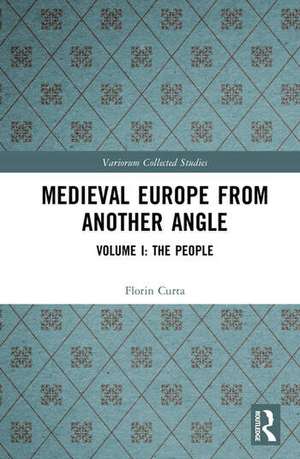
Medieval Europe From Another Angle: Volume I: The People: Variorum Collected Studies
Autor Florin Curtaen Limba Engleză Hardback – 29 mai 2025
This is the first volume of essays explicitly to reassess the significance of the region, as well as the role of the archaeological evidence in studying ethnicity in the Middle Ages, particularly in the case of the Slavs and the Avars. Because of its geographic, chronological, thematic, and methodological scope, this book offers a new perspective from a different angle on the analysis of the archaeological and written sources. Some chapters focus on settlement sites; others discuss artifacts from burial assemblages.
As well as advancing new models for the analysis of the written sources in relation to ethnicity, Medieval Europe from Another Angle offers new approaches to the understanding of how ethnicity may have been constructed in the Middle Ages in material culture terms. It will appeal to scholars and students alike studying Late Antiquity and the early Middle Ages with an interest in material culture and its use in building ethnic boundaries.
Din seria Variorum Collected Studies
- 18%
 Preț: 819.40 lei
 - 27%
 Preț: 1001.46 lei
 - 18%
 Preț: 817.97 lei
 - 8%
 Preț: 462.54 lei
 -
 Preț: 391.83 lei
 - 11%
 Preț: 397.81 lei
 - 18%
 Preț: 1347.90 lei
 - 27%
 Preț: 1406.25 lei
 - 18%
 Preț: 1349.92 lei
 - 15%
 Preț: 438.73 lei
 - 18%
 Preț: 817.97 lei
 - 18%
 Preț: 1348.92 lei
 -
 Preț: 418.49 lei
 - 18%
 Preț: 819.40 lei
 - 18%
 Preț: 819.40 lei
 - 18%
 Preț: 819.06 lei
 - 18%
 Preț: 819.76 lei
 - 18%
 Preț: 1346.09 lei
 - 18%
 Preț: 816.49 lei
 - 18%
 Preț: 818.25 lei
 -
 Preț: 442.70 lei
 -
 Preț: 352.37 lei
 -
 Preț: 472.65 lei
 - 18%
 Preț: 1348.23 lei
 - 18%
 Preț: 1147.81 lei
 - 18%
 Preț: 1348.03 lei
 - 18%
 Preț: 1354.95 lei
 -
 Preț: 398.09 lei
 -
 Preț: 417.44 lei
 -
 Preț: 396.84 lei
 - 18%
 Preț: 1349.39 lei
 -
 Preț: 504.76 lei
 - 18%
 Preț: 819.59 lei
 - 18%
 Preț: 1120.96 lei
 - 18%
 Preț: 902.77 lei
 - 18%
 Preț: 713.80 lei
 - 18%
 Preț: 1256.11 lei
 - 18%
 Preț: 726.26 lei
 - 18%
 Preț: 1013.62 lei
 - 18%
 Preț: 1261.45 lei
 -
 Preț: 418.73 lei
 - 18%
 Preț: 1112.48 lei
 - 18%
 Preț: 1066.58 lei
 - 18%
 Preț: 713.80 lei
 - 18%
 Preț: 1303.18 lei
 - 18%
 Preț: 724.85 lei
 - 23%
 Preț: 1750.26 lei
 - 18%
 Preț: 1071.02 lei
 - 18%
 Preț: 725.21 lei
 - 18%
 Preț: 1255.93 lei
Preț: 1121.80 lei
Preț vechi: 1368.04 lei
-18%
Puncte Express: 1683
Carte tipărită la comandă
Livrare economică 11-25 noiembrie
Livrare prin curier în România Termenul estimat este afișat lângă disponibilitate.
Transport gratuit pentru acest produs Plată online sau ramburs, în funcție de opțiunile comenzii.
Retur gratuit în 14 zile Comandă securizată și suport în română.
Specificații
ISBN-13: 9781032454696
ISBN-10: 1032454695
Pagini: 300
Ilustrații: 20
Dimensiuni: 156 x 234 x 21 mm
Greutate: 0.72 kg
Ediția:1
Editura: Taylor & Francis
Colecția Routledge
Seria Variorum Collected Studies
Locul publicării:Oxford, United Kingdom
ISBN-10: 1032454695
Pagini: 300
Ilustrații: 20
Dimensiuni: 156 x 234 x 21 mm
Greutate: 0.72 kg
Ediția:1
Editura: Taylor & Francis
Colecția Routledge
Seria Variorum Collected Studies
Locul publicării:Oxford, United Kingdom
Public țintă
Academic and PostgraduateCuprins
Introduction
Part I: East Central and Eastern Europe
1. East Central Europe: the gate to Byzantium
2. The archaeology of service settlements in Eastern Europe
Part II: Ethnicity in medieval archaeology
3. Medieval archaeology and ethnicity: where are we?
4. The elephant in the room. A reply to Sebastian Brather
Part III: Slavs and Avars
5. Slavs in Fredegar and Paul the Deacon: medieval gens of “scourge of God”?
6. Four questions for those who still believe in prehistoric Slavs and other fairy tales
7. Were there Slavs in seventh-century Macedonia?
8. The earliest Slavs in east central Europe? Remarks on the early medieval settlement in Nova Tabla (Slovenia)
9. An ironic smile: the Carpathian Mountains and the migration of the Slavs
10. The earliest Avar-age stirrups, or the “stirrup controversy” revisited
11. Avar Blitzkrieg, Slavic and Bulgar raiders, and Roman special ops: mobile warriors in the 6th-century Balkans
Bibliography
Part I: East Central and Eastern Europe
1. East Central Europe: the gate to Byzantium
2. The archaeology of service settlements in Eastern Europe
Part II: Ethnicity in medieval archaeology
3. Medieval archaeology and ethnicity: where are we?
4. The elephant in the room. A reply to Sebastian Brather
Part III: Slavs and Avars
5. Slavs in Fredegar and Paul the Deacon: medieval gens of “scourge of God”?
6. Four questions for those who still believe in prehistoric Slavs and other fairy tales
7. Were there Slavs in seventh-century Macedonia?
8. The earliest Slavs in east central Europe? Remarks on the early medieval settlement in Nova Tabla (Slovenia)
9. An ironic smile: the Carpathian Mountains and the migration of the Slavs
10. The earliest Avar-age stirrups, or the “stirrup controversy” revisited
11. Avar Blitzkrieg, Slavic and Bulgar raiders, and Roman special ops: mobile warriors in the 6th-century Balkans
Bibliography
Notă biografică
Florin Curta is Professor of Medieval History and Archaeology at the University of Florida. His books include Slavs in the Making (Routledge, 2021) and The Long Sixth Century in Eastern Europe (2021). He is also the editor of The Other Europe in the Middle Ages: Avars, Bulgars, Khazars, and Cumans (2008) and Neglected Barbarians (2011). Curta is the editor of the online Bibliography of the History and Archaeology of Eastern Europe in the Middle Ages, and co-editor of the series “East Central and Eastern Europe in the Middle Ages, 450–1450.”
Descriere
This is the first volume of essays explicitly to reassess the significance of the region, as well as the role of the archaeological evidence in studying ethnicity in the Middle Ages.