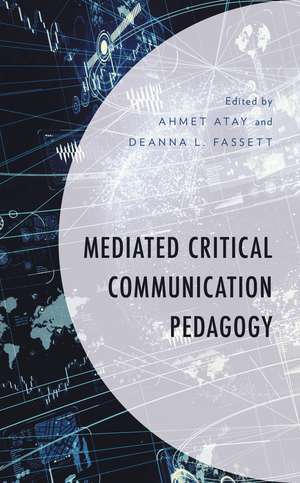
Mediated Critical Communication Pedagogy: Critical Communication Pedagogy
Editat de Ahmet Atay, Deanna L. Fassett Contribuţii de Allison D. Brenneise, Marcy R. Chvasta, Anthony Esposito, Tabitha Hart, David H. Kahl Jr., Yannick Kluch, Lara Martin Lengel, Jeremy M. Omori, Ronald K. Raymond, E. Michele Ramsey, Giuliana Sorce, Julie L. G. Walkeren Limba Engleză Hardback – 13 noi 2019
| Toate formatele și edițiile | Preț | Express |
|---|---|---|
| Paperback (1) | 209.73 lei 6-8 săpt. | |
| Bloomsbury Publishing – 23 mar 2023 | 209.73 lei 6-8 săpt. | |
| Hardback (1) | 554.93 lei 6-8 săpt. | |
| Bloomsbury Publishing – 13 noi 2019 | 554.93 lei 6-8 săpt. |



Preț: 554.93 lei
Preț vechi: 836.51 lei
-34%
Puncte Express: 832
Preț estimativ în valută:
98.10€ • 116.34$ • 85.10£
98.10€ • 116.34$ • 85.10£
Carte tipărită la comandă
Livrare economică 11-25 martie
Specificații
ISBN-13: 9781498568708
ISBN-10: 149856870X
Pagini: 236
Ilustrații: 1 tables;
Dimensiuni: 161 x 234 x 22 mm
Greutate: 0.52 kg
Editura: Bloomsbury Publishing
Colecția Lexington Books
Seria Critical Communication Pedagogy
Locul publicării:New York, United States
ISBN-10: 149856870X
Pagini: 236
Ilustrații: 1 tables;
Dimensiuni: 161 x 234 x 22 mm
Greutate: 0.52 kg
Editura: Bloomsbury Publishing
Colecția Lexington Books
Seria Critical Communication Pedagogy
Locul publicării:New York, United States
V-ar putea interesa
-
 SWAHILI: A Foundation for Speaking, Reading, and WritingThomas J. Hinnebusch-27%Preț: 279.25 lei380.87 lei
 -
 Espanol Para el Hispanohablante en los Estados UnidosAlfonso González-35%Preț: 456.91 lei699.89 lei
 -
 French Prepositions: Forms and UsageTrudie Maria Booth-29%Preț: 474.43 lei667.22 lei
 -
 -24%Preț: 306.39 lei403.95 lei
 -
 The Italian Language TodayAnna Laura Lepschy-17%Preț: 105.17 lei126.95 lei
 -
 Skill Building for ESL and Special Education: Student WorkbookKristine Setting Clark-26%Preț: 208.77 lei283.15 lei
 -
 Preț: 136.66 lei
 -
 SpanishPublishing, LindquistPreț: 107.49 lei
 -
 Russian LanguageArtemiy BelyaevPreț: 81.34 lei
 -
 Elementary Italian (Revised First Edition, Color)Jessica Greenfield-19%Preț: 543.89 lei671.47 lei
 -
 Preț: 107.77 lei
 -
 Unforgettable French (2nd Edition)Maria Rice-JonesPreț: 148.53 lei
 -
 Preț: 160.43 lei
Cuprins
Chapter 1: Questioning Dialogue, Arguing Dissemination, and Cultivating Generative Doubt
Chapter 2: Mitigating Pedagogical Marginalization: Critically Assessing the Use of Mediated Communication with Special Populations of Students
Chapter 3: Learning from One Another: Con/Divergences with/in/between Online Pedagogy, Andragogy, and Critical Pedagogy
Chapter 4: New Media, New Possibilities: Engaging Diversity
Chapter 5: Critiquing Hegemony through Mediated Critical Communication Pedagogy:Key Questions for Critical Media Analysis
Chapter 6: Critical Engagement or Critical Mistake?: Social Media, Ethics, and Critical Communication Pedagogy
Chapter 7: Applying Critical Communication Pedagogy Through Online Discussions on Stereotypes and Prejudicial Speech
Chapter 8: Beyond the Classroom Walls: The Intersection of Critical Communication Pedagogy and Public Pedagogy as Evidenced in "Let's Plays"
Chapter 9: Expanding Mediated Communication for Inclusivity
Chapter 10: Building Critical Feminist Media Literacy with Hot Girls Wanted: Discussing Gender, Sexuality, and Labor in the Age of Internet Pornography
Chapter 11: Critical Communication Pedagogy and Film
Chapter 2: Mitigating Pedagogical Marginalization: Critically Assessing the Use of Mediated Communication with Special Populations of Students
Chapter 3: Learning from One Another: Con/Divergences with/in/between Online Pedagogy, Andragogy, and Critical Pedagogy
Chapter 4: New Media, New Possibilities: Engaging Diversity
Chapter 5: Critiquing Hegemony through Mediated Critical Communication Pedagogy:Key Questions for Critical Media Analysis
Chapter 6: Critical Engagement or Critical Mistake?: Social Media, Ethics, and Critical Communication Pedagogy
Chapter 7: Applying Critical Communication Pedagogy Through Online Discussions on Stereotypes and Prejudicial Speech
Chapter 8: Beyond the Classroom Walls: The Intersection of Critical Communication Pedagogy and Public Pedagogy as Evidenced in "Let's Plays"
Chapter 9: Expanding Mediated Communication for Inclusivity
Chapter 10: Building Critical Feminist Media Literacy with Hot Girls Wanted: Discussing Gender, Sexuality, and Labor in the Age of Internet Pornography
Chapter 11: Critical Communication Pedagogy and Film
Recenzii
This edited collection from Atay (College of Wooster) and Fassett (San José State Univ.) is a timely release, given the rise of "alternative facts," "fake news," and Twitter today. Contributors examine provocative themes ranging from the significance of diversity in mediated critical communication pedagogy to the use of film as a conduit to the application of critical communication pedagogy while interrogating possibilities for maximizing theory and praxis in classrooms. Another key contribution is the synthesis of several concepts, such as mediated communication and critical communication pedagogy, to create new ways of talking about complex relations between media and technology uses and teaching and learning communication. Of particular significance is the contributors' attention to issues of social justice, diversity, equity, and inclusion in the classroom. For instance, David Kahl Jr.'s chapter makes a compelling case for how mediated communication can promote "special" student populations' marginalization in the classroom, and Allison Brenneise proposes a new, universal design for communication learning to advance ways teachers can reach diverse learners through new media technologies. This collection is a useful resource for scholars and students in communication education, instructional communication, media studies, and critical cultural studies. Summing Up: Highly recommended. Upper-division undergraduates through faculty.
For those who believe Critical Communication Pedagogy to be vital to the contemporary university classroom, Ahmet Atay and Deanna L. Fassett offer a compelling collection of essays that provide both scholarly insights and practical implications for teaching and learning. Readers will be challenged--and sometimes provoked--in the best possible way!
Mediated Critical Communication Pedagogy explores how mediated forms translate-communicate-the abstract into the everyday. The accessibility of the writing makes Mediated Critical Communication Pedagogy an excellent undergraduate or graduate textbook for courses in critical media or education. Mediated Critical Communication Pedagogy is also ideal for instructors looking to apply the teaching and learning tools across many disciplines, not just communication. This anthology also theorizes and challenges the role of mediated pedagogical practices in our classrooms and public spaces. The editors and authors ask important questions-and provide relevant, applicable answers-about the liberating and constraining aspects of our mediated lives.
For those who believe Critical Communication Pedagogy to be vital to the contemporary university classroom, Ahmet Atay and Deanna L. Fassett offer a compelling collection of essays that provide both scholarly insights and practical implications for teaching and learning. Readers will be challenged--and sometimes provoked--in the best possible way!
Mediated Critical Communication Pedagogy explores how mediated forms translate-communicate-the abstract into the everyday. The accessibility of the writing makes Mediated Critical Communication Pedagogy an excellent undergraduate or graduate textbook for courses in critical media or education. Mediated Critical Communication Pedagogy is also ideal for instructors looking to apply the teaching and learning tools across many disciplines, not just communication. This anthology also theorizes and challenges the role of mediated pedagogical practices in our classrooms and public spaces. The editors and authors ask important questions-and provide relevant, applicable answers-about the liberating and constraining aspects of our mediated lives.