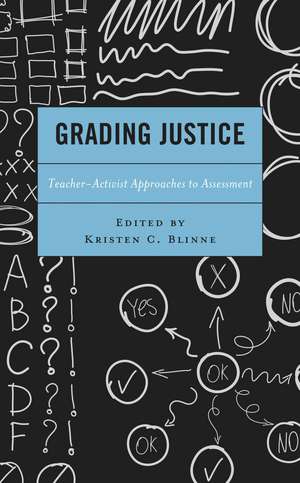
Grading Justice: Teacher-Activist Approaches to Assessment: Critical Communication Pedagogy
Editat de Kristen C. Blinne Contribuţii de Allison D. Brenneise, Mark J. Congdon Jr., Summer Cunningham, David Deifell, Leandra Hinojosa Hernández, David H. Kahl Jr., Londie T. Martin, Kristen McIntyre, Juliane Mora, David Palmer, C. Kyle Rudick, Sarah Uptonen Limba Engleză Hardback – 11 ian 2021



Preț: 694.46 lei
Preț vechi: 1055.77 lei
-34%
Puncte Express: 1042
Carte tipărită la comandă
Livrare economică 24 noiembrie-08 decembrie
Livrare prin curier în România Termenul estimat este afișat lângă disponibilitate.
Transport gratuit pentru acest produs Plată online sau ramburs, în funcție de opțiunile comenzii.
Retur gratuit în 14 zile Comandă securizată și suport în română.
Specificații
ISBN-13: 9781793609557
ISBN-10: 1793609551
Pagini: 555
Ilustrații: 2 b/w illustrations;8 tables;
Dimensiuni: 161 x 228 x 34 mm
Greutate: 0.72 kg
Editura: Bloomsbury Publishing
Colecția Lexington Books
Seria Critical Communication Pedagogy
Locul publicării:New York, United States
ISBN-10: 1793609551
Pagini: 555
Ilustrații: 2 b/w illustrations;8 tables;
Dimensiuni: 161 x 228 x 34 mm
Greutate: 0.72 kg
Editura: Bloomsbury Publishing
Colecția Lexington Books
Seria Critical Communication Pedagogy
Locul publicării:New York, United States
Cuprins
Table of Contents
Acknowledgments
Introduction: Grieving (Un)Grading (In)Justices
Kristen C. Blinne
1- Rhetoric of Grades: Evaluating Student Work and Its Consequences
David Deifell
2- Mobilizing a Critical Universal Design for Learning Framework for Justice Minded Course Design and Assessment
Mark Congdon Jr. and Allison D. Brenneise
3- Honoring Viviencias: A Borderlands Approach to Higher Education Pedagogy Justice
Leandra H. Hernandez and Sarah De Los Santos Upton
4- Walking the Tightrope: Navigating the Tensions of Teaching and Grading Communication Content Inside and Outside the Discipline
Juliane Mora
5- Student-Activist Mentor Letters as a Form of Social Movement-Building in Communication Activism Pedagogy
David L. Palmer
6- Love Letters Gone Wrong: Complicating the Romantic Ideal of Democratic Processes in the College Classroom
Londie T. Martin and Kristen A. McIntyre
7- Are We Just Grading or Grading Justly?: Adventures with Non-Traditional
Assessment
Acknowledgments
Introduction: Grieving (Un)Grading (In)Justices
Kristen C. Blinne
1- Rhetoric of Grades: Evaluating Student Work and Its Consequences
David Deifell
2- Mobilizing a Critical Universal Design for Learning Framework for Justice Minded Course Design and Assessment
Mark Congdon Jr. and Allison D. Brenneise
3- Honoring Viviencias: A Borderlands Approach to Higher Education Pedagogy Justice
Leandra H. Hernandez and Sarah De Los Santos Upton
4- Walking the Tightrope: Navigating the Tensions of Teaching and Grading Communication Content Inside and Outside the Discipline
Juliane Mora
5- Student-Activist Mentor Letters as a Form of Social Movement-Building in Communication Activism Pedagogy
David L. Palmer
6- Love Letters Gone Wrong: Complicating the Romantic Ideal of Democratic Processes in the College Classroom
Londie T. Martin and Kristen A. McIntyre
7- Are We Just Grading or Grading Justly?: Adventures with Non-Traditional
Assessment
Recenzii
A conceptually rich and pedagogically innovative collection of essays that will inspire and guide all communication educators, but especially critical communication teacher-activists who promote social justice, to think carefully about and employ grading/assessment practices that are socially just.
All across higher education, faculty grumble about doing their grading while students complain about how they were graded; administrators want more assessments from departments while accrediting institutions want more evaluations from colleges; the Old Guard argues for holding the line on norms that were never fair while disruptors experiment with methods that can leave you scratching your head in wonder. We educators are awash in grading disputes and debates about evaluation-and it is driving us mad. Grading Justice dives into this dilemma with gusto, good advice, and compelling case studies demonstrating how to think about grading as an exercise in building educational communities rooted in an ethic of care. Grading Justice demonstrates that the process of grading each student can be inclusive, transparent, and fair; more broadly, it argues that rethinking our practices around grading constitutes a first step toward reimagining the relationships between education, civic engagement, and social justice.
This collection of writings is an intervention into the taken-for-granted praxis of traditional-and unjust-modes of assessment and grading. The contributions herein are personal, political, analytical, critical, insightful, and helpful, all pointing toward a more humane and compassionate pedagogy. I invite all teachers, students, and administrators to read this book and seriously reconsider how we value and evaluate learning and education. It's time for change, and this book is calling us to action.
In Grading Justice, Kristen Blinne calls readers to interrogate the multiple ways assessment systems often perpetuate injustices in the college classroom and beyond. New and seasoned professors will find insights for critically reflecting on their own assessment practices and deploying communication pedagogies for social justice. I highly recommend this book for communication graduate students in pedagogy courses.
I have been teaching at the college level for almost 30 years now and have always wished for the broad scope of ideas, experiences, and praxis of grading that this collection brings together. This book reads like a compass toward grading justice while expertly avoiding the more typical how-to approach often found in assessment scholarship. I have come out full of new ideas and grading possibilities, further questions and imaginations about grading justly, and a renewed reassurance that the pervasive and complex issue of assessment is finally being confronted and interrogated ever gently and with the missing compassion by a critical studies lens. I look forward to using it in my classes and scholarship in years to come.
All across higher education, faculty grumble about doing their grading while students complain about how they were graded; administrators want more assessments from departments while accrediting institutions want more evaluations from colleges; the Old Guard argues for holding the line on norms that were never fair while disruptors experiment with methods that can leave you scratching your head in wonder. We educators are awash in grading disputes and debates about evaluation-and it is driving us mad. Grading Justice dives into this dilemma with gusto, good advice, and compelling case studies demonstrating how to think about grading as an exercise in building educational communities rooted in an ethic of care. Grading Justice demonstrates that the process of grading each student can be inclusive, transparent, and fair; more broadly, it argues that rethinking our practices around grading constitutes a first step toward reimagining the relationships between education, civic engagement, and social justice.
This collection of writings is an intervention into the taken-for-granted praxis of traditional-and unjust-modes of assessment and grading. The contributions herein are personal, political, analytical, critical, insightful, and helpful, all pointing toward a more humane and compassionate pedagogy. I invite all teachers, students, and administrators to read this book and seriously reconsider how we value and evaluate learning and education. It's time for change, and this book is calling us to action.
In Grading Justice, Kristen Blinne calls readers to interrogate the multiple ways assessment systems often perpetuate injustices in the college classroom and beyond. New and seasoned professors will find insights for critically reflecting on their own assessment practices and deploying communication pedagogies for social justice. I highly recommend this book for communication graduate students in pedagogy courses.
I have been teaching at the college level for almost 30 years now and have always wished for the broad scope of ideas, experiences, and praxis of grading that this collection brings together. This book reads like a compass toward grading justice while expertly avoiding the more typical how-to approach often found in assessment scholarship. I have come out full of new ideas and grading possibilities, further questions and imaginations about grading justly, and a renewed reassurance that the pervasive and complex issue of assessment is finally being confronted and interrogated ever gently and with the missing compassion by a critical studies lens. I look forward to using it in my classes and scholarship in years to come.