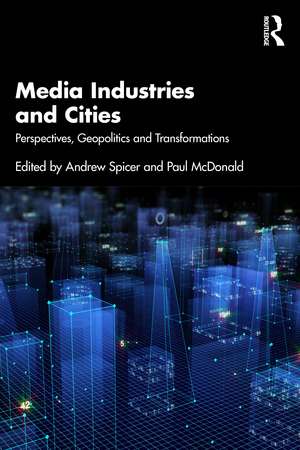
Media Industries and Cities: Perspectives, Geopolitics and Transformations
Editat de Andrew Spicer, Paul McDonalden Limba Engleză Paperback – 29 mai 2026
Written by field experts and based on extensive primary research, this book provides readers with comprehensive analysis of the complex relationship between media industries and cities across diverse global contexts. The twelve chapters examine examples from Asia, Europe and North America, covering film, television, music, games and journalism to demonstrate how media–city relationships take distinctive forms in specific locations. Readers will gain in-depth understanding of how global media flows interact with local urban contexts, and how these interactions produce cultural, economic, political and social consequences. The collection combines broad theoretical analysis with detailed case studies, advancing debates in the field of Media Industry Studies through analysing the media’s multifaceted relationship to cities in a highly accessible way.
This book is essential reading for undergraduates, postgraduates and academic researchers in Communications, Cultural Studies, Media Studies and Film and Television Studies, particularly those studying or researching media industries, global media flows, media economics, cultural production and the intersection of media and place.
Preț: 381.82 lei
Puncte Express: 573
Carte disponibilă
Livrare economică 13-27 noiembrie
Livrare express 30 octombrie-05 noiembrie pentru 32.17 lei
Livrare prin curier în România Termenul estimat este afișat lângă disponibilitate.
Transport gratuit de la 400.00 lei Plată online sau ramburs, în funcție de opțiunile comenzii.
Retur gratuit în 14 zile Comandă securizată și suport în română.
Specificații
ISBN-13: 9781032811673
ISBN-10: 1032811676
Pagini: 272
Ilustrații: 76
Dimensiuni: 156 x 234 mm
Greutate: 0.39 kg
Ediția:1
Editura: Taylor & Francis
Colecția Routledge
Locul publicării:Oxford, United Kingdom
ISBN-10: 1032811676
Pagini: 272
Ilustrații: 76
Dimensiuni: 156 x 234 mm
Greutate: 0.39 kg
Ediția:1
Editura: Taylor & Francis
Colecția Routledge
Locul publicării:Oxford, United Kingdom
V-ar putea interesa
-
 Understanding MediaJames CurranPreț: 93.58 lei
 -
 African Energy Worlds in Film and MediaCarmela GarritanoPreț: 202.97 lei
 -
 Media DisruptedAmanda D LotzPreț: 190.52 lei
 -
 Mobile CityJordan H. KraemerPreț: 240.57 lei
 -
 Media Industry StudiesDaniel HerbertPreț: 100.90 lei
 -
 Preț: 141.30 lei
 -
 The Love FixRachel ThompsonPreț: 137.14 lei
 -
 International Communication: Continuity and ChangeDaya Kishan Thussu-24%Preț: 191.87 lei251.68 lei
 -
 Year of the RatHarry ShukmanPreț: 106.72 lei
 -
 Take Me to the RiverJackie KempPreț: 144.22 lei
 -
 MiddlelandRory StewartPreț: 159.93 lei
 -
 Preț: 94.27 lei
 -
 -20%Preț: 102.61 lei127.52 lei
 -
 Immortal GesturesDamon YoungPreț: 92.32 lei
 -
 The Sirens' CallChris HayesPreț: 145.95 lei
 -
 Single and PsychoCaroline YoungPreț: 93.56 lei
 -
 Vinyl NYCJames & Karla MurrayPreț: 282.13 lei
 -
 -23%Preț: 227.56 lei296.75 lei
 -
 New Geographies of Music 2Séverin GuillardPreț: 336.20 lei
Public țintă
Postgraduate and Undergraduate AdvancedCuprins
The Nexus of Media Industries and Cities Part I: Conceptual Groundings 1. Media Industries In/Between Cities: Intracity and Intercity Embeddings 2. Transnational Media Corporations in Global Media Cities Part II: Media Production Hubs and Urban Transformations 3. Media Cities and the Reconstruction of Space and Place: MediaCityUK 4. Digital Media City Seoul: Creating a Korean Hollywood 5. Re-Branding Taipei Through Cinema: Municipal Policies and Cultural Strategies 6. Tracing an Alternative Cinema Ecosystem in Mumbai 7. Mavericks, Black Moguls and Outkasts: Atlanta’s ‘Southern Hospitality’ and the Making of a Service Media Capital 8. Broadcasting Spaces: Public Service Media, Built Environment and Regional Transformation in the UK Part III: Perspectives on Cities as Loci of Media Industries 9. The Place and Placelessness of the BFI London Film Festival 10. Ethnoburban Exhibition in Los Angeles 11. ‘Weird’ Austin: The Attraction of Local Event Imaginaries for Global Industry Networks 12. Representing Southeast Asia in Sino-Singaporean Television: The Geopolitics of Coproducing Place in Transnational Media Production
Notă biografică
Andrew Spicer is Professor of Cultural Production at the University of the West of England, Bristol. His recent publications include Sean Connery: Acting, Stardom and National Identity (2022); Go West! 2.5: Bristol’s Film and Television Industries (2025), co-authored with Jelena Krivosic; and The Politics of Place: Space and Location in European Screen Industries (2026) co-edited with Ruth Barton and Amy Genders.
Paul McDonald is Professor of Media Industries at King’s College London. Recent publications include editing The Routledge Companion to Media Industries (2022), and co-editing Locating Media Industries: Spaces, Places, Platforms (2026), Global Film Policies: New Perspectives (2025), and Digital Media Distribution: Portals, Platforms, Pipelines (2021).
Paul McDonald is Professor of Media Industries at King’s College London. Recent publications include editing The Routledge Companion to Media Industries (2022), and co-editing Locating Media Industries: Spaces, Places, Platforms (2026), Global Film Policies: New Perspectives (2025), and Digital Media Distribution: Portals, Platforms, Pipelines (2021).
Recenzii
'A long-overdue corrective to two conversations that have too often talked past one another, this volume shows — with analytical precision — that media industries are not only shaped by cities but actively shape them. It directly addresses the blind spot whereby critical media industry studies have sidelined spatiality while urban scholarship has flattened industrial complexity, and it demonstrates how urban media studies can bridge that divide with rigor rather than rhetoric.
By asking how, why and with what consequences cities become centres for media, the collection maps the local textures of production onto globally stretched circuits of capital, technology and labour, and in doing so locates media power in concrete urban sites as well as across transurban networks. It moves deftly from conceptual reframings of clusters and "places of flows", to comparative cases that range from MediaCityUK’s regeneration politics to Taipei’s cinematic city-branding, Atlanta’s ascendance as a service media capital, and the office geographies of platform-era transnational firms.
The result is a sharp, field-defining agenda that anchors media industry analysis to the material and symbolic life of cities — and gives urban studies a far more nuanced account of how media actually works'.
Petr Szczepanik, Charles University, Prague
'This collection shows, unequivocally, that cities still matter to media industries, even in an era of hypermobility. Each of its richly textured chapters persuasively re-centre space and place within media studies research, positioning the book as an essential intervention and enduring reference point for future scholarship'.
Kevin Sanson, Queensland University of Technology, and author of Mobile Hollywood: Labor and the Geography of Production
By asking how, why and with what consequences cities become centres for media, the collection maps the local textures of production onto globally stretched circuits of capital, technology and labour, and in doing so locates media power in concrete urban sites as well as across transurban networks. It moves deftly from conceptual reframings of clusters and "places of flows", to comparative cases that range from MediaCityUK’s regeneration politics to Taipei’s cinematic city-branding, Atlanta’s ascendance as a service media capital, and the office geographies of platform-era transnational firms.
The result is a sharp, field-defining agenda that anchors media industry analysis to the material and symbolic life of cities — and gives urban studies a far more nuanced account of how media actually works'.
Petr Szczepanik, Charles University, Prague
'This collection shows, unequivocally, that cities still matter to media industries, even in an era of hypermobility. Each of its richly textured chapters persuasively re-centre space and place within media studies research, positioning the book as an essential intervention and enduring reference point for future scholarship'.
Kevin Sanson, Queensland University of Technology, and author of Mobile Hollywood: Labor and the Geography of Production
Descriere
This collection investigates how cities have become centres for media industries, examining how local operations are shaped by global flows of finance, technology, and creative labour, and how media industries contribute to urban identity and cultural life. This book is essential reading for undergraduates and researchers in Media Studies.