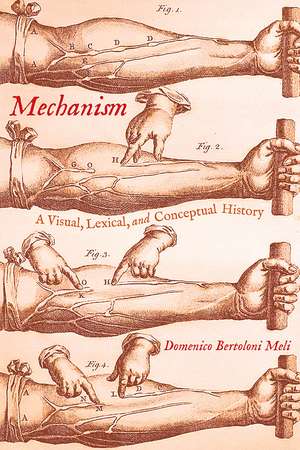
Mechanism: A Visual, Lexical, and Conceptual History
Autor Domenico Bertoloni Melien Limba Engleză Hardback – 2 apr 2019
Lucrarea Mechanism aduce o perspectivă nouă în istoriografia științei prin analiza triplă — vizuală, lexicală și conceptuală — a modului în care filozofia mecanică a modelat înțelegerea naturii. Spre deosebire de abordările pur teoretice, Domenico Bertoloni Meli investighează cum termenul „mecanism” a evoluat de la o expresie ambiguă la un concept central, capabil să explice totul, de la anatomie la natura sufletului. Suntem de părere că forța acestui volum rezidă în atenția acordată strategiei vizuale și modului în care reprezentările grafice au susținut argumentele filozofice în secolele XVI și XVII.
Autorul examinează contribuțiile unor figuri esențiale, de la Galen la Robert Boyle, dar se concentrează în mod special asupra lui Marcello Malpighi. Analiza problemelor legate de fecundație și generație prin prisma mecanismului oferă o claritate rară asupra dezbaterilor intelectuale complexe ale epocii. Mechanism este comparabil cu The Mechanization of Natural Philosophy de Sophie Roux în rigurozitate, dar este actualizat pentru o înțelegere mai profundă a intersecției dintre anatomie și filozofia materiei. Credem că această lucrare completează organic opera anterioară a lui Meli; dacă în Equivalence and Priority: Newton versus Leibniz s-a concentrat pe rigoarea matematică, iar în Thinking with Objects pe rolul dispozitivelor fizice, volumul de față sintetizează aceste direcții într-o istorie conceptuală a gândirii moderne.
Preț: 403.35 lei
Carte disponibilă
Livrare economică 14-28 noiembrie
Specificații
ISBN-10: 0822945479
Pagini: 232
Ilustrații: 58 Photos
Dimensiuni: 152 x 229 x 23 mm
Greutate: 0.43 kg
Ediția:1
Editura: University of Pittsburgh Press
Colecția University of Pittsburgh Press
V-ar putea interesa
-
 -27%Preț: 441.10 lei605.33 lei
 -
 How the Ray Gun Got Its Zap: Odd Excursions into OpticsStephen R. Wilk-11%Preț: 376.63 lei423.89 lei
 -
 -15%Preț: 671.56 lei790.08 lei
 -
 Thinking with ObjectsDomenico Bertoloni MeliPreț: 283.51 lei
 -
 Preț: 431.73 lei
 -
 -15%Preț: 474.35 lei558.05 lei
 -
 Preț: 440.78 lei
 -
 Global Scientific Practice in an Age of Revolutions, 1750-1850Patrick ManningPreț: 452.58 lei
 -
 Preț: 431.73 lei
 -
 Preț: 401.69 lei
 -
 Preț: 403.13 lei
 -
 Einstein's OpponentsMilena Wazeck-14%Preț: 1068.22 lei1242.11 lei
 -
 Animal Wonder WorldFrank W. LanePreț: 138.47 lei
 -
 Faraday, Maxwell, and the Electromagnetic FieldNancy ForbesPreț: 246.15 lei
 -
 The Tree of KnowledgeClaudio RonchiPreț: 247.73 lei
 -
 The Discourse of SensibilityHenry Martyn Lloyd-15%Preț: 665.89 lei783.39 lei
 -
 Direction of TimeSergio AlbeverioPreț: 411.03 lei
 -
 History and Evolution of Concepts in PhysicsHarry VarvoglisPreț: 503.21 lei
 -
 Reductionism, Emergence and Levels of RealitySergio Chibbaro-18%Preț: 978.51 lei1193.31 lei
 -
 -15%Preț: 1419.11 lei1669.54 lei
 -
 -18%Preț: 1274.46 lei1554.22 lei
 -
 Georg von Siemens: Ein Lebensbild aus Deutschlands großer ZeitKarl HelfferichPreț: 405.31 lei
 -
 Is Water H2O?Hasok Chang-18%Preț: 2019.74 lei2463.10 lei
De ce să citești această carte
Această carte este esențială pentru cercetătorii și studenții interesați de istoria ideilor și a științei. Cititorul câștigă o înțelegere nuanțată a modului în care metafora mașinii a cucerit gândirea europeană. Este o recomandare certă pentru cei care doresc să descopere cum s-a transformat limbajul științific și cum au influențat reprezentările vizuale primele teorii anatomice și biologice moderne.
Despre autor
Domenico Bertoloni Meli este profesor de istoria și filozofia științei la Indiana University. Expert recunoscut în transformările mecanicii din secolul al XVII-lea, Meli a explorat în lucrările sale anterioare tensiunile dintre marii gânditori ai iluminismului timpuriu și rolul obiectelor fizice în experimentul științific. Activitatea sa academică se concentrează pe intersecția dintre matematică, fizică și filozofie, fiind un cercetător erudit al manuscriselor lui Leibniz și al teoriilor lui Newton. În Mechanism, el își extinde expertiza către istoria lexicală și vizuală, oferind o sinteză matură a evoluției gândirii mecaniciste.
Descriere scurtă
Recenzii
“An interesting and original contribution. Bertoloni Meli’s book is well worth reading for its rich references and for the author's elegant writing.” —Metascience
“With great clarity, Bertoloni Meli presents us with a wealth of material on an intricate subject. His book complements recent scholarship, corrects erroneous interpretations, adds important reflections on the evolution of mechanical thinking, and thereby makes an outstanding contribution to early modern studies. His study may be acclaimed as a seminal text for our understanding of the mechanization of nature and of natural bodies in the seventeenth century and beyond.” —Early Science and Medicine
“Bertoloni Meli is an acknowledged maestro in this area of study. His crisp argument, unfolding via examples, case studies, textual or graphical analyses, and historiographical reflections, is aided by the extensive notes and bibliography . . . which can guide the interested reader’s follow-up on particular issues. . . . This erudite and energizing book redefines the problematic of early modern ‘mechanism.’” —Isis
“Bertoloni Meli’s Mechanism is a well-documented historical and philosophical work. . . . A substantive and well-argued book, erudite and rich in examples.” —Journal of Early Modern Studies