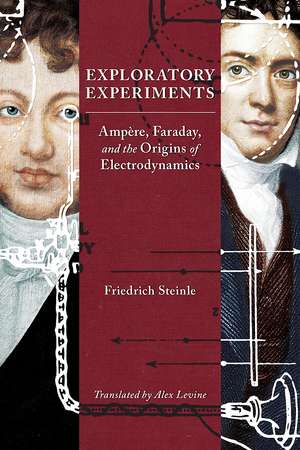
Exploratory Experiments: Ampère, Faraday, and the Origins of Electrodynamics
Autor Friedrich Steinle Traducere de Alex Levineen Limba Engleză Hardback – 18 mai 2016
Descoperim în Exploratory Experiments o analiză riguroasă a intersecției dintre istoria fizicii, filozofia științei și practica tehnologică a secolului al XIX-lea. Lucrarea semnată de Friedrich Steinle investighează modul în care experimentele exploratorii — acele demersuri care preced formularea unor teorii cristalizate — au stat la baza electrodinamicii moderne. Notăm cu interes cum autorul reușește să reconstruiască traiectoriile intelectuale divergente ale lui André-Marie Ampère și Michael Faraday, pornind de la descoperirea lui Ørsted din 1820.
Putem afirma că volumul extinde cadrul propus de Electrodynamics from Ampère to Einstein de Olivier Darrigol cu date noi extrase din arhive inedite, precum jurnale de laborator și corespondența cu artizanii de instrumente științifice. În timp ce Darrigol urmărește evoluția conceptelor pe termen lung, Steinle se concentrează pe micro-istoria practicii experimentale, oferind o perspectivă mult mai granulată asupra modului în care s-au născut conceptele fundamentale. Această abordare continuă preocuparea autorului pentru geneza ideilor științifice, temă centrală și în Scientific Concepts and Investigative Practice, unde analiza se mută de la teorii ca unități statice la procesul dinamic de formare a acestora.
Limbajul este de o precizie academică remarcabilă, beneficiind de traducerea premiată a lui Alex Levine. Structura celor 544 de pagini permite o incursiune detaliată în dezbaterea dintre teoria acțiunii la distanță și teoria câmpului, oferind un context istoric și epistemologic esențial pentru înțelegerea fundamentelor fizicii moderne. Este o resursă indispensabilă pentru cercetătorii care doresc să înțeleagă nu doar rezultatele finale ale științei, ci și „laboratorul” adesea haotic al descoperirii.
Preț: 474.39 lei
Preț vechi: 558.11 lei
-15%
Carte disponibilă
Livrare economică 07-21 noiembrie
Specificații
ISBN-10: 0822944502
Pagini: 544
Dimensiuni: 152 x 229 x 36 mm
Greutate: 0.82 kg
Ediția:1
Editura: University of Pittsburgh Press
Colecția University of Pittsburgh Press
V-ar putea interesa
-
 The Upright ThinkersLeonard MlodinowPreț: 116.25 lei
 -
 Galileo's Finger: The Ten Great Ideas of SciencePeter Atkins-17%Preț: 77.96 lei94.25 lei
 -
 Great Minds: Reflections of 111 Top ScientistsBalazs Hargittai-19%Preț: 380.54 lei467.19 lei
 -
 Nicolas-Louis De La Caille, Astronomer and GeodesistIan Stewart Glass-29%Preț: 537.87 lei752.27 lei
 -
 Preț: 165.86 lei
 -
 -20%Preț: 359.83 lei452.13 lei
 -
 Understanding Inconsistent SciencePeter Vickers-14%Preț: 622.13 lei723.41 lei
 -
 Crucible of Science: The Story of the Cori LaboratoryJohn H. Exton-28%Preț: 505.11 lei705.90 lei
 -
 -22%Preț: 205.97 lei263.09 lei
 -
 -15%Preț: 472.39 lei555.75 lei
 -
 Preț: 487.39 lei
 -
 Preț: 431.73 lei
 -
 -18%Preț: 855.29 lei1043.03 lei
 -
 Preț: 448.63 lei
 -
 Complexity and the Arrow of TimeCharles H. LineweaverPreț: 286.67 lei
 -
 Going Amiss in Experimental ResearchGiora Hon-15%Preț: 649.32 lei763.90 lei
 -
 GeometrySerge LangPreț: 464.80 lei
 -
 Scientific Concepts and Investigative PracticeFriedrich Steinle-23%Preț: 1478.99 lei1920.76 lei
De ce să citești această carte
Această monografie este esențială pentru istoricii și filozofii științei care caută o analiză documentată a tranziției către electrodinamică. Cititorul câștigă o înțelegere profundă a metodologiei experimentale de secol XIX, dincolo de miturile manualelor clasice. Este o recomandare fermă pentru cei interesați de modul în care instrumentele și practica de laborator modelează direct teoriile fizice fundamentale.
Despre autor
Friedrich Steinle este un distins istoric al științei, cunoscut pentru cercetările sale asupra perioadei iluminismului și a secolului al XIX-lea. În lucrări precum Ordering Colours in 18th and Early 19th Century Europe sau monografia dedicată lui Lavoisier, Steinle a explorat sistematic modul în care comunitățile științifice organizează cunoașterea și comunicarea tehnică. Expertiza sa în epistemologia experimentului este recunoscută internațional, volumul Exploratory Experiments reprezentând sinteza cercetărilor sale asupra modului în care investigația practică precede și fundamentează inovația conceptuală în fizică.
Descriere scurtă
In this foundational study, Friedrich Steinle compares the influential work of Ampère and Faraday to reveal the prominent role of exploratory experimentation in the development of science. While this exploratory phase was responsible for decisive conceptual innovations, it has yet to be examined in such great detail. Focusing on Ampère’s and Faraday’s research practices, reconstructed from previously unknown archival materials, including laboratory notes, diaries, letters, and interactions with instrument makers, this book considers both the historic and epistemological basis of exploratory experimentation and its importance to scientific development.
Winner of the 2017 Ungar German Translations Award from the American Translators Association
Recenzii
—Jutta Schickore, Indiana University
—Richard Burian, Virginia Tech
“Steinle is successful in presenting a fascinating picture of Ampère’s style in experimental praxis and in contextualizing his research program within the highly mathematized tradition of Laplacian physics.”
—Isis
“Steinle’s study can be recommended as a remarkable example of how to combine explicitly historical case studies with epistemological concepts in a manner that both parts benefit from the other. Moreover, the book is written very clearly and intelligibly. Therefore, readers who have no expertise in the history of electrodynamics will benefit from this study.”
—Nuncius
“This is a major contribution to scholarship on Ampère and Faraday. Steinle’s account of the interaction between exploratory experimentation and concept formation in Ampère’s and Faraday’s electrodynamic and electromagnetic work evinces a deep understanding of their concerns.”
—History and Philosophy of the Life Sciences
—Kevin Lambert, California State University Fullerton
Notă biografică
Alex Levine is professor of philosophy at the University of South Florida and editor of the journal Perspectives on Science. He is coauthor of From Man to Ape and Darwinistas He has published translations from German, French, and Spanish, including Paul Hoyningen-Huene’s Reconstructing Scientific Revolutions and Formal Logic: A Philosophical Approach.