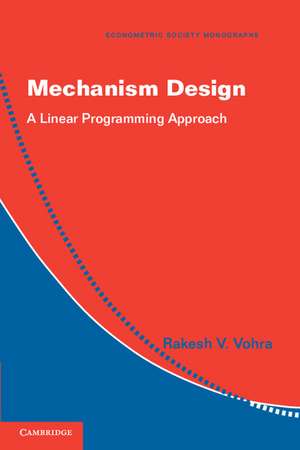
Mechanism Design: A Linear Programming Approach: Econometric Society Monographs, cartea 47
Autor Rakesh V. Vohraen Limba Engleză Paperback – 8 mai 2011
Considerăm că ceea ce diferențiază lucrarea Mechanism Design de restul literaturii de specialitate este utilizarea programării liniare nu doar ca instrument auxiliar, ci ca limbaj central de unificare. În timp ce alte tratate se bazează pe aparate matematice extrem de abstracte, Rakesh V. Vohra demonstrează că argumentele elementare pot oferi o transparență superioară în explicarea modului în care instituțiile pot atinge obiective specifice atunci când informația este dispersată. Abordarea sa diferă de cea din Designing Economic Mechanisms de Leonid Hurwicz prin faptul că este mai puțin axată pe structuri teoretice vaste și mult mai aplicabilă, oferind cititorului un set de unelte matematice concrete pentru a rezolva probleme care par insurmontabile prin metodele tradiționale.
Această carte reprezintă o evoluție naturală în opera autorului, rafinând conceptele prezentate în Advanced Mathematical Economics. Dacă în lucrările anterioare Rakesh V. Vohra explora fundamentele economiei matematice, aici el aplică acele principii pe o nișă critică: designul de reguli optimale pentru jocuri strategice. Structura cărții este riguros organizată, pornind de la Teorema lui Arrow și evoluând spre probleme de flux în rețea, compatibilitatea stimulentelor și maximizarea veniturilor. Această progresie indică o acoperire exhaustivă a domeniului, de la fundamentele alegerii sociale la mecanismele complexe de piață. Apreciem în mod deosebit modul în care autorul reușește să unifice rezultate din arii disparate ale teoriei economice folosind mașinăria programării liniare, oferind o perspectivă coerentă asupra eficienței și raționalizării.
Din seria Econometric Society Monographs
- 14%
 Preț: 1047.53 lei
 -
 Preț: 266.58 lei
 -
 Preț: 360.86 lei
 - 11%
 Preț: 400.75 lei
 -
 Preț: 371.20 lei
 -
 Preț: 295.78 lei
 -
 Preț: 335.72 lei
 -
 Preț: 376.55 lei
 -
 Preț: 411.29 lei
 -
 Preț: 336.22 lei
 - 11%
 Preț: 465.87 lei
 -
 Preț: 337.06 lei
 -
 Preț: 369.16 lei
 -
 Preț: 415.45 lei
 -
 Preț: 331.60 lei
 -
 Preț: 278.50 lei
 -
 Preț: 320.55 lei
 -
 Preț: 364.25 lei
 -
 Preț: 370.30 lei
 -
 Preț: 279.46 lei
 -
 Preț: 335.72 lei
 -
 Preț: 370.95 lei
 -
 Preț: 321.43 lei
 -
 Preț: 306.40 lei
 -
 Preț: 358.95 lei
 -
 Preț: 331.80 lei
 -
 Preț: 324.64 lei
 -
 Preț: 330.48 lei
 -
 Preț: 367.80 lei
 -
 Preț: 288.54 lei
 -
 Preț: 335.34 lei
Preț: 247.05 lei
Carte tipărită la comandă
Livrare economică 01-15 iulie
Specificații
ISBN-10: 0521179467
Pagini: 184
Ilustrații: 11 b/w illus.
Dimensiuni: 152 x 226 x 18 mm
Greutate: 0.27 kg
Editura: Cambridge University Press
Colecția Cambridge University Press
Seria Econometric Society Monographs
Locul publicării:New York, United States
V-ar putea interesa
-
 Before Sudoku: The World of Magic SquaresSeymour S Block-13%Preț: 130.37 lei150.02 lei
 -
 -23%Preț: 274.04 lei353.98 lei
 -
 Schelling's Game Theory: How to Make DecisionsRobert V. Dodge-11%Preț: 420.10 lei472.03 lei
 -
 Optimization-Theory and PracticeWilhelm Forst-15%Preț: 500.40 lei588.71 lei
 -
 Preț: 110.43 lei
 -
 Applied Integer ProgrammingDer-San Chen-9%Preț: 870.67 lei956.79 lei
 -
 Theory of Linear and Integer ProgrammingAlexander Schrijver-9%Preț: 763.95 lei839.50 lei
 -
 The Moscow PuzzlesBoris Kordemsky-20%Preț: 82.38 lei103.03 lei
 -
 Game TheoryMorton D. DavisPreț: 76.95 lei
 -
 -30%Preț: 2105.36 lei3021.36 lei
 -
 Graph-Related Optimization and Decision TheorySaoussen Krichen-20%Preț: 894.29 lei1117.87 lei
De ce să citești această carte
Recomandăm această carte studenților și cercetătorilor care doresc să stăpânească designul de mecanisme fără a se pierde în formalism excesiv. Veți câștiga o metodologie clară pentru a construi instituții și piețe eficiente, învățând cum să aliniați stimulentele individuale cu obiectivele colective. Este un instrument esențial pentru oricine vrea să înțeleagă arhitectura matematică din spatele licitațiilor și a sistemelor de alocare a resurselor.
Despre autor
Rakesh V. Vohra este profesor de economie managerială și științe ale deciziei la Kellogg School of Management, Universitatea Northwestern, unde conduce Centrul de Studii Matematice în Economie. Cu un doctorat solid în domeniu, Vohra este o autoritate recunoscută în economia matematică, fiind autorul unor lucrări de referință precum Advanced Mathematical Economics și Prices and Quantities. Expertiza sa acoperă domenii variate, de la teoria prețurilor până la optimizarea resurselor pe internet, fiind recunoscut pentru capacitatea de a simplifica concepte matematice complexe pentru aplicații economice practice.
Descriere scurtă
Cuprins
Recenzii
'Rakesh Vohra's exposition of the theory of mechanism design is wonderfully transparent and elegant. This short book equips the reader with a remarkably deep and comprehensive understanding of this important subject.' Tilman Borgers, University of Michigan
'Vohra convincingly demonstrates that linear programming can give a powerful and unified perspective on mechanism design, clarifying the ideas and methods underlying existing results, and leading in many cases to greater generality or new findings. Graduate students, researchers in other areas, and experienced mechanism designers will all benefit from this book, which will influence mechanism design research for years to come.' Andrew McLennan, University of Queensland
'Professor Vohra's rigorous text is unique in showing how numerous central results in mechanism design can be unified using the methodology of linear programming. His treatment is elegant and original, and it touches the most recent research frontiers.' Benny Moldovanu, University of Bonn
'Rakesh Vohra takes the reader from the basics of social choice theory and network flow problems to a deep understanding of optimal incentive systems for complex resource-allocation problems, using the mathematics of linear programming elegantly throughout the book.' Roger Myerson, University of Chicago and 2007 Nobel Laureate
'By situating the fundamental questions of social choice, incentive compatibility, and auction design within the theory of linear programming, Vohra is able to address the modern themes of mechanism design in a cohesive manner. The result is inspiring, enjoyable, and extremely compelling.' David Parkes, Harvard University
'This beautiful book provides an insightful and useful treatment of the fundamental theorems of social choice and mechanism design from the unifying and powerful perspective of linear programming. A terrific read covering a broad range of topics including a serious and rare treatment of multidimensional mechanism design.' Phillip J. Reny, University of Chicago
'The book does not assume any prior knowledge of mechanism design, but requires some familiarity with game theory, linear programming and convex analysis. As such, it is well suited to students and graduates of economic courses, but also to researchers and experienced mechanism designers.' Vangelis Grigoroudis, Zentralblatt MATH