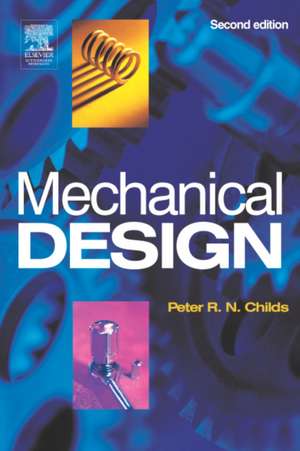
Mechanical Design
Autor P.R.N. Childsen Limba Engleză Paperback – 4 dec 2003
Descoperim în această a treia ediție a lucrării Mechanical Design o structură progresivă riguroasă, care ghidează cititorul de la definirea conceptuală a produsului până la implementarea tehnică detaliată. Autorul P.R.N. Childs adoptă metodologia SEED, definind proiectarea ca o activitate integrată menită să răspundă nevoilor pieței, nu doar ca un exercițiu tehnic izolat. Găsim în acest volum o trecere logică de la principiile fundamentale de inginerie mecanică spre calculul specific și selecția componentelor standard, precum arborii, angrenajele sau sistemele de etanșare.
Fiecare capitol este construit pentru a transforma teoria în competență practică. De exemplu, secțiunile dedicate angrenajelor nu se limitează la geometrie, ci integrează metodologiile de calcul al eforturilor conform standardelor ISO și AGMA. Ca și în Mechanical Design Engineering Handbook de Peter Childs, autorul distilează experiența reală în principii acționabile, oferind diagrame, fotografii și soluții pas cu pas pentru probleme complexe de proiectare. Această abordare practică este susținută de expertiza autorului în domenii conexe, vizibilă și în lucrarea sa anterioară Tribology for Energy Conservation, capitolele despre lubrifierea lagărelor și dinamica transmisiilor beneficiind de o rigoare științifică remarcabilă.
Structura cuprinsului reflectă o acoperire enciclopedică: după introducerea în elementele de mașini, textul avansează spre componente critice precum cuplajele, frânele și elementele de fixare, culminând cu capitole moderne despre senzori, actuatori și ingineria toleranțelor. Această ediție aduce noutăți esențiale privind carcasele și incintele, oferind o viziune de ansamblu asupra asamblării finale. Prin integrarea studiilor de caz și a fișelor de lucru rezolvate, Mechanical Design devine un instrument de lucru indispensabil pentru proiectarea sistemelor mecanice contemporane.
Preț: 342.93 lei
Preț vechi: 421.15 lei
-19%
Carte tipărită la comandă
Specificații
ISBN-10: 0750657715
Pagini: 384
Ilustrații: black & white illustrations
Dimensiuni: 189 x 246 x 21 mm
Greutate: 0.73 kg
Ediția:Revised
Editura: ELSEVIER SCIENCE
V-ar putea interesa
-
 Pipe Trades Pocket ManualMcGraw-HillPreț: 293.95 lei
 -
 Design of Machine ElementsMerhyle Franklin Spotts-23%Preț: 1641.58 lei2131.92 lei
 -
 Williams, D: Structural MechanicsD. Williams-11%Preț: 652.66 lei733.32 lei
 -
 Theory of Machines and MechanismsJohn J. Uicker, Jr.-25%Preț: 878.72 lei1169.36 lei
 -
 -31%Preț: 526.00 lei759.22 lei
 -
 Materials Selection in Mechanical DesignMichael F. Ashby-30%Preț: 455.56 lei654.07 lei
 -
 MechanicsJ. P. Den HartogPreț: 104.74 lei
 -
 Mechanical Engineers' Handbook, Volume 1Myer Kutz-23%Preț: 1140.90 lei1481.69 lei
 -
 Preț: 493.44 lei
 -
 Design of Mechanical ElementsBart Raeymaekers-23%Preț: 590.95 lei767.48 lei
 -
 -34%Preț: 395.30 lei600.82 lei
 -
 MechatronicsW. Bolton-11%Preț: 666.56 lei748.94 lei
 -
 -23%Preț: 412.01 lei535.90 lei
 -
 Dynamics and Mechanisms Design for Technology StudentsAnthony D´Angelo Jr.Preț: 311.60 lei
 -
 -15%Preț: 649.15 lei763.70 lei
 -
 Springer Handbook of Mechanical EngineeringKarl-Heinrich Grote-18%Preț: 2092.64 lei2552.00 lei
 -
 Mechanical and Metal Trades HandbookRoland GomeringerPreț: 331.30 lei
 -
 Machine Knitter's ReferenceBeleke Den HartogPreț: 185.45 lei
 -
 Fundamentals of Mechanisms and MachinesDhanesh N. Manik-18%Preț: 775.37 lei945.58 lei
Public țintă
Undergraduate students in Mechanical Engineering; Manufacturing Engineering; Industrial design; Automotive Engineering.De ce să citești această carte
Această carte este esențială pentru studenții și inginerii proiectanți care au nevoie de o metodologie clară pentru selecția și calculul componentelor mecanice. Dincolo de teorie, volumul oferă soluții concrete bazate pe standarde industriale (ISO, ANSI), pregătind cititorul pentru rigurozitatea mediului profesional din ingineria auto, robotică sau design industrial. Este un ghid practic care transformă conceptele abstracte în produse funcționale și sigure.
Descriere scurtă
The approach adopted for defining design follows that developed by the SEED (Sharing Experience in Engineering Design) programme where design is viewed as "the total activity necessary to provide a product or process to meet a market need." Within this framework the book concentrates on developing detailed mechanical design skills in the areas of bearings, shafts, gears, seals, belt and chain drives, clutches and brakes, springs and fasteners. Where standard components are available from manufacturers, the steps necessary for their specification and selection are developed.
The framework used within the text has been to provide descriptive and illustrative information to introduce principles and individual components and to expose the reader to the detailed methods and calculations necessary to specify and design or select a component. To provide the reader with sufficient information to develop the necessary skills to repeat calculations and selection processes, detailed examples and worked solutions are supplied throughout the text.
This book is principally a Year/Level 1 and 2 undergraduate text. Pre-requisite skills include some year one undergraduate mathematics, fluid mechanics and heat transfer, principles of materials, statics and dynamics. However, as the subjects are introduced in a descriptive and illustrative format and as full worked solutions are provided, it is possible for readers without this formal level of education to benefit from this book. The text is specifically aimed at automotive and mechanical engineering degree programmes and would be of value for modules in design, mechanical engineering design, design and manufacture, design studies, automotive power-train and transmission and tribology, as well as modules and project work incorporating a design element requiring knowledge about any of the content described.
The aims and objectives described are achieved by a short introductory chapters on total design, mechanical engineering and machine elements followed by ten chapters on machine elements covering: bearings, shafts, gears, seals, chain and belt drives, clutches and brakes, springs, fasteners and miscellaneous mechanisms. Chapters 14 and 15 introduce casings and enclosures and sensors and actuators, key features of most forms of mechanical technology. The subject of tolerancing from a component to a process level is introduced in Chapter 16. The last chapter serves to present an integrated design using the detailed design aspects covered within the book. The design methods where appropriate are developed to national and international standards (e.g. ANSI, ASME, AGMA, BSI, DIN, ISO).
The first edition of this text introduced a variety of machine elements as building blocks with which design of mechanical devices can be undertaken. The approach adopted of introducing and explaining the aspects of technology by means of text, photographs, diagrams and step-by-step procedures has been maintained. A number of important machine elements have been included in the new edition, fasteners, springs, sensors and actuators. They are included here. Chapters on total design, the scope of mechanical engineering and machine elements have been completely revised and updated. New chapters are included on casings and enclosures and miscellaneous mechanisms and the final chapter has been rewritten to provide an integrated approach. Multiple worked examples and completed solutions are included.
- New chapters on casings and enclosures, springs, and fasteners
- New information on important machine elements such as sensors and actuators
- Clear explanation of the total mechanical design process through the use of text, photographs, diagrams, step-by-step procedures and case studies
Cuprins
Recenzii
"Good general text for Mechanical Engineering Design courses. In depth look at gears, shafts, bearings, etc. "
"Excellent for detailed design studies."
"An excellent txt to help students design specific components for a particular design application. This book is an excellent source of procedural and theoretical information. Highly recommended."
Descriere
Mechanical Design: Theory and Applications, Third Edition introduces the design and selection of common mechanical engineering components and machine elements, hence providing the foundational "building blocks" engineers needs to practice their art. In this book, readers will learn how to develop detailed mechanical design skills in the areas of bearings, shafts, gears, seals, belt and chain drives, clutches and brakes, and springs and fasteners. Where standard components are available from manufacturers, the steps necessary for their specification and selection are thoroughly developed.
Descriptive and illustrative information is used to introduce principles, individual components, and the detailed methods and calculations that are necessary to specify and design or select a component. As well as thorough descriptions of methodologies, this book also provides a wealth of valuable reference information on codes and regulations.
- Presents new material on key topics, including actuators for robotics, alternative design methodologies, and practical engineering tolerancing
- Clearly explains best practice for design decision-making
- Provides end-of-chapter case studies that tie theory and methods together
- Includes up-to-date references on all standards relevant to mechanical design, including ASNI, ASME, BSI, AGMA, DIN and ISO