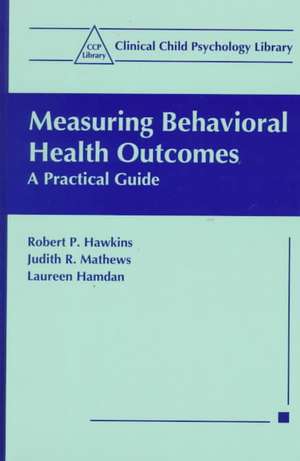
Measuring Behavioral Health Outcomes: Clinical Child Psychology Library
Autor Robert P. Hawkins, Judith R. Mathews, Laureen Hamdanen Limba Engleză Hardback – 31 mar 1999



Preț: 358.60 lei
Preț vechi: 377.47 lei
-5%
Puncte Express: 538
Carte tipărită la comandă
Livrare economică 12-26 noiembrie
Livrare prin curier în România Termenul estimat este afișat lângă disponibilitate.
Transport gratuit de la 400.00 lei Plată online sau ramburs, în funcție de opțiunile comenzii.
Retur gratuit în 14 zile Comandă securizată și suport în română.
Specificații
ISBN-13: 9780306460807
ISBN-10: 0306460807
Pagini: 208
Ilustrații: XIV, 191 p.
Dimensiuni: 160 x 241 x 17 mm
Greutate: 0.48 kg
Ediția:1999
Editura: Springer
Colecția Clinical Child Psychology Library
Seria Clinical Child Psychology Library
Locul publicării:New York, NY, United States
ISBN-10: 0306460807
Pagini: 208
Ilustrații: XIV, 191 p.
Dimensiuni: 160 x 241 x 17 mm
Greutate: 0.48 kg
Ediția:1999
Editura: Springer
Colecția Clinical Child Psychology Library
Seria Clinical Child Psychology Library
Locul publicării:New York, NY, United States
V-ar putea interesa
-
 Specialty Competencies in Cognitive and Behavioral PsychologyChristine Maguth Nezu-22%Preț: 390.38 lei497.54 lei
 -
 -19%Preț: 421.78 lei520.71 lei
 -
 Discovering the musical mind: A view of creativity as learningJeanne Bamberger-30%Preț: 489.05 lei695.38 lei
 -
 Child Psychology: A Very Short IntroductionUsha Goswami-21%Preț: 55.29 lei69.57 lei
 -
 -21%Preț: 325.14 lei409.10 lei
 -
 Narrative Imagination and Everyday LifeMolly Andrews-21%Preț: 366.03 lei464.92 lei
 -
 The Nurture AssumptionJudith Rich HarrisPreț: 128.44 lei
 -
 Preț: 193.06 lei
 -
 The Calm and Happy ToddlerChicot-19%Preț: 96.88 lei120.10 lei
 -
 -29%Preț: 137.81 lei194.11 lei
 -
 -26%Preț: 199.53 lei268.61 lei
 -
 Preț: 179.65 lei
Public țintă
ResearchCuprins
1. Why Get Quantitative Outcome Information on Clients?.- Benefits of Using Direct, Continuous Measurement.- Questions about Data Collection and Graphing.- Purpose and Organization of This Book.- 2. Targeting Behaviors to Measure and Change.- First Tasks of Clinical Services.- Determining Who Should Collect Quantitative Information.- Guide for Getting Children and Parents Started Collecting Quantitative Information.- Selecting Target Behaviors or Environmental Events to Measure and Potentially Change.- 3. Defining and Measuring Target Behaviors.- Define the Target Behaviors and/or Environmental Events.- Decide How to Measure the Behavior and/or Environmental Events.- 4. Using Checklists and Rating Scales.- Checklists.- Rating Scales.- When to Measure.- Conclusion.- 5. Arranging the Data in Graphs.- Arranging Quantitative Clinical Information for the “Consumers”.- Characteristics of a Graph.- Methods of Graphing.- Summary.- 6. Engaging the Child and Family in Collecting and Using Clinical Data.- Establish a Therapeutic Alliance with the Child and Family.- Maintain Recording by Family Members.- Summary.- 7. Interpreting Data.- Characteristics to Look for in the Data.- Conclusion.- 8. Troubleshooting the Problems.- Problem: Adult Fails to Collect the Clinical Information.- Problem: Child or Adolescent Fails to Collect Data as Requested.- Problem: Adolescent or Parent Loses Data Sheets at Home.- Problem: Parent or Adolescent Forgets to Bring the Data to Their Appointment.- Problem: Data Collector Is Estimating or Is Recording Data Right before Sessions.- Problem: The Child, Adolescent, or Parent Has Insufficient Skill or Motivation.- Problem: The Recording Task Is Difficult.- Problem: The Child, Adolescent, or Parent Reading Skills Are Limited.- Problem: The ParentCannot Afford Some Item Needed for Recording.- Concluding Remarks.- 9. Case Illustrations.- Case #1 : 8-Year-Old Boy with Encopresis.- Case #2: 14-Month-Old Boy with Sleep Problems.- Case # 3: 3-Year-Old Girl with Aggression and Noncompliance.- Case #4: 13-Year-Old Girl with Recurrent Abdominal Pain.- References.- General Forms.- ABC Recording Forms.- Frequency Recording Forms.- Duration Recording.- Interval/Momentary Time Sampling Recording.- Checklists.- Rating Scales/Quality Recording.- Cue-Effectiveness Recording.- Miscellaneous Other Forms.
Recenzii
`...the book is an excellent addition to the field. It surpasses other efforts of a similar nature in its readability, its comprehensiveness, and its vitality. My recommendation to all readers- read it and use it; you will love it!'
Saul Axelrod, Temple University
Saul Axelrod, Temple University