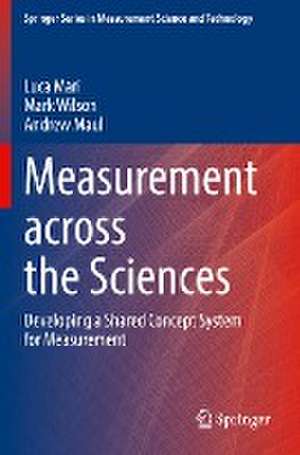
Measurement across the Sciences: Springer Series in Measurement Science and Technology
Autor Luca Mari, Mark Wilson, Andrew Maulen Limba Engleză Paperback – apr 2022
Researchers and academics across a wide range of disciplines including biological, physical, social and behavioral scientists, as well as specialists in measurement and philosophy will appreciate the work’s fresh and provocative approach to the field at a time when sound measurements of complex scientific systems are increasingly essential to solving critical global problems.
Din seria Springer Series in Measurement Science and Technology
- 24%
 Preț: 935.61 lei
 - 15%
 Preț: 625.01 lei
 - 18%
 Preț: 924.72 lei
 - 15%
 Preț: 621.56 lei
 - 18%
 Preț: 1783.64 lei
 - 18%
 Preț: 759.88 lei
 - 18%
 Preț: 1335.09 lei
 - 15%
 Preț: 567.43 lei
 - 18%
 Preț: 721.74 lei
 - 18%
 Preț: 1114.91 lei
 - 24%
 Preț: 823.33 lei
 - 15%
 Preț: 611.37 lei
 - 18%
 Preț: 1112.60 lei
 - 18%
 Preț: 1138.99 lei
 - 18%
 Preț: 786.81 lei
 -
 Preț: 347.34 lei
 - 18%
 Preț: 919.21 lei
 - 23%
 Preț: 632.44 lei
 - 18%
 Preț: 953.80 lei
Preț: 500.24 lei
Preț vechi: 625.31 lei
-20%
Puncte Express: 750
Carte tipărită la comandă
Livrare economică 04-10 august
Livrare prin curier în România Termenul estimat este afișat lângă disponibilitate.
Transport gratuit pentru acest produs Plată online sau ramburs, în funcție de opțiunile comenzii.
Retur gratuit în 14 zile Comandă securizată și suport în română.
Specificații
ISBN-13: 9783030655600
ISBN-10: 3030655601
Pagini: 316
Ilustrații: XXXV, 279 p. 72 illus., 64 illus. in color.
Dimensiuni: 155 x 235 x 17 mm
Greutate: 0.54 kg
Ediția:1st ed. 2021
Editura: Springer
Colecția Springer Series in Measurement Science and Technology
Seria Springer Series in Measurement Science and Technology
Locul publicării:Cham, Switzerland
ISBN-10: 3030655601
Pagini: 316
Ilustrații: XXXV, 279 p. 72 illus., 64 illus. in color.
Dimensiuni: 155 x 235 x 17 mm
Greutate: 0.54 kg
Ediția:1st ed. 2021
Editura: Springer
Colecția Springer Series in Measurement Science and Technology
Seria Springer Series in Measurement Science and Technology
Locul publicării:Cham, Switzerland
Cuprins
Part I: Introduction.- Chapter 1: Motivation.- Chapter 2: Basic concepts in measurement.- Chapter 3: History of measurement.- Chapter 4: A historical overview of philosophical perspectives on measurement.- Part II: A new integrated concept system for measurement.- Chapter 5: A meta-structural understanding of measurement.- Chapter 6: An epistemology of measurement.- Chapter 7: Measurand definitions and definitional uncertainty.- Chapter 8: Measurement across the sciences.- Part III: Controversies and Issues.- Chapter 9: Measurement in psychology: the legacy of operationalism.- Chapter 10: Big data.- Chapter 11: The role of human beings within measurement.- Chapter 12: Scaling.- Part IV Conclusion.- Chapter 13: Prospects for the future.
Notă biografică
Luca Mari is a professor of Measurement Science at Università Carlo Cattaneo - LIUC, Castellanza, Italy, where he teaches courses on measurement science, statistical data analysis, and systems theory. Internationally, he is chair of the TC 1 (Terminology) and the secretary of the TC 25 (Quantities and units) of the International Electrotechnical Commission (IEC), and an IEC expert in the WG2 (VIM) of the Joint Committee for Guides in Metrology (JCGM). In Italy, he chairs the Technical Committee CEI 1/25 "Terminologia, grandezze e unità" of the Comitato Elettrotecnico Italiano (CEI) and is chair of the Technical Commission UNI-CEI 500 "Metrologia". His research activities focus on fundamental topics of measurement science and its relations to information science and technology, systems theory, information systems, and eLearning. Dr. Mari received the Ph.D. from the Polytechnic of Torino, Italy in 1994.
Mark Wilson is a professor of Education at the University of California, Berkeley, and also at the University of Melbourne. His interests focus on measurement and applied statistics, and he has published over 100 refereed articles in those areas, and over 50 invited chapters. He was elected president of the Psychometric Society, also of the US National Council for Measurement in Education (NCME). He is also a Member of the US National Academy of Education, a Fellow of the American Educational Research Association, and a National Associate of the US National Research Council. He is Director of the Berkeley Evaluation and Assessment Research (BEAR) Center. His research interests focus on the development and application of sound approaches for measurement in education and the human sciences, the development of statistical models suitable for measurement contexts, the creation of instruments to measure new constructs, and scholarship on the philosophy of measurement. Dr. Wilson received his PhD degree from the University of Chicago in 1984.
Andrew Maul is a professor of Education at the University of California, Santa Barbara. His work integrates lines of inquiry traditionally associated with statistics, philosophy, psychology, and history, with the aim of improving the quality of methodological practices in the human sciences, and in particular the theory and practice of measurement. Dr. Maul received his Ph.D. in 2008 from the University of California, Berkeley. He regularly teaches courses on the construction and validation of measuring instruments, item response theory, and the philosophy of measurement, as well as introductory and advanced research methods and applied statistics.
Mark Wilson is a professor of Education at the University of California, Berkeley, and also at the University of Melbourne. His interests focus on measurement and applied statistics, and he has published over 100 refereed articles in those areas, and over 50 invited chapters. He was elected president of the Psychometric Society, also of the US National Council for Measurement in Education (NCME). He is also a Member of the US National Academy of Education, a Fellow of the American Educational Research Association, and a National Associate of the US National Research Council. He is Director of the Berkeley Evaluation and Assessment Research (BEAR) Center. His research interests focus on the development and application of sound approaches for measurement in education and the human sciences, the development of statistical models suitable for measurement contexts, the creation of instruments to measure new constructs, and scholarship on the philosophy of measurement. Dr. Wilson received his PhD degree from the University of Chicago in 1984.
Andrew Maul is a professor of Education at the University of California, Santa Barbara. His work integrates lines of inquiry traditionally associated with statistics, philosophy, psychology, and history, with the aim of improving the quality of methodological practices in the human sciences, and in particular the theory and practice of measurement. Dr. Maul received his Ph.D. in 2008 from the University of California, Berkeley. He regularly teaches courses on the construction and validation of measuring instruments, item response theory, and the philosophy of measurement, as well as introductory and advanced research methods and applied statistics.
Textul de pe ultima copertă
This book proposes a conceptual framework for understanding measurement across a broad range of scientific fields and areas of application, such as physics, engineering, education, and psychology. The authors, who themselves span these disciplines, argue that the justification of the public trust attributed to measurement results can in principle apply identically to both physical and psychosocial properties. They further argue that the lack of a common conceptualization of measurement hampers interdisciplinary communication and limits the ability to share knowledge. They advance their views by first surveying the conceptual history of the philosophy of measurement and arguing that classical, operationalist and representational perspectives on measurement each make important contributions but also each have important shortcomings. A synthesis is then offered as the foundation for a new conceptual framework. The authors describe how the framework, which operates as a shared concept system, supports understanding measurement’s work in different domains, using examples in the physical and human sciences. They consider connections and consequences with respect to causality, objectivity, and intersubjectivity, among other topics, and how measurement science concepts and issues are construed across these disciplines and settings. They also address contemporary issues and controversies within measurement in the light of the framework, including operationalism, definitional uncertainty, and the relations between measurement and computation. The book concludes with a justification for the basic claim that measurement is an empirical and informational process that produces explicitly justifiable information.Researchers and academics across a wide range of disciplines including biological, physical, social and behavioral scientists, as well as specialists in measurement and philosophy will appreciate the work’s fresh and provocative approach to the field at a time whensound measurements of complex scientific systems are increasingly essential to solving critical global problems.
Caracteristici
Proposes a unified view of measurement across physical and human sciences and applications Critiques philosophies of measurement in light of broader philosophical issues such causality, objectivity, and intersubjectivity Sheds new light on major issues in measurement, both practical and philosophical Provides a justification of the claimed epistemic authority of measurement Presents fresh perspectives on longstanding methodological controversies in the human sciences