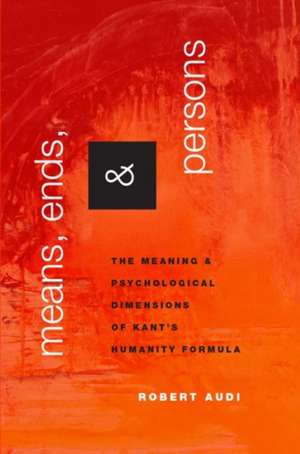
Means, Ends, and Persons: The Meaning and Psychological Dimensions of Kant's Humanity Formula
Autor Robert Audien Limba Engleză Paperback – 17 mai 2018
Ne-a atras atenția, în primul rând, modul în care Robert Audi utilizează o multitudine de studii de caz și exemple narative pentru a demonta distincția adesea abstractă dintre a trata o persoană ca „scop în sine” și a o folosi „doar ca mijloc”. Suntem de părere că forța acestui volum rezidă în capacitatea de a transforma un principiu kantian fundamental într-un instrument de analiză aplicabil în etica practică. Audi nu se limitează la exegeză, ci construiește o teorie a conduitei care integrează acțiunea, motivația și maniera de performanță, oferind astfel o structură tripartită care clarifică responsabilitatea morală în interacțiunile cotidiene.
Din punct de vedere al structurii, Means, Ends, and Persons propune o perspectivă psihologică asupra eticii, investigând elemente motivaționale care depășesc simplele manifestări de virtute sau viciu. Această abordare completează temele explorate de autor în lucrări precum Seeing, Knowing, and Doing, unde analiza percepției se intersecta cu teoria acțiunii, dar aici accentul cade pe normativitatea comportamentului uman. Lucrarea acoperă o arie tematică similară cu The Value of Humanity in Kant's Moral Theory de Richard Dean, însă volumul lui Audi se distinge printr-o metodologie mai interdisciplinară, ancorând conceptele kantiene în psihologia morală modernă și oferind o utilitate sporită pentru cei interesați de fundamentele drepturilor omului și demnității.
Putem afirma că acest titlu reprezintă o evoluție naturală în opera lui Audi, rafinând intuițiile din Moral Knowledge and Ethical Character. Stilul este unul academic precis, dar extrem de bogat în ilustrări practice, ceea ce face ca argumentația să fie accesibilă și studenților, nu doar cercetătorilor în filozofie morală. Este o lectură care recalibrează înțelegerea noastră despre ce înseamnă a acționa moral într-un context social complex.
Preț: 232.69 lei
Preț vechi: 313.73 lei
-26%
Carte tipărită la comandă
Livrare economică 20-25 noiembrie
Specificații
ISBN-10: 0190913746
Pagini: 192
Dimensiuni: 206 x 137 x 15 mm
Greutate: 0.23 kg
Editura: Oxford University Press
Colecția OUP USA
Locul publicării:New York, United States
V-ar putea interesa
-
 -30%Preț: 458.46 lei654.87 lei
 -
 The Trolley Problem MysteriesF. M. Kamm-21%Preț: 265.87 lei335.34 lei
 -
 -25%Preț: 632.97 lei844.55 lei
 -
 -19%Preț: 335.75 lei416.63 lei
 -
 -14%Preț: 255.92 lei296.09 lei
 -
 Oxford Studies in Agency and Responsibility: Volume 3David Shoemaker-19%Preț: 297.94 lei368.18 lei
 -
 On What Matters: Volume ThreeDerek Parfit-11%Preț: 317.44 lei357.41 lei
 -
 -31%Preț: 533.62 lei771.55 lei
 -
 Talking to Our Selves: Reflection, Ignorance, and AgencyJohn M. Doris-20%Preț: 253.00 lei316.64 lei
 -
 Persons: The Difference between `Someone' and `Something'Robert SpaemannPreț: 275.56 lei
 -
 Moral Brains: The Neuroscience of MoralityS. Matthew Liao-19%Preț: 370.22 lei456.74 lei
 -
 Conversations on EthicsAlex Voorhoeve-16%Preț: 173.18 lei206.83 lei
 -
 Constructivism in Practical PhilosophyJames Lenman-31%Preț: 756.81 lei1099.71 lei
 -
 -21%Preț: 355.98 lei451.53 lei
 -
 Beyond Humanity?: The Ethics of Biomedical EnhancementAllen E. Buchanan-21%Preț: 217.40 lei275.34 lei
 -
 On What Matters: Volume OneDerek Parfit-14%Preț: 224.72 lei262.61 lei
 -
 Evil MenJames DawesPreț: 141.11 lei
 -
 Immanuel Kant′s Groundwork for the Metaphysics o – Morals – a CommentaryDieter SchöneckerPreț: 232.97 lei
 -
 One Another's EqualsJeremy WaldronPreț: 204.66 lei
 -
 Inside Ethics – On the Demands of Moral ThoughtAlice CraryPreț: 438.09 lei
 -
 Preț: 341.24 lei
 -
 Preț: 454.38 lei
 -
 Constructivism in EthicsCarla BagnoliPreț: 316.76 lei
 -
 The Cambridge Companion to UtilitarianismBen EgglestonPreț: 247.13 lei
De ce să citești această carte
Recomandăm această carte cercetătorilor și studenților la filozofie care doresc să depășească interpretările pur teoretice ale lui Kant. Cititorul câștigă un cadru analitic clar pentru a evalua conduita morală, beneficiind de expertiza unuia dintre cei mai importanți filosofi contemporani, Robert Audi. Este o resursă esențială pentru a înțelege cum motivația și contextul transformă o simplă acțiune într-un act de respect față de demnitatea umană.
Despre autor
Robert Audi este profesor de filozofie (catedra John A. O'Brien) la University of Notre Dame și o figură centrală în epistemologia și filozofia morală contemporană. Cu o carieră distinsă, a servit ca președinte al American Philosophical Association și a editat publicații de prestigiu precum Journal of Philosophical Research. Opera sa vastă include titluri de referință ca Epistemology și Moral Perception, fiind recunoscut pentru capacitatea de a sintetiza intuiționismul etic cu rigoarea analitică. Contribuțiile sale la Oxford University Press reflectă un interes constant pentru intersecția dintre rațiune, religie și etică.
Descriere
Recenzii
There are many things to appreciate about this book. The chapters are rich with detailed examples which provide a valuable resource for teaching and for further study. Also, Audi has again demonstrated his mastery of the difficult feat of writing a serious philosophical text that has significant depth, while at the same time giving us a text that is jargon-free enough to be of use to the non-specialist. Furthermore, despite the theoretical focus of the book, practical concerns are never far from view. In fact, the final chapter focuses on the extent to which we have control over our treatment of one another and ends with a discussion that reveals his deep concern for acting morally toward one another. It's a lovely way to end a book about what it means to treat people as ends in themselves.