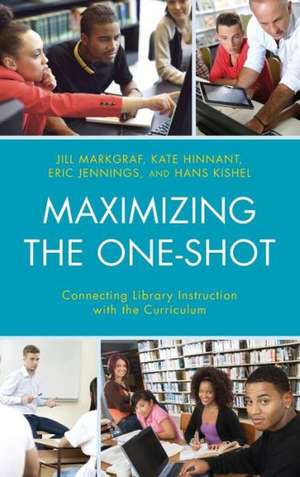
Maximizing the One-Shot: Connecting Library Instruction with the Curriculum
Autor Jill Markgraf, Kate Hinnant, Eric Jennings, Hans Kishelen Limba Engleză Hardback – 8 apr 2015
Working with faculty teams from academic departments, the authors used the collaborative Lesson Study method to redesign undergraduate research instruction. They describe how to winnow the one-shot down to a manageable active learning experience while simultaneously augmenting it with extra-sessional prerequisites and learning activities. They also discuss how to conceptualize the role of the one-shot within a course, a curriculum, and the larger information literacy goals of the institution. This book offers customizable strategies, sample lesson plans, and generalized observations based on the experiences of the authors.
Maximizing the One-Shot: Connecting Library Instruction with the Curriculum covers the following aspects of one-shot development:
Understanding the role of the one-shot institutionally and its limits. Setting realistic goals.The Lesson Study approach.Collaborating with departmental faculty.Assessment of the one-shot.Supporting the one-shot with additional materials.Expanding one-shot development to other departments and programs.
In addition, the book provides interviews with collaborating faculty members of academic departments who have partnered with library faculty.
Preț: 677.08 lei
Preț vechi: 787.30 lei
-14%
Puncte Express: 1016
Carte tipărită la comandă
Livrare economică 01-15 decembrie
Livrare prin curier în România Termenul estimat este afișat lângă disponibilitate.
Transport gratuit pentru acest produs Plată online sau ramburs, în funcție de opțiunile comenzii.
Retur gratuit în 14 zile Comandă securizată și suport în română.
Specificații
ISBN-13: 9781442238657
ISBN-10: 1442238658
Pagini: 188
Ilustrații: 38 BW Photos, 4 Tables
Dimensiuni: 159 x 238 x 20 mm
Greutate: 0.48 kg
Editura: Bloomsbury Publishing
Colecția Rowman & Littlefield
Locul publicării:New York, United States
ISBN-10: 1442238658
Pagini: 188
Ilustrații: 38 BW Photos, 4 Tables
Dimensiuni: 159 x 238 x 20 mm
Greutate: 0.48 kg
Editura: Bloomsbury Publishing
Colecția Rowman & Littlefield
Locul publicării:New York, United States
V-ar putea interesa
-
 Preț: 269.04 lei
 -
 Preț: 229.65 lei
 -
 Law Librarianship in the Digital AgeEllyssa Kroski-31%Preț: 570.66 lei829.35 lei
 -
 Health Sciences LibrarianshipM. Sandra Wood-30%Preț: 579.41 lei830.41 lei
 -
 Internationalization and the North American University LibraryKaren Bordonaro-35%Preț: 625.81 lei959.02 lei
 -
 Law Librarianship in the Twenty-First CenturyRoy Balleste-28%Preț: 401.28 lei553.85 lei
 -
 Managing Copyright in Higher Education: A GuidebookDonna L. Ferullo-25%Preț: 220.85 lei293.12 lei
 -
 -21%Preț: 282.40 lei357.04 lei
 -
 -28%Preț: 430.66 lei596.75 lei
 -
 -19%Preț: 312.75 lei387.95 lei
 -
 Academic Library Metamorphosis and RegenerationMarcy Simons-32%Preț: 521.87 lei767.39 lei
 -
 Academic Librarianship TodayTodd Gilman-30%Preț: 708.08 lei1009.88 lei
 -
 Academic Librarianship TodayTodd Gilman-29%Preț: 395.00 lei554.02 lei
 -
 Student Engagement and the Academic LibraryLoanne Snavely-33%Preț: 326.94 lei488.28 lei
 -
 Embedded Librarianship: What Every Academic Librarian Should KnowAlice L. Daugherty-26%Preț: 365.03 lei492.75 lei
 -
 -8%Preț: 354.20 lei385.00 lei
 -
 -8%Preț: 364.72 lei396.44 lei
Cuprins
Introduction
Chapter 1: Confronting the One-Shot: Seeing the Limitations
Chapter 2: Getting Real About the One-Shot
Chapter 3: Having Conversations: Beginning the Lesson Study Approach
Chapter 4: Implementing the New One-Shot
Chapter 5: Expanding the Process: The Lesson Study in Other Disciplines
Chapter 6: Supplementing the One-Shot
Chapter 7: The Benefits and Challenges of Collaboration
Chapter 8: Organizational Considerations
Chapter 9: Fine-Tuning the One-Shot
Chapter 10: Interviewing the "Others": What the Disciplinary Faculty Said
Conclusion
Appendixes
About the Authors
Chapter 1: Confronting the One-Shot: Seeing the Limitations
Chapter 2: Getting Real About the One-Shot
Chapter 3: Having Conversations: Beginning the Lesson Study Approach
Chapter 4: Implementing the New One-Shot
Chapter 5: Expanding the Process: The Lesson Study in Other Disciplines
Chapter 6: Supplementing the One-Shot
Chapter 7: The Benefits and Challenges of Collaboration
Chapter 8: Organizational Considerations
Chapter 9: Fine-Tuning the One-Shot
Chapter 10: Interviewing the "Others": What the Disciplinary Faculty Said
Conclusion
Appendixes
About the Authors
Recenzii
This book is a case study of how university librarians collaborated with faculty to integrate information literacy instruction in a selected curriculum. The authors address the challenges of institutional reality, instructing students, and collaborating with faculty. They initially developed lessons for students in composition classes; their approach was expanded for science and nursing classes. The narrative explains lesson goals, planning processes, lesson activities, helping faculty understand the importance, scaffolding, and assessment. Selected worksheets, research guides, and less on study outlines are featured. The information will be helpful to high school and post-secondary librarians implementing a similar program.
[A] newer librarian-instructor or a library school student may find the pragmatic approach of this book, with its reliance on real-world tools rather than esoteric teaching ideologies, to be very helpful. Also, it is refreshing to read a book that does not follow the prevailing criticism of the one-shot as an abomination of instruction. . . .This book is recommended as a good teaching book for a library school program or a tool for a beginning instructor. Even veteran instructors will find this a refreshing take on an old topic and might also find the Lesson Study outlines at the end of the book useful in designing a new course or modifying an existing one.
Given that most teaching librarians spend most of their time teaching one-shot sessions, it is refreshing to read a book that wholeheartedly embraces the challenge of making those sessions better. What I like about the lesson study approach outlined in Maximizing the One-Shot is that it provides a framework where librarians can use what they already know about instructional design and assessment to build deep collaborative relationships that make everyone - teaching librarians and classroom teachers alike - better at teaching research. While the lesson study may seem to be about improving the lesson, it's really about improving ourselves as teachers - equipping classroom faculty and teaching librarians alike with new ways to make research instruction relevant, effective, and useful to students.
As librarians are pressed to make a bigger impact on student learning without the staff or curriculum support for credit-courses, this book shows the value of collaboration, assessment, and scaffolding of library instruction within a credit-course. It offers inspiration and a pathway for librarians and faculty who are seeking to improve student research in a higher education setting.
The one-shot session is a staple of academic librarianship instruction practice. Though the one-shot is often bemoaned for its limitations, these authors provide a re-framing of that perspective and demonstrate its true potential for transformation and impact through their thoughtful Lesson Study approach. Highly recommended for all academic libraries!
[A] newer librarian-instructor or a library school student may find the pragmatic approach of this book, with its reliance on real-world tools rather than esoteric teaching ideologies, to be very helpful. Also, it is refreshing to read a book that does not follow the prevailing criticism of the one-shot as an abomination of instruction. . . .This book is recommended as a good teaching book for a library school program or a tool for a beginning instructor. Even veteran instructors will find this a refreshing take on an old topic and might also find the Lesson Study outlines at the end of the book useful in designing a new course or modifying an existing one.
Given that most teaching librarians spend most of their time teaching one-shot sessions, it is refreshing to read a book that wholeheartedly embraces the challenge of making those sessions better. What I like about the lesson study approach outlined in Maximizing the One-Shot is that it provides a framework where librarians can use what they already know about instructional design and assessment to build deep collaborative relationships that make everyone - teaching librarians and classroom teachers alike - better at teaching research. While the lesson study may seem to be about improving the lesson, it's really about improving ourselves as teachers - equipping classroom faculty and teaching librarians alike with new ways to make research instruction relevant, effective, and useful to students.
As librarians are pressed to make a bigger impact on student learning without the staff or curriculum support for credit-courses, this book shows the value of collaboration, assessment, and scaffolding of library instruction within a credit-course. It offers inspiration and a pathway for librarians and faculty who are seeking to improve student research in a higher education setting.
The one-shot session is a staple of academic librarianship instruction practice. Though the one-shot is often bemoaned for its limitations, these authors provide a re-framing of that perspective and demonstrate its true potential for transformation and impact through their thoughtful Lesson Study approach. Highly recommended for all academic libraries!