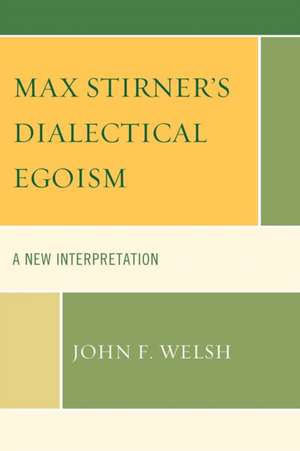
Max Stirner's Dialectical Egoism: A New Interpretation
Autor John F. Welshen Limba Engleză Paperback – 23 sep 2010
Autorul John F. Welsh, a cărui expertiză a fost consolidată prin activitatea academică la University of Louisville, propune în Max Stirner's Dialectical Egoism o reevaluare riguroasă a unuia dintre cei mai controversați gânditori ai secolului al XIX-lea. Găsim în această lucrare o continuare firească a cercetărilor sale anterioare din The Dialectics of Liberty, unde Welsh a explorat modul în care metoda dialectică poate susține libertatea individuală. Aici, el aplică acest instrumentar asupra operei lui Max Stirner, investigând trecerea de la scrierile de tinerețe la celebrul tratat The Ego and Its Own.
Suntem de părere că forța acestui volum rezidă în capacitatea de a poziționa egoismul lui Stirner nu ca pe o simplă curiozitate istorică, ci ca pe o critică sistematică a modernității. Welsh demonstrează cum Stirner a identificat „umanitatea” ca fiind noul „fiu suprem” al epocii moderne, transformând umanismul într-o formă subtilă de dominație socială. Comparabil cu ediția îngrijită de Saul Newman în Max Stirner în ceea ce privește rigoarea teoretică, volumul lui Welsh este actualizat pentru a include o analiză a modului în care egoismul dialectic a fost absorbit și transformat de figuri precum Benjamin Tucker sau Dora Marsden în discuțiile despre capitalism și feminism.
Structura lucrării este tripartită: prima parte stabilește bazele teoretice ale egoismului dialectic, a doua examinează recepția acestuia în rândul gânditorilor radicali, iar a treia oferă o sinteză critică. O secțiune remarcabilă este cea dedicată disocierii lui Stirner de Nietzsche, unde Welsh demontează mitul influenței directe, subliniind diferențele fundamentale de perspectivă. Descoperim astfel un Stirner eliberat de etichetele simpliste de nihilist sau anarhist, fiind prezentat drept un pionier al analizei raportului dintre individ și structurile colectiviste.
Preț: 354.08 lei
Preț vechi: 484.60 lei
-27%
Carte tipărită la comandă
Livrare economică 07-21 decembrie
Specificații
ISBN-10: 0739141562
Pagini: 304
Dimensiuni: 157 x 232 x 19 mm
Greutate: 0.48 kg
Ediția:New.
Editura: Bloomsbury Publishing
Colecția Lexington Books
Locul publicării:New York, United States
V-ar putea interesa
-
 Tipperary to TexasJohn F. Jr. WelshPreț: 96.58 lei
 -
 -34%Preț: 536.39 lei815.06 lei
 -
 -25%Preț: 305.82 lei406.65 lei
 -
 -34%Preț: 698.31 lei1054.27 lei
 -
 -28%Preț: 351.97 lei491.46 lei
 -
 Government Birds: Air Transport and the State in Western EuropeMartin Staniland-30%Preț: 405.27 lei579.11 lei
 -
 -22%Preț: 181.42 lei231.41 lei
 -
 -35%Preț: 345.61 lei530.66 lei
 -
 Bureaucracy and the Policy Process: Keeping the PromisesDennis D. Riley-29%Preț: 473.19 lei670.36 lei
 -
 Hegel and the Metaphysical Frontiers of Political TheoryEric Goodfield-15%Preț: 424.28 lei499.14 lei
 -
 Theories of SecessionPercy B. LehningPreț: 467.54 lei
 -
 -35%Preț: 404.43 lei625.36 lei
 -
 A Ciência ao Serviço do Desenvolvimento?Teresa Cruz E SilvaPreț: 332.93 lei
 -
 Political Economy of Post-apartheid South AfricaVusi GumedePreț: 330.68 lei
 -
 Elektroschrott als giftiges Milliardengeschäft. Unaufhaltsam trotz Gesetz und KontrolleLisa-Marleen BuchholzPreț: 86.67 lei
 -
 Preț: 223.89 lei
 -
 Das Planspiel im PolitikunterrichtKathryn MetznerPreț: 81.11 lei
 -
 Economic Reforms in India and ChinaR. K. MishraPreț: 234.98 lei
 -
 Alguien Quiere Saber Por Fin El Porque de Tanto Independentismo En Cataluna?: Por Un CatalanAlberto Reverte SaavedraPreț: 78.70 lei
De ce să citești această carte
Această monografie se adresează cercetătorilor și studenților la științe politice care doresc o înțelegere profundă a egoismului dialectic dincolo de clișeele istorice. Cititorul câștigă o perspectivă clară asupra criticii modernității și a modului în care individualitatea poate fi apărată împotriva omogenizării culturale. Este o resursă esențială pentru cei interesați de rădăcinile filosofice ale libertarianismului și de evoluția gândirii post-hegeliene.
Descriere
Welsh traces Stirner's thought from his early essays to The Ego and Its Own and Stirner's responses to his critics. He also examines how Benjamin Tucker, James L. Walker, and Dora Marsden applied Stirner's dialectical egoism to the analysis of (a) the transformations of capitalism, (b) culture, ethics, and mass psychology, and (c) feminism, socialism, and communism. All three viewed Stirner as a champion of individuality against the collectivizing and homogenizing forces of the modern world.
Welsh also takes great care to dissociate Stirner's thought from that of the other great egoist critic of modernity, Friedrich Nietzsche. He argues that the similarities in the dissidence of Stirner and Nietzsche are superficial. The book concludes with an interpretation of Stirner's thought as a form of dialectical egoism that includes (a) a multi-tiered analysis of culture, society, and individuality; (b) the basic principles of Stirner's view of the relationship between individuals and social organization; and (c) the forms of critique he employs. Stirner's critique of modernity is a significant contribution to the growing literature on libertarianism, dialectical analysis, and post-modernism.
Cuprins
Recenzii
A book of this kind has been long awaited. It is the first modern book-length sympathetic, yet balanced and scholarly, exposition of Max Stirner's thought and, in my opinion, the best book on Max Stirner on the market. John Welsh's Max Stirner's Dialectic Egoism contains new and useful arguments based on sound scholarship. Welsh shows a good grasp of what Stirner means and what he doesn't, and of the different interpretations of him up until the present. The text includes different interpretations and understandings of Stirner, an exegesis of Stirner's major work, The Ego and Its Own, insights of leading historians of philosophy, and a comparison of Stirner and his disciples. Overall, well researched and very informative!
Welsh is clearly aware of these central aspects of Stirner's project..He has.offered a very useful tool for anarchists, egoists and Stirner scholars, a tool that is well worth using. And it is not difficult to use. The language is fairly simple and straightforward. The content is well organized. I recommend the book for anyone interested in exploring what Stirner has to offer us in our confrontations with the ruling institutions.
Any reader of this journal, and anyone who has ever tried to grapple with Stirner, will enjoy and benefit from this book. Scholars and students seeking a clear, honest, up-to-date introduction to Stirner need look no further. Individual-minded individuals outside the academy will also find this book of use.