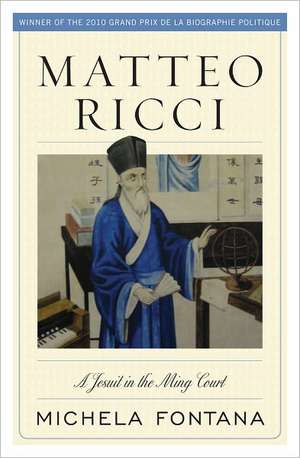
Matteo Ricci: A Jesuit in the Ming Court: Rowman & Littlefield Publishers
Autor Michela Fontanaen Limba Engleză Hardback – 16 mai 2011
Michela Fontana traces Ricci's travels in China in detail, providing a rich portrait of Ming China and the growing importance of cultural exchanges between China and the West. She shows how Ricci incorporated his ideas of "cultural accommodation" into both his life and his writings aimed at the Chinese elite. Her biography is the first to highlight Ricci's immensely important scientific work and that of key Christian converts, such as Xu Guangqi, who translated Euclid's Elements together with Ricci. Exploring the history of science in China and the West as well as their dramatically different cultural attitudes toward religious and philosophical issues, Michela Fontana introduces not only Ricci's life but the first significant encounter between Western and Chinese civilizations.
Din seria Rowman & Littlefield Publishers
-
 Preț: 113.89 lei
 - 13%
 Preț: 155.38 lei
 -
 Preț: 109.93 lei
 - 20%
 Preț: 370.93 lei
 - 19%
 Preț: 323.76 lei
 - 25%
 Preț: 228.52 lei
 - 19%
 Preț: 328.78 lei
 - 28%
 Preț: 148.13 lei
 - 20%
 Preț: 191.09 lei
 - 24%
 Preț: 255.02 lei
 - 16%
 Preț: 109.26 lei
 - 31%
 Preț: 351.69 lei
 - 15%
 Preț: 127.13 lei
 - 22%
 Preț: 330.19 lei
 - 19%
 Preț: 324.21 lei
 - 30%
 Preț: 355.24 lei
 - 23%
 Preț: 258.39 lei
 -
 Preț: 402.96 lei
 - 23%
 Preț: 282.77 lei
 - 24%
 Preț: 275.28 lei
 - 31%
 Preț: 351.50 lei
 - 22%
 Preț: 331.09 lei
 - 32%
 Preț: 373.39 lei
 - 34%
 Preț: 842.33 lei
 - 18%
 Preț: 325.06 lei
 - 23%
 Preț: 363.28 lei
 - 21%
 Preț: 128.84 lei
 - 30%
 Preț: 774.75 lei
 - 23%
 Preț: 278.65 lei
 - 22%
 Preț: 266.38 lei
 - 19%
 Preț: 344.02 lei
 - 32%
 Preț: 594.45 lei
 - 31%
 Preț: 566.85 lei
 - 22%
 Preț: 367.22 lei
 - 19%
 Preț: 322.03 lei
 - 16%
 Preț: 148.06 lei
 - 21%
 Preț: 369.53 lei
 - 19%
 Preț: 323.37 lei
 - 20%
 Preț: 314.77 lei
 - 30%
 Preț: 424.70 lei
 - 25%
 Preț: 344.18 lei
 - 30%
 Preț: 703.64 lei
 - 14%
 Preț: 152.49 lei
 - 30%
 Preț: 847.72 lei
 - 19%
 Preț: 316.66 lei
 - 23%
 Preț: 283.57 lei
 - 29%
 Preț: 727.24 lei
 - 23%
 Preț: 262.16 lei
 - 19%
 Preț: 343.92 lei
Preț: 573.44 lei
Preț vechi: 826.23 lei
-31%
Puncte Express: 860
Carte tipărită la comandă
Livrare economică 07-21 decembrie
Livrare prin curier în România Termenul estimat este afișat lângă disponibilitate.
Transport gratuit pentru acest produs Plată online sau ramburs, în funcție de opțiunile comenzii.
Retur gratuit în 14 zile Comandă securizată și suport în română.
Specificații
ISBN-13: 9781442205864
ISBN-10: 1442205865
Pagini: 336
Dimensiuni: 164 x 239 x 27 mm
Greutate: 0.67 kg
Editura: Bloomsbury Publishing
Colecția Rowman & Littlefield
Seria Rowman & Littlefield Publishers
Locul publicării:New York, United States
ISBN-10: 1442205865
Pagini: 336
Dimensiuni: 164 x 239 x 27 mm
Greutate: 0.67 kg
Editura: Bloomsbury Publishing
Colecția Rowman & Littlefield
Seria Rowman & Littlefield Publishers
Locul publicării:New York, United States
Cuprins
Prologue
Chapter 1: The Jesuit and Mathematics
Chapter 2: In the East
Chapter 3: The Difficulty of Learning Chinese
Chapter 4: The Man from the West
Chapter 5: The Pride of Li Madou
Chapter 6: The Meeting of Confucius and Euclid
Chapter 7: Metamorphosis into Mandarins
Chapter 8: The Strength of Friendship
Chapter 9: To Beijing!
Chapter 10: Heated Disputes and Science Lessons
Chapter 11: Prisoner of the Eunuch
Chapter 12: In the Heart of the Empire
Chapter 13: The Empty Throne
Chapter 14: The Lord of Heaven
Chapter 15: Doctor Paul
Chapter 16: Euclid Becomes Chinese
Chapter 17: The Open Door
Chapter 18: After Matteo Ricci: The Scientific Legacy, Triumph, and Persecution
Chronology
Chinese Dynasties
Glossary
Bibliography
Chapter 1: The Jesuit and Mathematics
Chapter 2: In the East
Chapter 3: The Difficulty of Learning Chinese
Chapter 4: The Man from the West
Chapter 5: The Pride of Li Madou
Chapter 6: The Meeting of Confucius and Euclid
Chapter 7: Metamorphosis into Mandarins
Chapter 8: The Strength of Friendship
Chapter 9: To Beijing!
Chapter 10: Heated Disputes and Science Lessons
Chapter 11: Prisoner of the Eunuch
Chapter 12: In the Heart of the Empire
Chapter 13: The Empty Throne
Chapter 14: The Lord of Heaven
Chapter 15: Doctor Paul
Chapter 16: Euclid Becomes Chinese
Chapter 17: The Open Door
Chapter 18: After Matteo Ricci: The Scientific Legacy, Triumph, and Persecution
Chronology
Chinese Dynasties
Glossary
Bibliography
Recenzii
Fontana chronicles the life of a 16th-century foreign missionary with historical precision, geographical vision, and linguistic acumen while maintaining an engaging, inviting prose. This is the story of the first substantive encounter between Continental Europe and China. While Fontana's subject, Matteo Ricci, remains front and center, the author is instructive about the various milieus that distinguish him: the Society of Jesus, or the Jesuits, of which he was a member; the culture of Christendom, within which he was raised; and the determinedly impenetrable China of the Ming Dynasty, wherein he spent his life. Respectively, Fontana manifests an unprecedented cosmopolitan sensitivity, a political and spiritual verve, and the protocols, powers, and progress of an ulterior empire. A special feature of the study is its ability to bridge two disparate civilizations along the lines of scientific inquiry, revealing, in turn, the resilience of intellectual and spiritual quest. An important scholarly contribution is Fontana's discussion of Ricci's pioneering translation of Euclid's Greek-inspired Elements from Latin to Mandarin and its reception by Ming China. Highly recommended. All levels/libraries.
Michela Fontana's definitive biography has the merit of presenting Ricci's everyday life with splendid narrative rhythm, historical rigor, and precise scientific understanding while helping readers to find their way in the Middle Kingdom.
Matteo Ricci is a fascinating figure, and this excellent biography by Michela Fontana, a journalist and popularizer of science resident for some years in Beijing, does full justice to its subject.
Michela Fontana's superb biography offers not only a detailed reconstruction of the extraordinary life of Matteo Ricci but also an exemplary introduction to the history of relations between the Christian West and China.
The extraordinary adventures of Matteo Ricci are related with the utmost care in this admirable biography by Michela Fontana, whose scientific background enables her to present a clear picture of both Western and Chinese knowledge in the various fields of science at the time.
The [award] reflects both the members' recognition of the extraordinarily high quality of the author's research and writing and a desire to share their own pleasure in discovering a little-known figure in world political and religious history. At a time when the papacy was a European power to be reckoned with and the Jesuit order an authentic political force, the man that Michela Fontana's book reveals to us played a considerable part in forging a link and establishing dialogue between Europe and China. This work also shows us that globalization is not confined to the history of conquest and domination but can also be an extraordinary intellectual, spiritual, and cultural adventure.
This biography of that renowned Jesuit father by a writer who shares with her famous subject not only nationality and science education but also years of experience in the capital city and various provinces of China cannot but be a uniquely valuable addition to an already notable flurry of biographical and scholarly publications all paying homage to and attempting brave new assessments of one of the most fascinating characters in the long history of intellectual interactions between East Asia and the West.
Missionaries of various traditions have long admired Matteo Ricci, the Jesuit who entered China in the sixteenth century. This work, showing significant knowledge of the politics and culture of China during the Ming dynasty, is the most thorough biography of Ricci of which I am aware. . . . This is a remarkable book, carefully researched, well written, and will be of interest to any student of mission history.
[This book] is a detailed biography of the famous Jesuit missionary. . . .Fontana masterfully presents the story of the Jesuit mission to China, weaving together the intricate details of this intersection of European and Chinese cultures. . . .Fontana's biography provides a very accessible historical sketch to a general audience.
In this gripping account, Michela Fontana traces the life of an exceptional individual and through it explores the epochal encounter of Chinese and European cultures in early modern times. The author's expertise in the history of science distinguishes this new biography as she provides fascinating detail on early modern Chinese and European sciences and societies and their interaction through historical actors. In addition to offering a compelling read appealing to a wide audience, this is also an excellent and accessible overview of Chinese-Western cultural relations, reminding us that the circulation of knowledge so typical of contemporary 'globalization' is, after all, an old phenomenon.
A stimulating and inspiring read. The first biography of the famous Jesuit truly based on Ricci's own account of his experience in China, this lively and captivating book is also knowledgeably informed by recent research on late Ming and late Renaissance society. Fontana skillfully shows readers the world Ricci encountered as he made his way from Rome to Beijing and explains his many scientific contributions. Unlike other attempts, this life story does not glorify him as either a hero or a saint, nor does it favor the scholar or the apostle. Instead, it shows Ricci the man and the challenges he faced in China in all their historical and human dimensions.
Michela Fontana's definitive biography has the merit of presenting Ricci's everyday life with splendid narrative rhythm, historical rigor, and precise scientific understanding while helping readers to find their way in the Middle Kingdom.
Matteo Ricci is a fascinating figure, and this excellent biography by Michela Fontana, a journalist and popularizer of science resident for some years in Beijing, does full justice to its subject.
Michela Fontana's superb biography offers not only a detailed reconstruction of the extraordinary life of Matteo Ricci but also an exemplary introduction to the history of relations between the Christian West and China.
The extraordinary adventures of Matteo Ricci are related with the utmost care in this admirable biography by Michela Fontana, whose scientific background enables her to present a clear picture of both Western and Chinese knowledge in the various fields of science at the time.
The [award] reflects both the members' recognition of the extraordinarily high quality of the author's research and writing and a desire to share their own pleasure in discovering a little-known figure in world political and religious history. At a time when the papacy was a European power to be reckoned with and the Jesuit order an authentic political force, the man that Michela Fontana's book reveals to us played a considerable part in forging a link and establishing dialogue between Europe and China. This work also shows us that globalization is not confined to the history of conquest and domination but can also be an extraordinary intellectual, spiritual, and cultural adventure.
This biography of that renowned Jesuit father by a writer who shares with her famous subject not only nationality and science education but also years of experience in the capital city and various provinces of China cannot but be a uniquely valuable addition to an already notable flurry of biographical and scholarly publications all paying homage to and attempting brave new assessments of one of the most fascinating characters in the long history of intellectual interactions between East Asia and the West.
Missionaries of various traditions have long admired Matteo Ricci, the Jesuit who entered China in the sixteenth century. This work, showing significant knowledge of the politics and culture of China during the Ming dynasty, is the most thorough biography of Ricci of which I am aware. . . . This is a remarkable book, carefully researched, well written, and will be of interest to any student of mission history.
[This book] is a detailed biography of the famous Jesuit missionary. . . .Fontana masterfully presents the story of the Jesuit mission to China, weaving together the intricate details of this intersection of European and Chinese cultures. . . .Fontana's biography provides a very accessible historical sketch to a general audience.
In this gripping account, Michela Fontana traces the life of an exceptional individual and through it explores the epochal encounter of Chinese and European cultures in early modern times. The author's expertise in the history of science distinguishes this new biography as she provides fascinating detail on early modern Chinese and European sciences and societies and their interaction through historical actors. In addition to offering a compelling read appealing to a wide audience, this is also an excellent and accessible overview of Chinese-Western cultural relations, reminding us that the circulation of knowledge so typical of contemporary 'globalization' is, after all, an old phenomenon.
A stimulating and inspiring read. The first biography of the famous Jesuit truly based on Ricci's own account of his experience in China, this lively and captivating book is also knowledgeably informed by recent research on late Ming and late Renaissance society. Fontana skillfully shows readers the world Ricci encountered as he made his way from Rome to Beijing and explains his many scientific contributions. Unlike other attempts, this life story does not glorify him as either a hero or a saint, nor does it favor the scholar or the apostle. Instead, it shows Ricci the man and the challenges he faced in China in all their historical and human dimensions.