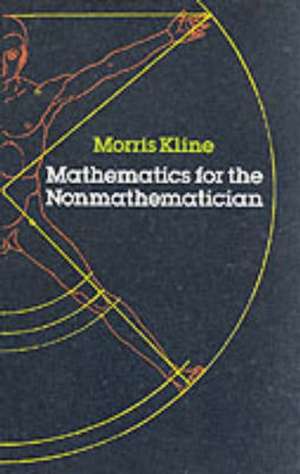
Mathematics for the Nonmathematician
Autor Morris Klineen Limba Engleză Paperback – feb 1985
Remarcăm în Mathematics for the Nonmathematician o deschidere interdisciplinară rară, unde rigoarea matematică se împletește organic cu arta, filozofia și istoria ideilor. Morris Kline nu tratează disciplina ca pe un set izolat de formule, ci ca pe o componentă esențială a culturii umane, investigând modul în care căutarea frumosului și problemele practice au modelat gândirea matematică. Lucrarea este structurată cronologic și tematic, pornind de la moștenirea grecilor antici și ajungând la revoluțiile intelectuale ale secolului al XIX-lea și ale fizicii moderne. Subliniem abordarea didactică a autorului, care reușește să simplifice concepte complexe precum calculul diferențial sau probabilitățile, fără a le dilua substanța. Un punct central al volumului este analiza geometriei neeuclidiene, pe care Kline o plasează, alături de evoluționism, printre conceptele care au transformat radical dezvoltarea noastră intelectuală. Comparativ cu Mathematics for the Liberal Arts de D. Bindner, care oferă o punte similară între matematică și artele liberale, volumul de față are o abordare mai tehnică și mai aplicată, incluzând seturi de exerciții menite să fixeze conceptele prin practică directă. Această lucrare completează magistral opera autorului, făcând trecerea de la cercetarea istorică vastă din Mathematical Thought from Ancient to Modern Times către un format accesibil studenților și autodidacților. Dacă în Calculus Kline se concentra strict pe aplicațiile științifice ale derivatelor și integralelor, aici el oferă contextul cultural și filozofic necesar pentru a înțelege de ce aceste instrumente au fost create.
Preț: 174.26 lei
Preț vechi: 227.43 lei
-23%
Carte disponibilă
Livrare economică 06-13 noiembrie
Specificații
ISBN-10: 0486248232
Pagini: 672
Ilustrații: illustrations
Dimensiuni: 138 x 216 x 33 mm
Greutate: 0.66 kg
Editura: Dover Publications
Locul publicării:New York, NY, United States
V-ar putea interesa
-
 American GunChris KylePreț: 119.51 lei
 -
 Design for Six SigmaGreg BruePreț: 124.99 lei
 -
 SIPRI Yearbook 2001: Armaments, Disarmament and International SecurityStockholm International Peace Research Institute-32%Preț: 722.90 lei1061.54 lei
 -
 Shapes, Space, and SymmetryAlan HoldenPreț: 96.53 lei
 -
 Ordinary Differential EquationsHarry PollardPreț: 283.84 lei
 -
 Webley Air PistolsGordon BrucePreț: 378.95 lei
 -
 The Illustrated World Encyclopedia of GunsWilliam FowlerPreț: 169.16 lei
 -
 Gödel''s ProofErnest NagelPreț: 97.10 lei
 -
 Set TheoryDaniel W. CunninghamPreț: 513.54 lei
 -
 Practical Gas Airsoft Pistols Upgrade & MaintenanceAirsoftpressPreț: 141.04 lei
 -
 Winchester Lever-Action RiflesMartin Pegler-27%Preț: 84.12 lei114.62 lei
 -
 Walther Pistols: PP, PPK and P 38John Walter-26%Preț: 79.23 lei107.67 lei
 -
 Everything You Need to Ace Geometry in One Big Fat NotebookChristy Needham-19%Preț: 86.03 lei106.83 lei
 -
 Pistols and Revolvers and Their UseJulian HatcherPreț: 131.81 lei
 -
 Survival - Army FM 21-76 (1957 Historic Edition)US Department of the ArmyPreț: 132.37 lei
 -
 First Aid - FM 4-25.11 US Army Field Manual (2002 Civilian Reference Edition)Navy And Air Force Us ArmyPreț: 110.42 lei
 -
 Preț: 118.23 lei
 -
 Preț: 112.25 lei
 -
 Preț: 152.67 lei
 -
 Christian, C: Ultimate Shooting Skills ManualChris Christian-9%Preț: 87.49 lei96.51 lei
 -
 Pistols: An Illustrated History of Their ImpactJeff Kinard-44%Preț: 406.89 lei726.28 lei
 -
 Design of Structures to Resist the Effects of Explosions & Atomic Weapons - Vol.1 Strength of Materials & Structural ElementsArmy Engineers U. S. Army EngineersPreț: 218.07 lei
 -
 Preț: 409.33 lei
 -
 Preț: 434.53 lei
De ce să citești această carte
Recomandăm această carte cititorilor care doresc să depășească bariera formulelor abstracte și să înțeleagă rolul matematicii în evoluția civilizației. Este o resursă valoroasă pentru studenții de la profilurile umaniste și pentru elevii de liceu avansați, oferind nu doar teorie, ci și exerciții practice. Veți câștiga o perspectivă nouă asupra modului în care logica matematică fundamentează arta, ingineria și filozofia modernă.
Despre autor
Morris Kline a fost un renumit matematician american și Profesor Emeritus la Courant Institute of Mathematical Sciences din cadrul New York University. Timp de două decenii, acesta a condus Divizia de Cercetare Electromagnetică, îmbinând rigoarea academică cu o pasiune deosebită pentru istoria și pedagogia matematicii. Kline este recunoscut la nivel mondial pentru capacitatea sa de a contextualiza evoluția ideilor matematice în cadrul istoriei mai largi a culturii și științei, fiind un critic vocal al modului abstract în care matematica este adesea predată în sistemul educațional.
Descriere
Practical, scientific, philosophical, and artistic problems have caused men to investigate mathematics. But there is one other motive which is as strong as any of these the search for beauty. Mathematics is an art, and as such affords the pleasures which all the arts afford." In this erudite, entertaining college-level text, Morris Kline, Professor Emeritus of Mathematics at New York University, provides the liberal arts student with a detailed treatment of mathematics in a cultural and historical context. The book can also act as a self-study vehicle for advanced high school students and laymen.
Professor Kline begins with an overview, tracing the development of mathematics to the ancient Greeks, and following its evolution through the Middle Ages and the Renaissance to the present day. Subsequent chapters focus on specific subject areas, such as "Logic and Mathematics," "Number: The Fundamental Concept," "Parametric Equations and Curvilinear Motion," "The Differential Calculus," and "The Theory of Probability." Each of these sections offers a step-by-step explanation of concepts and then tests the student's understanding with exercises and problems. At the same time, these concepts are linked to pure and applied science, engineering, philosophy, the social sciences or even the arts.
In one section, Professor Kline discusses non-Euclidean geometry, ranking it with evolution as one of the "two concepts which have most profoundly revolutionized our intellectual development since the nineteenth century." His lucid treatment of this difficult subject starts in the 1800s with the pioneering work of Gauss, Lobachevsky, Bolyai and Riemann, and moves forward to the theory of relativity, explaining the mathematical, scientific and philosophical aspects of this pivotal breakthrough. "Mathematics for the Nonmathematician" exemplifies Morris Kline's rare ability to simplify complex subjects for the nonspecialist."
Notă biografică
Morris Kline: Mathematics for the Masses
Morris Kline (1908 1992) had a strong and forceful personality which he brought both to his position as Professor at New York University from 1952 until his retirement in 1975, and to his role as the driving force behind Dover's mathematics reprint program for even longer, from the 1950s until just a few years before his death. Professor Kline was the main reviewer of books in mathematics during those years, filling many file drawers with incisive, perceptive, and always handwritten comments and recommendations, pro or con. It was inevitable that he would imbue the Dover math program which he did so much to launch with his personal point of view that what mattered most was the quality of the books that were selected for reprinting and the point of view that stressed the importance of applications and the usefulness of mathematics. He urged that books should concentrate on demonstrating how mathematics could be used to solve problems in the real world, not solely for the creation of intellectual structures of theoretical interest to mathematicians only.
Morris Kline was the author or editor of more than a dozen books, including "Mathematics in Western Culture" (Oxford, 1953), "Mathematics: The Loss of Certainty" (Oxford, 1980), and "Mathematics and the Search for Knowledge" (Oxford, 1985). His "Calculus, An Intuitive and Physical Approach, " first published in 1967 and reprinted by Dover in 1998, remains a widely used text, especially by readers interested in taking on the sometimes daunting task of studying the subject on their own. His 1985 Dover book, "Mathematics for the Nonmathematician" could reasonably be regarded as the ultimate math for liberal arts text and may have reached more readers over its long life than any other similarly directed text.
In the Author's Own Words:
"Mathematics is the key to understanding and mastering our physical, social and biological worlds."
"Logic is the art of going wrong with confidence."
"Statistics: the mathematical theory of ignorance."
"A proof tells us where to concentrate our doubts." Morris Kline"