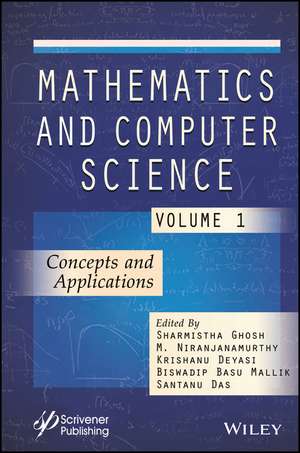
Mathematics and Computer Science, Volume 1
Editat de Sharmistha Ghosh, M. Niranjanamurthy, Krishanu Deyasi, Biswadip Basu Mallik, Santanu Dasen Limba Engleză Hardback – 15 aug 2023
Observăm că Mathematics and Computer Science, Volume 1 se adresează în primul rând studenților la facultățile de profil tehnic, cercetătorilor și practicienilor din industrie care au nevoie de o fundamentare matematică riguroasă pentru tehnologiile emergente. Această lucrare, publicată sub egida Wiley, reprezintă primul volum dintr-o serie ambițioasă care își propune să documenteze simbioza tot mai strânsă dintre conceptele matematice abstracte și aplicațiile practice din informatică. Apreciem structura densă a celor 560 de pagini, care nu se limitează la o singură ramură, ci explorează un spectru diversificat: de la ecuații diferențiale și integrale aplicate în dinamica fluidelor, până la logica fuzzy, Big Data și Internet of Things. În contextul operei editorilor, acest volum acționează ca o continuare firească a temelor din Mathematical Modeling for Computer Applications, trecând de la fundamentele modelării la inovații tehnologice specifice și implementări de ultimă oră. Credem că acest volum completează perspectiva oferită de Emerging Advancements in Mathematical Sciences de Bhagwati Prasad Chamola. În timp ce lucrarea lui Chamola se concentrează pe fundamentele teoretice ale matematicii pure și aplicate, Mathematics and Computer Science, Volume 1 adaugă o componentă tehnologică pronunțată, punând accent pe modul în care aceste teorii creează valoare pentru utilizatorii finali prin inteligență artificială și securitate cibernetică. Tonul este unul academic precis, capitolele fiind riguros documentate pentru a servi drept referință în bibliografiile cursurilor universitare de licență și master.
Preț: 1262.60 lei
Preț vechi: 1639.75 lei
-23%
Carte disponibilă
Livrare economică 05-19 noiembrie
Specificații
ISBN-10: 1119879671
Pagini: 560
Dimensiuni: 155 x 229 x 33 mm
Greutate: 0.89 kg
Ediția:1
Editura: Wiley
Locul publicării:Hoboken, United States
De ce să citești această carte
Această lucrare este esențială pentru cei care doresc să înțeleagă arhitectura matematică din spatele algoritmilor moderni. Cititorul câștigă acces la o sinteză actualizată a cercetărilor internaționale în domenii critice precum criptografia și învățarea automată. Este o resursă de referință pentru bibliotecile universitare, oferind soluții practice pentru probleme computaționale complexe prin metode statistice și optimizare.
Despre autor
Volumul este coordonat de o echipă de experți recunoscuți, printre care Sharmistha Ghosh, M. Niranjanamurthy și Biswadip Basu Mallik. Acești editori au o experiență vastă în cercetarea interdisciplinară, fiind implicați anterior în proiecte precum Mathematical Modeling for Computer Applications. Expertiza lor colectivă acoperă atât matematica aplicată, cât și ingineria sistemelor de calcul, facilitând o abordare integrată a inovațiilor tehnologice. Activitatea lor se concentrează pe transformarea teoriilor matematice în instrumente utile pentru mediul academic și industrial global.
Notă biografică
M. Niranjanamurthy, PhD, is an assistant professor in the Department of Computer Applications, M S Ramaiah Institute of Technology, Bangalore, Karnataka. He earned his PhD in computer science at JJTU, Rajasthan, India. He has over 11 years of teaching experience and two years of industry experience as a software engineer. He has published several books, and he is working on numerous books for Scrivener Publishing. He has published over 60 papers for scholarly journals and conferences, and he is working as a reviewer in 22 scientific journals. He also has numerous awards to his credit.
Krishanu Deyasi is an associate professor in the Department of Basic Sciences and Humanities at the Institute of Engineering and Management, India. He earned his PhD from the Indian Institute of Science Education and Research, and he has postdoctoral experience from The Institute of Mathematical Sciences, India. He has written three books and has published papers in scientific journals. He is also an editor for several scientific journals.
Biswadip Basu Mallik is a senior assistant professor of mathematics in the Department of Basic Sciences and Humanities at the Institute of Engineering and Management, India. He has been involved in teaching and research for more than 21 years and has published several research papers in various scientific journals along with book chapters with various publishers. He has authored five books and has five patents to his credit. He is a managing editor of the Journal of Mathematical Sciences & Computational Mathematics and is an editorial board member and reviewer for several scientific journals.
Santanu Das is an assistant professor in the Department of Basic Sciences and Humanities at the Institute of Engineering and Management, India. He completed his undergraduate degree, and is pursuing his doctorate, from Jadavpur University.
Descriere scurtă
This new edited volume from Wiley-Scrivener is the first of its kind to present scientific and technological innovations by leading academicians, eminent researchers, and experts around the world in the areas of mathematical sciences and computing. The chapters focus on recent advances in computer science, and mathematics, and where the two intersect to create value for end users through practical applications of the theory.
The chapters herein cover scientific advancements across a diversified spectrum that includes differential as well as integral equations with applications, computational fluid dynamics, nanofluids, network theory and optimization, control theory, machine learning and artificial intelligence, big data analytics, Internet of Things, cryptography, fuzzy automata, statistics, and many more. Readers of this book will get access to diverse ideas and innovations in the field of computing together with its growing interactions in various fields of mathematics. Whether for the engineer, scientist, student, academic, or other industry professional, this is a must-have for any library.
Cuprins
1 Error Estimation of the Function by (Z ru ,r ¿ 1) Using Product Means (E,s)( N, pn ,,qn) n of) the Conjugate Fourier Series 1
Aradhana Dutt Jauhari and Pankaj Tiwar
1.1 Introduction 1
1.2 Theorems 5
1.3 Lemmas 6
1.4 Proof of the Theorems 9
1.5 Corollaries 16
1.6 Example 16
1.7 Conclusion 18
References 18
2 Blow Up and Decay of Solutions for a Klein-Gordon Equation With Delay and Variable Exponents 21
Hazal Yüksekkaya and Erhan Pi¿kin
2.1 Introduction 21
2.2 Preliminaries 23
2.3 Blow Up of Solutions 26
2.4 Decay of Solutions 36
Acknowledgment 43
References 43
3 Some New Inequalities Via Extended Generalized Fractional Integral Operator for Chebyshev Functional 45
Bhagwat R. Yewale and Deepak B. Pachpatte
3.1 Introduction 45
3.2 Preliminaries 46
3.3 Fractional Inequalities for the Chebyshev Functional 47
3.4 Fractional Inequalities in the Case of Extended Chebyshev Functional 53
3.5 Some Other Fracional Inequalities Related to the Extended Chebyshev Functional 57
3.6 Concluding Remark 63
References 64
4 Blow Up of the Higher-Order Kirchhoff-Type System With Logarithmic Nonlinearities 67
Nazl¿ Irkil and Erhan Pi¿kin
4.1 Introduction 67
4.2 Preliminaries 69
4.3 Blow Up for Problem for E (0) < d 78
4.4 Conclusion 84
References 85
5 Developments in Post-Quantum Cryptography 89
Srijita Sarkar, Saranya Kumar, Anaranya Bose and Tiyash Mukherjee
5.1 Introduction 90
5.2 Modern-Day Cryptography 90
5.3 Quantum Computing 93
5.4 Algorithms Proposed for Post-Quantum Cryptography 97
5.5 Launching of the Project Called "Open Quantum Safe" 100
5.6 Algorithms Proposed During the NIST Standardization Procedure for Post-Quantum Cryptography 101
5.7 Hardware Requirements of Post-Quantum Cryptographic Algorithms 101
5.8 Challenges on the Way of Post-Quantum Cryptography 104
5.9 Post-Quantum Cryptography Versus Quantum Cryptography 105
5.10 Future Prospects of Post-Quantum Cryptography 106
References 107
6 A Statistical Characterization of MCX Crude Oil Price with Regard to Persistence Behavior and Seasonal Anomaly 111
Anindita Bhattacharjee, Jaya Mamta Prosad and M.K. Das
6.1 Introduction 111
6.2 Related Literature 113
6.3 Data Description and Methodology 114
6.4 Analysis and Findings 117
6.5 Conclusion and Implications 123
References 125
Appendix 128
7 Some Fixed Point and Coincidence Point Results Involving G¿ -Type Weakly Commuting Mappings 133
Krishna Kanta Sarkar, Krishnapada Das and Abhijit Pramanink
7.1 Introduction 133
7.2 Definitions and Mathematical Preliminaries 134
7.3 Main Results 140
7.4 Conclusion 170
7.5 Open Question 171
References 171
8 Grobner Basis and Its Application in Motion of Robot Arm 173
Anjan Samanta
8.1 Introduction 173
8.2 Hilbert Basis Theorem and Grobner Basis 175
8.3 Properties of Grobner Basis 175
8.4 Applications of Grobner Basis 176
8.5 Application of Grobner Basis in Motion of Robot Arm 178
8.6 Conclusion 189
References 189
9 A Review on the Formation of Pythagorean Triplets and Expressing an Integer as a Difference of Two Perfect Squares 191
Souradip Roy, Tapabrata Bhattacharyya, Subhadip Roy, Souradeep Paul and Arpan Adhikary
9.1 Introduction 191
9.2 Calculation of Triples 193
9.3 Computing the Number of Primitive Triples 200
9.4 Representation of Integers as Difference of Two Perfect Squares 205
9.5 Conclusion 211
References 211
10 Solution of Matrix Games With Pay¿Offs of Single-Valued Neutrosophic Numbers and Its Application to Market Share Problem 213
Mijanur Rahaman Seikh and Shibaji Dutta
10.1 Introduction 213
10.2 Preliminaries 216
10.3 Matrix Games With SVNN Pay-Offs and Concept of Solution 218
10.4 Mathematical Model Construction for SVNNMG 219
10.5 Numerical Example 224
10.6 Conclusion 228
References 228
11 A Novel Score Function-Based EDAS Method for the Selection of a Vacant Post of a Company with q-Rung Orthopair Fuzzy Data 231
Utpal Mandal and Mijanur Rahaman Seikh
11.1 Introduction 231
11.2 Preliminaries 234
11.3 A Novel Score Function of q-ROFNs 236
11.4 EDAS Method for q-ROF MADM Problem 240
11.5 Numerical Example 244
11.6 Comparative Analysis 246
11.7 Conclusions 247
Acknowledgments 248
References 248
12 Complete Generalized Soft Lattice 251
Manju John and Susha D.
12.1 Introduction 251
12.2 Soft Sets and Soft Elements-Some Basic Concepts 252
12.3 gs-Posets and gs-Chains 253
12.4 Soft Isomorphism and Duality of gs-Posets 257
12.5 gs-Lattices and Complete gs-Lattices 259
12.6 s-Closure System and s-Moore Family 264
12.7 Complete gs-Lattices From s-Closure Systems 266
12.8 A Representation Theorem of a Complete gs-Lattice as an s-Closure System 267
12.9 gs-Lattices and Fixed Point Theorem 268
References 269
13 Data Representation and Performance in a Prediction Model 271
Apurbalal Senapati, Soumen Maji and Arunendu Mondal
13.1 Introduction 272
13.2 Data Description and Representations 276
13.3 Experiment and Result 281
13.4 Error Analysis 282
13.5 Conclusion 283
References 284
14 Video Watermarking Technique Based on Motion Frames by Using Encryption Method 285
Praful Saxena and Santosh Kumar
14.1 Introduction 286
14.2 Methodology Used 287
14.3 Literature Review 289
14.4 Watermark Encryption 290
14.5 Proposed Watermarking Scheme 292
14.6 Experimental Results 296
14.7 Conclusion 297
References 298
15 Feature Extraction and Selection for Classification of Brain Tumors 299
Saswata Das
15.1 Introduction 299
15.2 Related Work 301
15.3 Methodology 303
15.4 Results 313
15.5 Future Scope 313
15.6 Conclusion 314
References 315
16 Student's Self-Esteem on the Self-Learning Module in Mathematics 6 317
Ariel Gulla Villar and Biswadip Basu Mallik
16.1 Introduction 318
16.2 Methodology 320
16.3 Results and Discussion 322
16.4 Conclusion 329
16.5 Recommendation 330
References 331
17 Effects on Porous Nanofluid due to Internal Heat Generation and Homogeneous Chemical Reaction 333
Hiranmoy Mondal and Sharmistha Ghosh
Nomenclature 334
17.1 Introduction 334
17.2 Mathematical Formulations 336
17.3 Method of Local Nonsimilarity 341
17.4 Results and Discussions 342
17.5 Concluding Remarks 348
References 349
18 Numerical Solution of Partial Differential Equations: Finite Difference Method 353
Roushan Kumar, Rakhi Tiwari and Rashmi Prasad
18.1 Introduction 353
18.2 Finite Difference Method 356
18.3 Multilevel Explicit Difference Schemes 360
18.4 Two-Level Implicit Scheme 364
18.5 Conclusion 371
References 371
19 Godel Code Enciphering for QKD Protocol Using DNA Mapping 373
Partha Sarathi Goswami and Tamal Chakraborty
19.1 Introduction 374
19.2 Related Work 375
19.3 The DNA Code Set 376
19.4 Godel Code 376
19.5 Key Exchange Protocol 378
19.6 Encoding and Decoding of the Plain Text- The QKD Protocol 378
19.7 Experimental Setup 388
19.8 Detection Probability and Dark Counts 389
19.9 Security Analysis of Our Algorithm 390
19.10 Conclusion 393
References 393
20 Predictive Analysis of Stock Prices Through Scikit-Learn: Machine Learning in Python 397
Vikash Kumar Mishra, Richa Binyala, Pratibha Sharma and Simran Singh
20.1 Introduction 397
20.2 Study Area and Dataset 398
20.3 Methodology 399
20.4 Results 401
20.5 Conclusion 402
References 403
21 Pose Estimation Using Machine Learning and Feature Extraction 405
J. Palanimeera and K. Ponmozhi
21.1 Introduction 406
21.2 Related Work 408
21.3 Proposed Work 409
21.4 Outcome and Discussion 420
21.5 Conclusion 422
References 423
22 E-Commerce Data Analytics Using Web Scraping 425
Vikash Kumar Mishra, Bosco Paul Alapatt, Aaditya Aggarwal and Divya Khemani
22.1 Introduction 425
22.1.1 Uses of Web Scraping 426
22.2 Research Objective 426
22.3 Literature Review 427
22.4 Feasibility and Application 428
22.5 Proposed Methodology 428
22.6 Conclusion 433
References 433
23 A New Language-Generating Mechanism of SNPSSP 435
Prithwineel Paul, Soumadip Ghosh and Anjan Pal
23.1 Introduction 436
23.2 Spiking Neural P Systems With Structural Plasticity ((SNPSSP) 437
23.3 Labeled SNPSSP (LSNPSSP) 440
23.4 Main Results 442
23.5 Conclusion 450
References 450
24 Performance Analysis and Interpretation Using Data Visualization 455
Vikash Kumar Mishra, Iyyappan, M., Muskan Soni and Neha Jain
24.1 Introduction 455
24.2 Selecting Data Set 456
24.3 Proposed Methodology 457
24.4 Results 458
24.5 Conclusion 460
References 460
25 Dealing with Missing Values in a Relation Dataset Using the DROPNA Function in Python 463
Vikash Kumar Mishra, Shoney Sebastian, Maria Iqbal and Yashwin Anand
25.1 Introduction 464
25.2 Background 464
25.3 Study Area and Data Set 464
25.4 Methodology 466
25.5 Results 468
25.6 Conclusion 468
25.7 Acknowledgment 469
References 469
26 A Dynamic Review of the Literature on Blockchain-Based Logistics Management 471
C. Devi Parameswari and M. Ilayaraja
26.1 Introduction 471
26.2 Blockchain Concepts and Framework 473
26.3 Study of the Literature 475
26.4 Challenges and Processes of Supply Chain Transparency 477
26.5 Challenges in Security 478
26.6 Discussion: In Terms of Supply Chain Dynamics, Blockchain Technology and Supply Chain Integration 479
26.7 Conclusion 481
Acknowledgment 481
References 482
27 Prediction of Seasonal Aliments Using Big Data: A Case Study 485
K. Indhumathi and K. Sathesh Kumar
27.1 Introduction 486
27.2 Related Works 486
27.3 Conclusion 489
References 490
28 Implementation of Tokenization in Natural Language Processing Using NLTK Module of Python 493
Vikash Kumar Mishra, Abhimanyu Dhyani, Sushree Barik and Tanish Gupta
28.1 Introduction 493
28.2 Background 494
28.3 Study Area and Data Set 495
28.4 Proposed Methodology 495
28.5 Result 498
28.6 Conclusion 500
28.7 Acknowledgment 501
Conflicts of Interest/Competing Interests 501
Availability of Data and Material 503
References 503
29 Application of Nanofluids in Heat Exchanger and its Computational Fluid Dynamics 505
M. Appadurai, E. Fantin Irudaya Raj and M. Chithambara Thanu
29.1 Computational Fluid Dynamics 506
29.2 Nanofluids 510
29.3 Preparation of Nanofluids 512
29.4 Use of Computational Fluid Dynamics for Nanofluids 517
29.5 CFD Approach to Solve Heat Exchanger 518
29.6 Conclusion 522
References 522
About the Editors 525
Index 527