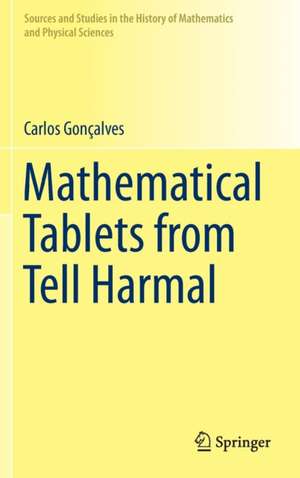
Mathematical Tablets from Tell Harmal: Sources and Studies in the History of Mathematics and Physical Sciences
Autor Carlos Gonçalvesen Limba Engleză Hardback – 23 noi 2015
Recomandăm volumul Mathematical Tablets from Tell Harmal cercetătorilor în istoria științei, asiriologilor și matematicienilor interesați de rădăcinile gîndirii algoritmice. Autorul Carlos Gonçalves propune prima ediție critică unitară a celor douăsprezece tăblițe descoperite în situl Tell Harmal (vechiul Šaduppûm), oferind o perspectivă integrată asupra unui material care, timp de peste șase decenii, a fost accesibil doar fragmentar, prin articole disparate. Observăm o abordare duală a conținutului: pe de o parte, textul analizează probleme de geometrie abstractă, iar pe de altă parte, documentează matematica aplicată în logistica administrativă a regatului Ešnunna, de la calculul forței de muncă necesare pentru zidirea unui perete, pînă la gestiunea stocurilor de alimente. Lucrarea este organizată riguros, începînd cu contextul arheologic al sitului și continuînd cu o sinteză a matematicii din perioada veche babiloniană. Apreciem în mod deosebit includerea comentariilor filologice care însoțesc traducerile, facilitînd înțelegerea terminologiei specifice scribilor locali. Această ediție Springer completează perspectiva oferită de New Mathematical Cuneiform Texts de Jöran Friberg, adăugînd o dimensiune geografică și socială specifică regiunii Diyala, pe care lucrările mai vaste de tip catalog tind să o generalizeze. În timp ce Jöran Friberg se concentrează pe corpusuri extinse de texte numerice, Carlos Gonçalves reușește să ancoreze cele douăsprezece tăblițe în contextul cultural local, demonstrînd cum practicile matematice erau modelate de necesitățile imediate ale cetății. Structura progresivă, susținută de un glosar terminologic detaliat, face ca acest volum tehnic să fie accesibil și specialiștilor din discipline conexe care studiază civilizația mesopotamiană.
Din seria Sources and Studies in the History of Mathematics and Physical Sciences
- 18%
 Preț: 1149.46 lei
 - 18%
 Preț: 915.26 lei
 - 18%
 Preț: 845.30 lei
 - 18%
 Preț: 1001.10 lei
 - 15%
 Preț: 615.59 lei
 - 15%
 Preț: 646.58 lei
 - 18%
 Preț: 907.28 lei
 -
 Preț: 380.62 lei
 - 18%
 Preț: 1158.29 lei
 - 15%
 Preț: 662.83 lei
 - 23%
 Preț: 771.29 lei
 - 18%
 Preț: 858.62 lei
 - 18%
 Preț: 1118.70 lei
 - 15%
 Preț: 667.40 lei
 - 15%
 Preț: 644.73 lei
 - 18%
 Preț: 896.92 lei
 - 18%
 Preț: 765.46 lei
 - 15%
 Preț: 644.82 lei
 - 15%
 Preț: 614.19 lei
 - 18%
 Preț: 919.16 lei
 - 24%
 Preț: 1407.01 lei
 - 15%
 Preț: 669.32 lei
 - 15%
 Preț: 697.97 lei
 -
 Preț: 387.02 lei
 - 18%
 Preț: 1253.11 lei
 - 18%
 Preț: 1420.20 lei
 - 15%
 Preț: 655.37 lei
 -
 Preț: 393.24 lei
 - 18%
 Preț: 920.97 lei
 - 15%
 Preț: 583.04 lei
 - 18%
 Preț: 919.32 lei
 - 15%
 Preț: 627.14 lei
 - 18%
 Preț: 1127.07 lei
 - 15%
 Preț: 584.13 lei
 -
 Preț: 390.50 lei
 - 24%
 Preț: 3733.93 lei
 - 24%
 Preț: 930.25 lei
 - 18%
 Preț: 2189.31 lei
 - 18%
 Preț: 1036.45 lei
Preț: 389.28 lei
Carte tipărită la comandă
Livrare economică 19 noiembrie-03 decembrie
Specificații
ISBN-10: 3319225235
Pagini: 160
Ilustrații: XV, 141 p.
Dimensiuni: 160 x 241 x 15 mm
Greutate: 0.41 kg
Ediția:1st edition 2015
Editura: Springer
Colecția Sources and Studies in the History of Mathematics and Physical Sciences
Seria Sources and Studies in the History of Mathematics and Physical Sciences
Locul publicării:Cham, Switzerland
V-ar putea interesa
-
 Analysis and ProbabilityAurel Spataru-26%Preț: 662.55 lei891.54 lei
 -
 Turing's CathedralGeorge Dyson-23%Preț: 83.17 lei108.61 lei
 -
 -33%Preț: 1731.38 lei2575.61 lei
 -
 Fibonacci's Liber AbaciLaurence Sigler-15%Preț: 667.40 lei785.18 lei
 -
 The Colorado Mathematical Olympiad and Further ExplorationsAlexander SoiferPreț: 433.72 lei
 -
 The Mathematical ExperiencePhilip J. DavisPreț: 130.45 lei
 -
 -32%Preț: 128.87 lei188.71 lei
 -
 In Pursuit of the UnknownIan StewartPreț: 109.35 lei
 -
 Preț: 386.55 lei
 -
 Mathematics for the Liberal ArtsD Bindner-23%Preț: 664.98 lei863.60 lei
 -
 -23%Preț: 577.85 lei750.46 lei
 -
 -23%Preț: 459.68 lei596.99 lei
 -
 The Noether TheoremsYvette Kosmann-Schwarzbach-15%Preț: 583.04 lei685.92 lei
 -
 Handbook on the History of Mathematics EducationAlexander Karp-18%Preț: 2128.03 lei2595.16 lei
 -
 The Scholar and the State: In Search of Van der WaerdenAlexander Soifer-15%Preț: 717.04 lei843.58 lei
 -
 -15%Preț: 646.96 lei761.14 lei
 -
 Creators of Mathematical and Computational SciencesRavi P Agarwal-47%Preț: 424.61 lei804.44 lei
 -
 -18%Preț: 1376.99 lei1679.25 lei
Public țintă
ResearchDe ce să citești această carte
Această ediție critică este esențială pentru oricine studiază evoluția gîndirii matematice pre-euclidiene. Cititorul câștigă acces la o interpretare modernă, bazată pe cele mai recente descoperiri din asiriologie, a unor texte fundamentale pentru înțelegerea modului în care abstractizarea matematică s-a născut din nevoi practice, administrative. Este o resursă rară ce combină rigoarea matematică cu analiza istorică și filologică a perioadei vechi babiloniene.
Descriere scurtă
This new edition of the texts is the first to group them, and takes into account all the recent developments of the research in the history of Mesopotamian mathematics. Its introductory chapters are directed to readers interested in an overview of the mathematical contents of these tablets and the language issues involved in their interpretation, while a chapter of synthesis discusses the ways history of mathematics has typically dealt with the mathematical evidence and inquires how and to what degree mathematical tablets can be made part of a picture of the larger social context. Furthermore, the volume contributes to a geography of the Old Babylonian mathematical practices, by evidencing that scribes at Šaduppûm made use of cultural material that was locally available. The edited texts are accompanied by translations, philological, and mathematical commentaries.
Cuprins
Recenzii
“This work is a compilation of transcriptions and translations of twelve mathematical tablets unearthed at a site near Baghdad, mostly in 1949. … For those interested in the mathematics of Old Babylonia, this book provides numerous ideas to ponder.” (Victor J. Katz, Mathematical Reviews, July, 2016)