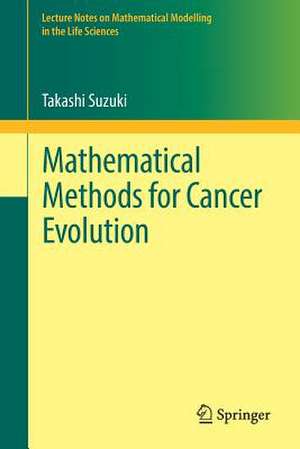
Mathematical Methods for Cancer Evolution: Lecture Notes on Mathematical Modelling in the Life Sciences
Autor Takashi Suzukien Limba Engleză Paperback – 20 iun 2017
Considerăm că Mathematical Methods for Cancer Evolution reprezintă o resursă tehnică esențială pentru înțelegerea mecanismelor biologice prin prisma rigorii matematice. Volumul debutează cu o analiză detaliată a dinamicii moleculare în fazele incipiente ale invaziei tumorale, stabilind structuri matematice precise pentru rețelele de căi de semnalizare. Această abordare fundamentată pe date biologice concrete transformă fenomenele celulare complexe în modele abstracte, dar aplicabile.
Structura monografiei, organizată în patru capitole mari, ghidează cititorul de la modelarea teoretică la analiza matematică pură. Capitolul al doilea introduce sistemele Keller-Segel și utilizarea ecuațiilor cu derivate parțiale pentru a descrie transportul și gradienții de concentrație, în timp ce capitolul al treilea se concentrează pe teoriile câmpului mediu și simulările stocastice. Comparabil cu Introduction to Mathematical Oncology de Yang Kuang în ceea ce privește rigurozitatea, volumul de față se distinge prin accentul pus pe modelele multi-scală și pe fundamentarea termodinamică a sistemelor de reacție-difuzie.
Autorul, Takashi Suzuki, își continuă aici munca începută în Non-Local Partial Differential Equations for Engineering and Biology, rafinând instrumentele tehnice pentru analiza comportamentului soluțiilor în context biologic. Spre deosebire de lucrările sale anterioare, această ediție din seria Lecture Notes on Mathematical Modelling in the Life Sciences pune un accent sporit pe metodele hibride, utilizând metoda Monte Carlo pentru variabilele particulelor. Finalul cărții este rezervat unei analize matematice avansate, abordând sisteme competitive de chemotaxis și ecuația Smoluchowski-Poisson, oferind astfel un cadru complet pentru cercetarea teoretică în oncologie.
Din seria Lecture Notes on Mathematical Modelling in the Life Sciences
- 17%
 Preț: 475.06 lei
 - 15%
 Preț: 707.88 lei
 - 15%
 Preț: 609.86 lei
 - 15%
 Preț: 409.20 lei
 - 15%
 Preț: 709.30 lei
 -
 Preț: 379.03 lei
 -
 Preț: 396.88 lei
 -
 Preț: 351.37 lei
 - 15%
 Preț: 476.37 lei
 - 15%
 Preț: 493.68 lei
 - 18%
 Preț: 788.41 lei
 -
 Preț: 383.53 lei
 - 15%
 Preț: 587.12 lei
 - 15%
 Preț: 520.92 lei
 - 15%
 Preț: 589.72 lei
 -
 Preț: 402.42 lei
 -
 Preț: 459.56 lei
 -
 Preț: 364.71 lei
 - 15%
 Preț: 639.42 lei
 - 20%
 Preț: 620.20 lei
 -
 Preț: 387.35 lei
Preț: 552.21 lei
Preț vechi: 649.66 lei
-15%
Carte tipărită la comandă
Livrare economică 30 noiembrie-14 decembrie
Specificații
ISBN-10: 9811036705
Pagini: 152
Ilustrații: VII, 144 p. 23 illus.
Dimensiuni: 155 x 235 x 9 mm
Greutate: 0.24 kg
Ediția:1st edition 2017
Editura: Springer
Colecția Lecture Notes on Mathematical Modelling in the Life Sciences
Seria Lecture Notes on Mathematical Modelling in the Life Sciences
Locul publicării:Singapore, Singapore
V-ar putea interesa
-
 Here Is a Human BeingMisha AngristPreț: 106.82 lei
 -
 Methods in Theoretical Quantum OpticsStephen M. Barnett-29%Preț: 516.80 lei723.63 lei
 -
 Building a MealHervé ThisPreț: 83.86 lei
 -
 Foundations of CodingJ. Adamek-20%Preț: 1473.79 lei1842.24 lei
 -
 Preț: 93.41 lei
 -
 Practical Computing for BiologistsSteven H. D. Haddock-27%Preț: 797.38 lei1092.30 lei
 -
 -15%Preț: 623.85 lei733.94 lei
 -
 Essential Maths Skills for AS/A Level BiologyDan Foulder-13%Preț: 102.63 lei117.69 lei
 -
 Essential Maths Skills for AS/A Level PsychologyMolly Marshall-13%Preț: 101.75 lei117.49 lei
 -
 Python Scripting for Computational ScienceHans Petter LangtangenPreț: 472.77 lei
 -
 Space-Filling CurvesMichael Bader-15%Preț: 593.84 lei698.63 lei
De ce să citești această carte
Recomandăm această monografie studenților masteranzi și cercetătorilor în matematică aplicată care doresc să stăpânească modelarea fenomenelor oncologice. Cititorul câștigă o înțelegere profundă a sistemelor Keller-Segel și a metodelor hibride de simulare. Este o lectură fundamentală pentru cei care vor să aplice analiza matematică riguroasă, precum limitele de scalare și sistemele de reacție-difuzie, în biologia teoretică modernă.