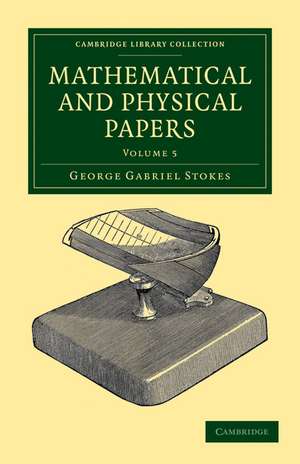
Mathematical and Physical Papers
Autor George Gabriel Stokesen Limba Engleză Paperback – 16 iul 2009
Preț: 444.43 lei
Puncte Express: 667
Carte tipărită la comandă
Livrare economică 30 noiembrie-14 decembrie
Livrare prin curier în România Termenul estimat este afișat lângă disponibilitate.
Transport gratuit pentru acest produs Plată online sau ramburs, în funcție de opțiunile comenzii.
Retur gratuit în 14 zile Comandă securizată și suport în română.
Specificații
ISBN-13: 9781108002677
ISBN-10: 1108002676
Pagini: 404
Dimensiuni: 140 x 216 x 24 mm
Greutate: 0.57 kg
Editura: Cambridge University Press
Locul publicării:Cambridge, United Kingdom
ISBN-10: 1108002676
Pagini: 404
Dimensiuni: 140 x 216 x 24 mm
Greutate: 0.57 kg
Editura: Cambridge University Press
Locul publicării:Cambridge, United Kingdom
V-ar putea interesa
-
 COLL EDEXCEL GCSE MATHS FT ALLCollins GcsePreț: 88.94 lei
 -
 COLL AQA MATHS HT ALLCollins GcsePreț: 89.94 lei
 -
 Preț: 47.49 lei
 -
 Preț: 89.84 lei
 -
 COLL GCSE ENG LANG & LIT ALLCollins GcsePreț: 89.28 lei
 -
 GCSE 9-1 Maths Higher Revision GuideCollins GcsePreț: 49.01 lei
 -
 Edexcel GCSE 9-1 Maths Higher Revision GuideCollins GcsePreț: 47.41 lei
 -
 KS2 Maths SATs Study BookCollins Ks2Preț: 48.90 lei
 -
 The Math Behind the MusicLeon HarkleroadPreț: 203.53 lei
 -
 Integration of FunctionsHardy G. H.Preț: 325.33 lei
 -
 The Pleasures of CountingT. W. Körner-8%Preț: 418.37 lei454.76 lei
 -
 A Course of Pure MathematicsG. H. Hardy-11%Preț: 436.29 lei490.21 lei
 -
 Hexaflexagons, Probability Paradoxes, and the Tower of HanoiMartin GardnerPreț: 111.07 lei
 -
 Prime Numbers and the Riemann HypothesisBarry MazurPreț: 213.38 lei
 -
 Professor Stewart's Casebook of Mathematical MysteriesProfessor Ian Stewart-18%Preț: 64.61 lei79.27 lei
Cuprins
Obituary notice by Lord Rayleigh; 1. Note on certain formulæ in the calculus of operations; 2. An experiment on electro-magnetic rotation; 3. On the foci of lines seen through a crystalline plate; 4. On certain movements of radiometers; 5. On the question of a theoretical limit to the apertures of microscopic objectives; 6. On an easy and at the same time accurate method of determining the ratio of the dispersions of glasses intended for objectives; 7. On a method of detecting inequalities of unknown periods in a series of observations; 8. Description of the card supported for sunshine recorders adopted at the meteorological office; 9. On a simple mode of eliminating errors of adjustment in delicate observations of compared spectra; 10. Discussion of the results of some experiments with whirled anemometers; 11. On the determination of the constants of the cup anemometer by experiments with a whirling machine; 12. Note on the reduction of Mr Crookes's experiments on the decrement of the arc of vibration of a mice plate oscillating within a bulb containing more or less rarefied gas; 13. On the cause of the light border frequently noticed in photographs just outside the outline of a dark body seen against the sky; 14. Extracts from reports of the Committee of Solar Physics; 15. Memorandum for the use of observers with Professor Balfour Stewart's actinometer; 16. On the highest wave of uniform propagation; 17. On the maximum wave of uniform propagation; 18. Note on the theory of the solitary wave; 19. The outskirts of the solitary wave; 20. On a remarkable phenomenon of crystalline reflection; 21. The coefficient of viscosity of air; 22. Note on the determination of arbitrary constants which appear as multipliers of semi-convergent series; 23. On a graphical representation of the results of Dr Alder Wright's experiments on ternary alloys; 24. On an optical proof of the existence of suspended matter in flames; 25. On the reactions occurring in flames; 26. The influence of surface-loading on the flexure of beams; 27. On the best methods of recording the direct intensity of solar radiation; 28. On the nature of the Röntgen rays; 29. On the nature of the Röntgen rays (Wilde lecture); 30. Mathematical proof of the identity of the stream lines obtained by means of a viscous film with those of a perfect fluid moving in two dimensions; 31. On the discontinuity of arbitrary constants that appear as multipliers of semi-convergent series; 32. On the methods of chemical fractionation; 33. The ultra-violet Spectrum of Radium; Appendix; Index.
Descriere
The collected papers of Sir George Stokes, the outstanding and influential nineteenth-century Cambridge mathematician.