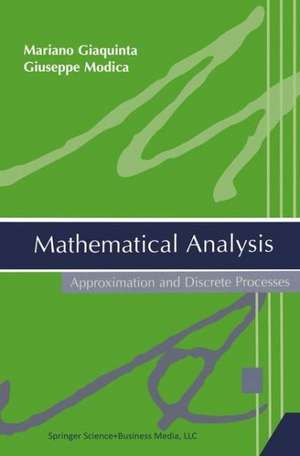
Mathematical Analysis
Autor Mariano Giaquinta, Giuseppe Modicaen Limba Engleză Hardback – 2 apr 2004
Preț: 678.49 lei
Preț vechi: 798.22 lei
-15%
Puncte Express: 1018
Carte tipărită la comandă
Livrare economică 28 noiembrie-12 decembrie
Livrare prin curier în România Termenul estimat este afișat lângă disponibilitate.
Transport gratuit pentru acest produs Plată online sau ramburs, în funcție de opțiunile comenzii.
Retur gratuit în 14 zile Comandă securizată și suport în română.
Specificații
ISBN-13: 9780817643133
ISBN-10: 0817643133
Pagini: 404
Ilustrații: XII, 388 p.
Dimensiuni: 183 x 260 x 27 mm
Greutate: 0.89 kg
Ediția:2004
Editura: birkhäuser
Locul publicării:Boston, MA, United States
ISBN-10: 0817643133
Pagini: 404
Ilustrații: XII, 388 p.
Dimensiuni: 183 x 260 x 27 mm
Greutate: 0.89 kg
Ediția:2004
Editura: birkhäuser
Locul publicării:Boston, MA, United States
V-ar putea interesa
-
 An Introduction to ¿-ConvergenceGianni Dal Maso-18%Preț: 1151.77 lei1404.59 lei
 -
 The Arnold-Gelfand Mathematical SeminarsV. Arnold-18%Preț: 920.57 lei1122.64 lei
 -
 Fundamentals of CalculusCarla C. Morris-27%Preț: 825.48 lei1130.80 lei
 -
 -23%Preț: 634.58 lei824.12 lei
 -
 -9%Preț: 777.29 lei854.17 lei
 -
 Calculus For Dummies, 2nd EditionMark RyanPreț: 109.93 lei
 -
 A First Course in Probability and Markov ChainsGiuseppe Modica-19%Preț: 515.58 lei636.52 lei
 -
 Calculus: Early TranscendentalsWilliam Briggs-15%Preț: 576.28 lei679.82 lei
 -
 Stochastic Calculus and ApplicationsSamuel N. CohenPreț: 482.21 lei
 -
 Numerical Methods For Simulationde Saporta-9%Preț: 1021.17 lei1122.17 lei
 -
 Calculus of Variations IMariano Giaquinta-18%Preț: 1159.55 lei1414.08 lei
 -
 Calculus of Variations IIMariano Giaquinta-18%Preț: 831.89 lei1014.50 lei
 -
 -15%Preț: 579.81 lei682.13 lei
 -
 Preț: 209.06 lei
Public țintă
GraduateCuprins
1. Real Numbers and Natural Numbers.- 1.1 Introduction.- 1.2 The Axiomatic Approach to Real Numbers.- 1.3 Natural Numbers.- 1.4 Summing Up.- 1.5 Exercises.- 2. Sequences of Real Numbers.- 2.1 Sequences.- 2.2 Equivalent Formulations of the Continuity Axiom.- 2.3 Limits of Sequences and Continuity.- 2.4 Some Special Sequences.- 2.5 An Alternative Definition of Exponentials and Logarithms.- 2.6 Summing Up.- 2.7 Exercises.- 3. Integer Numbers: Congruences, Counting and Infinity.- 3.1 Congruences.- 3.2 Combinatorics.- 3.3 Infinity.- 3.4 Summing Up.- 3.5 Exercises.- 4. Complex Numbers.- 4.1 Complex Numbers.- 4.2 Sequences of Complex Numbers.- 4.3 Some Elementary Applications.- 4.4 Summing Up.- 4.5 Exercises.- 5. Polynomials, Rational Functions and Trigonometric Polynomials.- 5.1 Polynomials.- 5.2 Solutions of Polynomial Equations.- 5.3 Rational Functions.- 5.4 Sinusoidal Functions and Their Sums.- 5.5 Summing Up.- 5.6 Exercises.- 6. Series.- 6.1 Basic Facts.- 6.2 Taylor Series, e and ?.- 6.3 Series of Nonnegative Terms.- 6.4 Series of Terms of Arbitrary Sign.- 6.5 Series of Products.- 6.6 Products of Series.- 6.7 Rearrangements.- 6.8 Summing Up.- 6.9 Exercises.- 7. Power Series.- 7.1 Basic Theory.- 7.2 Further Results.- 7.3 Some Applications.- 7.4 Further Applications.- 7.5 Summing Up.- 7.6 Exercises.- 8. Discrete Processes.- 8.1 Recurrences.- 8.2 One-Dimensional Dynamical Systems.- 8.3 Two-Dimensional Dynamical Systems.- 8.4 Exercises.- A. Mathematicians and Other Scientists.- B. Bibliographical Notes.- C. Index.
Recenzii
"This self-contained book aims to introduce the main ideas for studying approximation processes, more generally discrete processes at graduate level. The use of computers induces a growing need for studying discrete processes.... A key feature this lively yet rigorous and systematic treatment is the historical accounts of ideas and methods of the subject. Ideas in mathematics develop in cultural, historical and economical contexts, thus the authors made brief accounts of those aspects and used a large number of beautiful illustrations.... Each chapter has a short summary where the most important facts discussed are collected and described. There is also a large number of exercises inserted at various points into the text....The book is meant principally for graduate students in mathematics, physics, engineering, and computer science, but it can be used at technological and scientific faculties by anyone who wants to approach these topics. It may also be used in graduate seminars and courses or as a reference text by mathematicians, physicists, and engineers." —Zentralblatt MATH
"Mathematical Analysis does contain a substantial amount of material that is unusual in terms of an introductory text in real analysis…These are all interesting topics that have gained increasing importance in modern applications of mathematics, albeit outside the traditional area of analysis. It is very nice to have these topics developed outside a specialized textbook, in, e.g., combinatorics, dynamical systems, or number theory. The authors do a very good job presenting this material…Mathematical Analysis includes substantial amounts of historical background…The book also contains a lot of examples…I can happily recommend Mathematical Analysis as a good resource for instructors of introductory analysis courses, especially in terms of providing some unusual applications of analysis and developments of some basic classic topics that are oftenshortchanged in standard texts." —SIAM Review
“This is the second volume of a series on analysis. … a real hodgepodge that could only be the primary textbook for a course specifically based on it. … In this series Giaquinta and Modica have set themselves the formidable task of constructing from scratch an analysis sequence of several years length. … they have more regard for classical topics and arguments than most authors writing analysis books today. … I enjoyed reading this volume … .” (Warren Johnson, The Mathematical Association of America, January, 2010)
"Mathematical Analysis does contain a substantial amount of material that is unusual in terms of an introductory text in real analysis…These are all interesting topics that have gained increasing importance in modern applications of mathematics, albeit outside the traditional area of analysis. It is very nice to have these topics developed outside a specialized textbook, in, e.g., combinatorics, dynamical systems, or number theory. The authors do a very good job presenting this material…Mathematical Analysis includes substantial amounts of historical background…The book also contains a lot of examples…I can happily recommend Mathematical Analysis as a good resource for instructors of introductory analysis courses, especially in terms of providing some unusual applications of analysis and developments of some basic classic topics that are oftenshortchanged in standard texts." —SIAM Review
“This is the second volume of a series on analysis. … a real hodgepodge that could only be the primary textbook for a course specifically based on it. … In this series Giaquinta and Modica have set themselves the formidable task of constructing from scratch an analysis sequence of several years length. … they have more regard for classical topics and arguments than most authors writing analysis books today. … I enjoyed reading this volume … .” (Warren Johnson, The Mathematical Association of America, January, 2010)
Caracteristici
This fairly self-contained work embraces a broad range of topics in analysis at the graduate level, requiring only a sound knowledge of calculus and the functions of one variable Replete with beautiful illustrations, examples, exercises at the end of each chapter, and a comprehensive index May be used in graduate seminars and courses, or as a reference text by mathematicians, physicists, and engineers
Textul de pe ultima copertă
Mathematical Analysis: Foundations and Advanced Techniques for Functions of Several Variables builds upon the basic ideas and techniques of differential and integral calculus for functions of several variables, as outlined in an earlier introductory volume. The presentation is largely focused on the foundations of measure and integration theory.
The book begins with a discussion of the geometry of Hilbert spaces, convex functions and domains, and differential forms, particularly k-forms. The exposition continues with an introduction to the calculus of variations with applications to geometric optics and mechanics. The authors conclude with the study of measure and integration theory – Borel, Radon, and Hausdorff measures and the derivation of measures. An appendix highlights important mathematicians and other scientists whose contributions have made a great impact on the development of theories in analysis.
This work may be used as a supplementary text in the classroom or for self-study by advanced undergraduate and graduate students and as a valuable reference for researchers in mathematics, physics, and engineering. One of the key strengths of this presentation, along with the other four books on analysis published by the authors, is the motivation for understanding the subject through examples, observations, exercises, and illustrations.
Other books published by the authors – all of which provide the reader with a strong foundation in modern-day analysis – include:
* Mathematical Analysis: Functions of One Variable
* Mathematical Analysis: Approximation and Discrete Processes
* Mathematical Analysis: Linear and Metric Structures and Continuity
* Mathematical Analysis: An Introduction to Functions of Several Variables
Reviews of previous volumes of Mathematical Analysis:
The presentation of the theory is clearly arranged, all theorems haverigorous proofs, and every chapter closes with a summing up of the results and exercises with different requirements. . . . This book is excellently suitable for students in mathematics, physics, engineering, computer science and all students of technological and scientific faculties.
—Journal of Analysis and its Applications
The exposition requires only a sound knowledge of calculus and the functions of one variable. A key feature of this lively yet rigorous and systematic treatment is the historical accounts of ideas and methods of the subject. Ideas in mathematics develop in cultural, historical and economical contexts, thus the authors made brief accounts of those aspects and used a large number of beautiful illustrations.
—Zentralblatt MATH
The book begins with a discussion of the geometry of Hilbert spaces, convex functions and domains, and differential forms, particularly k-forms. The exposition continues with an introduction to the calculus of variations with applications to geometric optics and mechanics. The authors conclude with the study of measure and integration theory – Borel, Radon, and Hausdorff measures and the derivation of measures. An appendix highlights important mathematicians and other scientists whose contributions have made a great impact on the development of theories in analysis.
This work may be used as a supplementary text in the classroom or for self-study by advanced undergraduate and graduate students and as a valuable reference for researchers in mathematics, physics, and engineering. One of the key strengths of this presentation, along with the other four books on analysis published by the authors, is the motivation for understanding the subject through examples, observations, exercises, and illustrations.
Other books published by the authors – all of which provide the reader with a strong foundation in modern-day analysis – include:
* Mathematical Analysis: Functions of One Variable
* Mathematical Analysis: Approximation and Discrete Processes
* Mathematical Analysis: Linear and Metric Structures and Continuity
* Mathematical Analysis: An Introduction to Functions of Several Variables
Reviews of previous volumes of Mathematical Analysis:
The presentation of the theory is clearly arranged, all theorems haverigorous proofs, and every chapter closes with a summing up of the results and exercises with different requirements. . . . This book is excellently suitable for students in mathematics, physics, engineering, computer science and all students of technological and scientific faculties.
—Journal of Analysis and its Applications
The exposition requires only a sound knowledge of calculus and the functions of one variable. A key feature of this lively yet rigorous and systematic treatment is the historical accounts of ideas and methods of the subject. Ideas in mathematics develop in cultural, historical and economical contexts, thus the authors made brief accounts of those aspects and used a large number of beautiful illustrations.
—Zentralblatt MATH