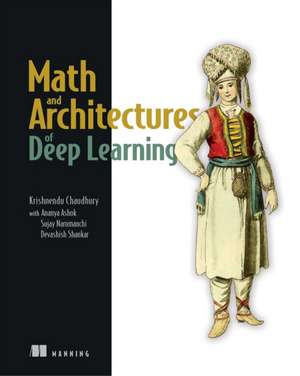
Math and Architectures of Deep Learning
Autor Krishnendu Chaudhuryen Limba Engleză Paperback – 15 mar 2024
Considerăm că principala barieră în dezvoltarea unor sisteme de inteligență artificială performante nu este scrierea codului, ci înțelegerea matematicii care guvernează optimizarea și arhitectura acestora. Math and Architectures of Deep Learning propune o soluție tehnică riguroasă pentru depășirea dependenței de modelele pre-configurate („black box”), oferind instrumentele necesare pentru a re-arhitecturaliza soluțiile în funcție de nevoi specifice. Autorul Krishnendu Chaudhury structurează materialul într-o progresie logică: începe cu fundamentarea în spații vectoriale și calcul vectorial, trece prin distribuții probabilistice și unelte bayesiene, pentru a culmina cu implementarea practică a arhitecturilor bazate pe convoluție 2D pentru recunoașterea obiectelor. Notăm cu interes modul în care fiecare concept teoretic este dublat de cod Python și PyTorch bine adnotat. Spre deosebire de alte lucrări care tratează subiectul tangențial, această publicație de la Manning Publications insistă pe mecanica internă a antrenării rețelelor, dedicând capitole extinse propagării înapoi (backpropagation), regularizării și optimizării. Cititorul care a aplicat ideile din Deep Learning with Python de Nikhil Ketkar va găsi aici rigoarea matematică necesară pentru a înțelege de ce anumite configurații funcționează, completând latura practică cu o bază teoretică solidă. În timp ce alte titluri se concentrează pe utilizarea bibliotecilor, lucrarea de față pune accent pe construcția lor, de la aproximarea funcțiilor la manipularea tensorială complexă, oferind o perspectivă tehnică indispensabilă pentru inginerii de date și cercetători.
Preț: 410.21 lei
Preț vechi: 512.76 lei
-20%
Carte disponibilă
Livrare economică 06-20 noiembrie
Livrare express 22-28 octombrie pentru 139.74 lei
Specificații
ISBN-10: 1617296481
Pagini: 450
Dimensiuni: 186 x 234 x 33 mm
Greutate: 1.02 kg
Editura: Manning Publications
V-ar putea interesa
-
 Deep Learning IllustratedAglae Bassens-20%Preț: 328.25 lei410.31 lei
 -
 Learning Deep LearningMagnus Ekman-20%Preț: 414.01 lei517.52 lei
 -
 Deep LearningIan Goodfellow-21%Preț: 684.46 lei865.01 lei
 -
 Understanding Deep LearningSimon J. D. Prince-20%Preț: 636.22 lei795.27 lei
 -
 -39%Preț: 394.79 lei646.62 lei
 -
 -31%Preț: 607.05 lei885.58 lei
 -
 Linear Algebra and Learning from DataGilbert Strang-8%Preț: 528.40 lei574.35 lei
 -
 Grokking Deep LearningAndrew W Trask-20%Preț: 288.36 lei360.45 lei
 -
 Deep Learning with PyTorchEli Stevens-20%Preț: 293.41 lei366.76 lei
 -
 Deep Learning with Python, Second EditionFrancois Chollet-20%Preț: 358.75 lei448.44 lei
 -
 Inside Deep Learning: Math, Algorithms, ModelsEdward Raff-20%Preț: 398.09 lei497.61 lei
 -
 -20%Preț: 251.45 lei314.31 lei
 -
 Math for ProgrammingRonald T. Kneusel-35%Preț: 244.36 lei373.43 lei
 -
 -20%Preț: 249.08 lei311.36 lei
 -
 Deep Learning Crash CourseGiovanni Volpe-35%Preț: 290.84 lei445.88 lei
 -
 Practical Deep Learning, 2nd Edition: A Python-Based IntroductionRonald T. Kneusel-35%Preț: 333.73 lei515.68 lei
 -
 Why Machines LearnAnil AnanthaswamyPreț: 160.44 lei
 -
 Deep Learning ArchitecturesOvidiu Calin-15%Preț: 498.66 lei586.66 lei
 -
 Materials Data ScienceStefan Sandfeld-15%Preț: 591.20 lei695.53 lei
 -
 Practical Deep Learning with PyTorchDeepak Gowda-20%Preț: 225.42 lei281.77 lei
De ce să citești această carte
Această carte se adresează programatorilor și cercetătorilor care doresc să treacă dincolo de simpla utilizare a bibliotecilor de Deep Learning. Cititorul câștigă capacitatea de a diagnostica erorile de antrenare și de a personaliza arhitecturile neuronale prin înțelegerea fundamentelor de algebră liniară și calcul vectorial. Este un ghid esențial pentru a transforma cercetarea de ultimă oră în aplicații practice robuste, folosind PyTorch ca instrument de bază.
Descriere scurtă
Inside Math and Architectures of Deep Learning you will find:
- Math, theory, and programming principles side by side
- Linear algebra, vector calculus and multivariate statistics for deep learning
- The structure of neural networks
- Implementing deep learning architectures with Python and PyTorch
- Troubleshooting underperforming models
- Working code samples in downloadable Jupyter notebooks
The mathematical paradigms behind deep learning models typically begin as hard-to-read academic papers that leave engineers in the dark about how those models actually function. Math and Architectures of Deep Learning bridges the gap between theory and practice, laying out the math of deep learning side by side with practical implementations in Python and PyTorch. Written by deep learning expert Krishnendu Chaudhury, you’ll peer inside the “black box” to understand how your code is working, and learn to comprehend cutting-edge research you can turn into practical applications.
Foreword by Prith Banerjee.
About the technology
Discover what’s going on inside the black box! To work with deep learning you’ll have to choose the right model, train it, preprocess your data, evaluate performance and accuracy, and deal with uncertainty and variability in the outputs of a deployed solution. This book takes you systematically through the core mathematical concepts you’ll need as a working data scientist: vector calculus, linear algebra, and Bayesian inference, all from a deep learning perspective.
About the book
Math and Architectures of Deep Learning teaches the math, theory, and programming principles of deep learning models laid out side by side, and then puts them into practice with well-annotated Python code. You’ll progress from algebra, calculus, and statistics all the way to state-of-the-art DL architectures taken from the latest research.
What's inside
- The core design principles of neural networks
- Implementing deep learning with Python and PyTorch
- Regularizing and optimizing underperforming models
About the reader
Readers need to know Python and the basics of algebra and calculus.
About the author
Krishnendu Chaudhury is co-founder and CTO of the AI startup Drishti Technologies. He previously spent a decade each at Google and Adobe.
Table of Contents
1 An overview of machine learning and deep learning
2 Vectors, matrices, and tensors in machine learning
3 Classifiers and vector calculus
4 Linear algebraic tools in machine learning
5 Probability distributions in machine learning
6 Bayesian tools for machine learning
7 Function approximation: How neural networks model the world
8 Training neural networks: Forward propagation and backpropagation
9 Loss, optimization, and regularization
10 Convolutions in neural networks
11 Neural networks for image classification and object detection
12 Manifolds, homeomorphism, and neural networks
13 Fully Bayes model parameter estimation
14 Latent space and generative modeling, autoencoders, and variational autoencoders
A Appendix