
Materials Informatics: Molecules, Crystals, and Beyond: Acta Materialia Book Series
Autor Krishna Rajanen Limba Engleză Paperback – 26 iun 2026
Building on these topics, chapters then cover the development of physics/chemistry informed data representations of structure and properties, the application of machine learning for structure and property prediction and screening for targeted properties, and the utilization of techniques such a graphics recognition, natural language processing, and statistically driven visualization tools in deciphering processing-structure-property-performance relationships in materials.
- Explores the nature of data curation from the perspective of both data production and consumption and the different paradigms of data management
- Highlights the role of informatics in correlative imaging for different genres of microscopy methods ranging from optical imaging to atomic-scale tomography
- Provides a framework for transforming materials science and engineering education through the lens of Materials Informatics


Preț: 1112.33 lei
Preț vechi: 1599.44 lei
-30%
Puncte Express: 1668
Carte tipărită la comandă
Livrare economică 16-30 decembrie
Livrare prin curier în România Termenul estimat este afișat lângă disponibilitate.
Transport gratuit pentru acest produs Plată online sau ramburs, în funcție de opțiunile comenzii.
Retur gratuit în 14 zile Comandă securizată și suport în română.
Specificații
ISBN-13: 9780443222566
ISBN-10: 0443222568
Pagini: 574
Dimensiuni: 152 x 229 mm
Greutate: 0.92 kg
Editura: ELSEVIER SCIENCE
Colecția Acta Materialia Book Series
Seria Acta Materialia Book Series
ISBN-10: 0443222568
Pagini: 574
Dimensiuni: 152 x 229 mm
Greutate: 0.92 kg
Editura: ELSEVIER SCIENCE
Colecția Acta Materialia Book Series
Seria Acta Materialia Book Series
V-ar putea interesa
-
 Materials: Engineering, Science, Processing and DesignMichael F. Ashby-29%Preț: 429.07 lei601.54 lei
-
 Materials and the Environment: Eco-informed Material ChoiceMichael F. Ashby-30%Preț: 362.16 lei520.30 lei
-
 -22%Preț: 579.55 lei739.82 lei
-
 Materials: A Very Short IntroductionChristopher Hall-19%Preț: 57.36 lei70.82 lei
-
 -13%Preț: 131.58 lei151.53 lei
-
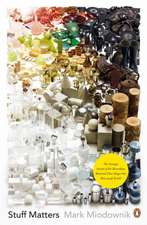 Stuff MattersMark Miodownik-24%Preț: 65.20 lei86.08 lei
-
 -38%Preț: 398.93 lei646.62 lei
-
 The Materials Sourcebook for Design ProfessionalsRob Thompson-15%Preț: 506.63 lei597.00 lei
-
 Advances in Materials Science and TechnologySrikari Srinivasan-15%Preț: 547.72 lei644.38 lei
-
 Data Science Essentials for DummiesLillian Pierson-20%Preț: 76.56 lei95.69 lei
-
 -29%Preț: 98.78 lei139.80 lei
-
 Materials for DesignChris Lefteri-28%Preț: 139.96 lei195.35 lei
-
 Materials Data ScienceStefan Sandfeld-19%Preț: 624.52 lei771.02 lei
-
 Statistics for ScientistsUmberto Michelucci-20%Preț: 300.42 lei375.52 lei
-
 A Concise Introduction to Polymer PhysicsReinhard Hentschke-15%Preț: 492.05 lei578.89 lei
-
 Antimicrobial Materials and InterfacesEn-Tang Kang-23%Preț: 1511.42 lei1962.88 lei
-
 -23%Preț: 754.90 lei980.40 lei
-
 Materials ScienceA. MarikaniPreț: 344.13 lei
-
 Advances in Materials and ProcessingSupratik Roychowdhury-18%Preț: 1442.58 lei1759.24 lei
-
 Advanced Materials and ManufacturingJitendra Kumar Katiyar-18%Preț: 1458.93 lei1779.19 lei
Cuprins
1 . Information science for materials science
2 . Enabling knowledge discovery from data
3. Informatics for thermodynamics: Stability to synthesizability
4. Pixels to properties
5. Combinatorial to autonomous experimentation
6. Mapping Connections and Pathways
7. Sustaining the growth of the materials informatics ecosystem
8. Shifting the educational paradigm: Discovering concepts and connections
Notă biografică
Krishna Rajan is the SUNY Distinguished Professor and Erich Bloch Chair of the Department of Materials Design and Innovation (MDI) at the University at Buffalo; with a joint appointment as Chief Scientist in the Energy Processes and Materials Division at Pacific Northwest National Laboratory (PNNL). He has pioneered the field of Materials Informatics and data driven discovery in materials science and engineering and its impact on characterization, processing, and modeling of materials. He has received numerous recognitions including the Alexander von Humboldt Award from Germany, the CSIRO- Australia Distinguished Visiting Scientist Award, the CNRS Visiting Professorship from France and the Presidential Lecture Award from the National Institute of Materials Science, Japan.
Dr Rajan received his undergraduate degree in Metallurgy and Materials Science from the University of Toronto followed by a doctorate in Materials Science from MIT with a minor in Science and Technology policy. He subsequently held post-doctoral appointments at MIT and Cambridge University. He was a staff scientist at the National Research Council of Canada, followed by faculty positions at Rensselaer Polytechnic Institute and Iowa State University before coming to the University at Buffalo as the founding chair of the MDI department. It is the first department that has its research and curriculum built around an informatics perspective of materials science and engineering.
Dr Rajan received his undergraduate degree in Metallurgy and Materials Science from the University of Toronto followed by a doctorate in Materials Science from MIT with a minor in Science and Technology policy. He subsequently held post-doctoral appointments at MIT and Cambridge University. He was a staff scientist at the National Research Council of Canada, followed by faculty positions at Rensselaer Polytechnic Institute and Iowa State University before coming to the University at Buffalo as the founding chair of the MDI department. It is the first department that has its research and curriculum built around an informatics perspective of materials science and engineering.