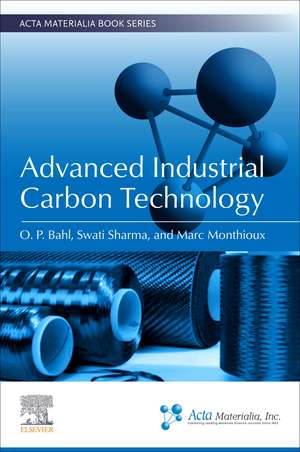
Advanced Industrial Carbon Technology: Acta Materialia Book Series
Autor O. P. Bahl, Swati Sharma, Marc Monthiouxen Limba Engleză Paperback – sep 2026
Drawing on extensive academic and industrial experience, the authors share their practical insights, solutions, and contributions to both research-oriented and industrial carbon technologies, providing readers with real-world applications and examples that highlight key concepts in effective technology transfer from academia to industry.
- Describes industrial carbon technology with a focus on challenges faced during large-scale manufacturing of carbon materials and their solutions
- Features a chronological review of numerous patents, detailing the development of carbon technology and its industrial adaptation
- Includes real-world applications and examples that illustrate crucial concepts behind an efficient technology transfer from academia to industry


Preț: 1130.61 lei
Preț vechi: 1643.91 lei
-31% Nou
Puncte Express: 1696
Carte disponibilă
Livrare economică 22 octombrie-05 noiembrie
Livrare prin curier în România Termenul estimat este afișat lângă disponibilitate.
Transport gratuit pentru acest produs Plată online sau ramburs, în funcție de opțiunile comenzii.
Retur gratuit în 14 zile Comandă securizată și suport în română.
Specificații
ISBN-13: 9780443449017
ISBN-10: 0443449015
Pagini: 500
Dimensiuni: 152 x 229 mm
Greutate: 0.45 kg
Editura: ELSEVIER SCIENCE
Colecția Acta Materialia Book Series
Seria Acta Materialia Book Series
ISBN-10: 0443449015
Pagini: 500
Dimensiuni: 152 x 229 mm
Greutate: 0.45 kg
Editura: ELSEVIER SCIENCE
Colecția Acta Materialia Book Series
Seria Acta Materialia Book Series
V-ar putea interesa
-
 Organic Chemistry: A Very Short IntroductionGraham PatrickPreț: 50.48 lei
 -
 -8%Preț: 438.42 lei476.53 lei
 -
 Manufacturing Processes for Design ProfessionalsRob Thompson-17%Preț: 496.79 lei595.66 lei
 -
 Advanced Computational NanomechanicsNuno Silvestre-23%Preț: 760.29 lei987.39 lei
 -
 Cellulose NanocrystalsWadood Y Hamad-23%Preț: 780.46 lei1013.59 lei
 -
 Materials and DematerializationVaclav SmilPreț: 282.17 lei
 -
 Advanced Nanotube & Nanofiber MaterialsA K Haghi-26%Preț: 503.70 lei676.91 lei
 -
 -31%Preț: 95.45 lei137.35 lei
 -
 -23%Preț: 780.67 lei1013.86 lei
 -
 Carbon Nanostructured MaterialsAlexander KhovavkoPreț: 429.03 lei
 -
 -18%Preț: 1407.34 lei1716.26 lei
 -
 Enhancing Carbon Fibre Production Through Life Cycle AnalysisThomas Groetsch-18%Preț: 1077.00 lei1313.41 lei
 -
 -15%Preț: 679.91 lei799.89 lei
 -
 -14%Preț: 784.93 lei912.71 lei
 -
 Advanced Materials and ManufacturingJitendra Kumar Katiyar-18%Preț: 1402.65 lei1710.55 lei
 -
 Recent Advances in Materials and ManufacturingC. V. Chandrashekara-18%Preț: 1579.53 lei1926.25 lei
 -
 Recent Advances in Composites Engineering and ResearchMulakaluri Rama Manohara Babu-18%Preț: 1069.72 lei1304.53 lei
 -
 GrapheneDalton RainsPreț: 51.85 lei
Cuprins
Part 1: Introduction to carbon materials
1. Carbon in the 21st century
2. Introduction to carbon materials: from bulk crystalline solids to nanomaterials
3. Allotropes of carbon
4. Hybridisation
5. Precursors for carbon preparation
6. Heat-treatment of organic materials
7 Effect of heat-treatment on properties of carbon
8 Nomenclature
9 General characterisation techniques
10 Overview of industrial applications of carbon
11 Conclusions and prospects References
Part 2: Pitches
1. History of tar and pitch evolution
2. Production of coal tar pitch
3. Development of impregnating coal-tar pitch
4. Development of impregnating petroleum pitches
5. Mesophase development
6. Pitch shelf-life, storage and transportation
7. Testing of pitches
8. Toxic effects of pitch
9. Conclusions and prospects References
Part 3: Extruded polycrystalline graphite
1. Background
2. Fabrication of graphite electrodes
3. Future trends
4. Testing/characterisation of graphite electrodes (astm standards)
5 Conclusions and prospects References
Part 4: Carbon fibres
1. Introduction
2. Pan-based carbon fibres
3. Cellulose-based carbon fibres
4. Pitch-based carbon fibres
5. Vapour-grown carbon fibres (vgcfs)
6. Current trends and prospects
7. Conclusions References
Part 5: Carbon fibre-based composites
1. Introduction
2. Manufacturing of carbon fibre-based composites
3. Mechanical properties of cfrps
4. Carbon/carbon composites
5. Applications and state-of-the-art
6. Recent advancements and challenges
7. Conclusions References
Part 6: Isotropic graphites
1. Introduction
2. Preparation of isotropic graphites
3. Classification of isotropic graphites
4. Manufacturing of isotropic graphite (flow diagram)
5. Structure of isotropic graphite (datasheets from leading manufacturers)
6. Conclusion and prospects References
Part 7: Non-graphitisable carbons
1. Introduction
2. Microstructure of non-graphitisable carbons
3 Characterisation of non-graphitisable carbons
4. Glass-like carbons (glassy carbons)
5. Porous and activated carbons
6. Carbon coatings
7. Conclusions and prospects References
Part 8: Carbon nanoforms
1. Introduction
2. Three nanosized dimensions (0d nanoforms)
3. Two nanosized dimensions (1d nanoforms)
4. One nanosized dimension (2d nanoforms)
5. Conclusions References
1. Carbon in the 21st century
2. Introduction to carbon materials: from bulk crystalline solids to nanomaterials
3. Allotropes of carbon
4. Hybridisation
5. Precursors for carbon preparation
6. Heat-treatment of organic materials
7 Effect of heat-treatment on properties of carbon
8 Nomenclature
9 General characterisation techniques
10 Overview of industrial applications of carbon
11 Conclusions and prospects References
Part 2: Pitches
1. History of tar and pitch evolution
2. Production of coal tar pitch
3. Development of impregnating coal-tar pitch
4. Development of impregnating petroleum pitches
5. Mesophase development
6. Pitch shelf-life, storage and transportation
7. Testing of pitches
8. Toxic effects of pitch
9. Conclusions and prospects References
Part 3: Extruded polycrystalline graphite
1. Background
2. Fabrication of graphite electrodes
3. Future trends
4. Testing/characterisation of graphite electrodes (astm standards)
5 Conclusions and prospects References
Part 4: Carbon fibres
1. Introduction
2. Pan-based carbon fibres
3. Cellulose-based carbon fibres
4. Pitch-based carbon fibres
5. Vapour-grown carbon fibres (vgcfs)
6. Current trends and prospects
7. Conclusions References
Part 5: Carbon fibre-based composites
1. Introduction
2. Manufacturing of carbon fibre-based composites
3. Mechanical properties of cfrps
4. Carbon/carbon composites
5. Applications and state-of-the-art
6. Recent advancements and challenges
7. Conclusions References
Part 6: Isotropic graphites
1. Introduction
2. Preparation of isotropic graphites
3. Classification of isotropic graphites
4. Manufacturing of isotropic graphite (flow diagram)
5. Structure of isotropic graphite (datasheets from leading manufacturers)
6. Conclusion and prospects References
Part 7: Non-graphitisable carbons
1. Introduction
2. Microstructure of non-graphitisable carbons
3 Characterisation of non-graphitisable carbons
4. Glass-like carbons (glassy carbons)
5. Porous and activated carbons
6. Carbon coatings
7. Conclusions and prospects References
Part 8: Carbon nanoforms
1. Introduction
2. Three nanosized dimensions (0d nanoforms)
3. Two nanosized dimensions (1d nanoforms)
4. One nanosized dimension (2d nanoforms)
5. Conclusions References