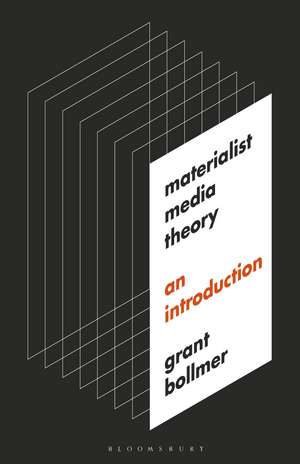
Materialist Media Theory: An Introduction
Autor Dr. Grant Bollmeren Limba Engleză Paperback – 19 sep 2019
More than a mere introduction, Materialist Media Theory provides a critical intervention into matter and media, of interest to students and researchers in media studies, communication, cultural studies, visual culture, and beyond. Media determine our reality, and any politics of media must begin by foregrounding the media's materiality.
Preț: 198.91 lei
Preț vechi: 265.45 lei
-25%
Puncte Express: 298
Carte tipărită la comandă
Livrare economică 05-19 decembrie
Livrare prin curier în România Termenul estimat este afișat lângă disponibilitate.
Transport gratuit de la 400.00 lei Plată online sau ramburs, în funcție de opțiunile comenzii.
Retur gratuit în 14 zile Comandă securizată și suport în română.
Specificații
ISBN-13: 9781501337116
ISBN-10: 1501337114
Pagini: 206
Dimensiuni: 134 x 214 x 16 mm
Greutate: 0.3 kg
Editura: Bloomsbury Publishing
Colecția Bloomsbury Academic
Locul publicării:New York, United States
ISBN-10: 1501337114
Pagini: 206
Dimensiuni: 134 x 214 x 16 mm
Greutate: 0.3 kg
Editura: Bloomsbury Publishing
Colecția Bloomsbury Academic
Locul publicării:New York, United States
V-ar putea interesa
-
 Interpreting TelevisionProfessor Karen Lury-16%Preț: 242.61 lei287.56 lei
 -
 Climate and Sustainability Communication: Global PerspectivesDonnalyn Pompper-18%Preț: 1108.48 lei1351.80 lei
 -
 Reconsidering RootsErica L. Ball-23%Preț: 539.14 lei700.18 lei
 -
 -37%Preț: 219.25 lei347.66 lei
 -
 Mainstreaming Islam in IndonesiaInaya RakhmaniPreț: 455.95 lei
 -
 -18%Preț: 1253.42 lei1528.56 lei
 -
 -18%Preț: 1115.51 lei1360.37 lei
 -
 Screen Comedy and Online AudiencesInger-Lise Kalviknes Bore-18%Preț: 1110.91 lei1354.77 lei
 -
 Sport, Media and Mega-EventsLawrence A. Wenner-15%Preț: 479.28 lei563.86 lei
 -
 -18%Preț: 1307.32 lei1594.29 lei
 -
 The Ethics of Reality TV: A Philosophical ExaminationPhD Wendy N. Wyatt-16%Preț: 256.84 lei304.99 lei
 -
 The Italian Antimafia, New Media, and the Culture of LegalityRobin Pickering-Iazzi-13%Preț: 220.14 lei252.44 lei
 -
 Inhuman Networks: Social Media and the Archaeology of ConnectionDr. Grant Bollmer-24%Preț: 263.75 lei347.50 lei
 -
 Digital Reality: The Body and Digital TechnologiesDr. Melanie Chan-33%Preț: 613.23 lei910.42 lei
 -
 Making Media Theory: Thinking Critically with TechnologyMarcel O’Gorman-12%Preț: 169.14 lei192.98 lei
 -
 -33%Preț: 910.79 lei1355.98 lei
 -
 -29%Preț: 898.89 lei1263.81 lei
 -
 Blogistan: The Internet and Politics in IranAnnabelle Sreberny-36%Preț: 158.00 lei245.63 lei
 -
 Rating the Audience: The Business of MediaProf. Mark Balnaves-14%Preț: 237.20 lei274.49 lei
Cuprins
Introduction: Thinking About (and in) the Materiality of Media
1. Representations and Performances
2. Inscriptions and Techniques
3. Spaces and Times
4. Bodies and Brains
5. Objects and Affects
Conclusion: Ten Theses on the Materiality of Media
Acknowledgments
Works Cited
Index
1. Representations and Performances
2. Inscriptions and Techniques
3. Spaces and Times
4. Bodies and Brains
5. Objects and Affects
Conclusion: Ten Theses on the Materiality of Media
Acknowledgments
Works Cited
Index
Recenzii
Materialist Media Theory is much more than just an introduction. Instead, Bollmer's book is an attempt, and a very successful one, to reshape the domain of media studies by defending a special take on the major issues and stakes of the field as well as by critically rereading a large number of its foundational and contemporary thinkers.
The book will be especially useful for those interested in media theory. Nonspecialists will appreciate the survey of the major ideas in media theory and the compelling description of the interconnections between scholars. Advanced scholars will find the book helpful context for recent works in this field, for example, Daniel Reynolds's Media in Mind (2019). Summing Up: Recommended.
Grant Bollmer's Materialist Media Theory is a deceptive book: on the surface, it appears to draw a straightforward map of materialist media studies. Through Bollmer's accessible style and relatable case studies, he takes what is a rather abstract concept and makes its implications for the study of media refreshingly concrete and tangible. But beneath this surface, something far more complex is afoot, as Bollmer establishes the core tenets of a materialist approach to media, while subjecting these foundational theories to a rigorous and sustained skepticism. What emerges is an intellectually ambitious and politically urgent manifesto for the methodological and analytical utility of a materialist media studies.
Grant Bollmer's Materialist Media Theory is a crystal clear pathway into and a direct response to how 20th- and 21st-century media studies is defined by a distinctly materialist turn. He provides us with succinct yet sophisticated introductions to some of the most opaque theories about the so-called hard materialisms built into our everyday technologes. At the same time, Bollmer always counter-balances his overviews with interventionist reminders of how social, cultural, and political power establishes and perpetuates itself through the material structures of these same technologies. He performs the best kind of pragmatic criticism insofar as he continually reminds us that matter and materiality don't simply extend from technologies to their human users; instead, humans and media technologies are bound together by way of complex assemblages of material forces bouncing back and forth between the one and the other. In short, if you've ever wondered about the place of people and politics in materialist media theory, this book is a must-read.
[Emphasising] the intrinsic power of materiality itself and mak[ing] it compatible - quite successfully.
The book will be especially useful for those interested in media theory. Nonspecialists will appreciate the survey of the major ideas in media theory and the compelling description of the interconnections between scholars. Advanced scholars will find the book helpful context for recent works in this field, for example, Daniel Reynolds's Media in Mind (2019). Summing Up: Recommended.
Grant Bollmer's Materialist Media Theory is a deceptive book: on the surface, it appears to draw a straightforward map of materialist media studies. Through Bollmer's accessible style and relatable case studies, he takes what is a rather abstract concept and makes its implications for the study of media refreshingly concrete and tangible. But beneath this surface, something far more complex is afoot, as Bollmer establishes the core tenets of a materialist approach to media, while subjecting these foundational theories to a rigorous and sustained skepticism. What emerges is an intellectually ambitious and politically urgent manifesto for the methodological and analytical utility of a materialist media studies.
Grant Bollmer's Materialist Media Theory is a crystal clear pathway into and a direct response to how 20th- and 21st-century media studies is defined by a distinctly materialist turn. He provides us with succinct yet sophisticated introductions to some of the most opaque theories about the so-called hard materialisms built into our everyday technologes. At the same time, Bollmer always counter-balances his overviews with interventionist reminders of how social, cultural, and political power establishes and perpetuates itself through the material structures of these same technologies. He performs the best kind of pragmatic criticism insofar as he continually reminds us that matter and materiality don't simply extend from technologies to their human users; instead, humans and media technologies are bound together by way of complex assemblages of material forces bouncing back and forth between the one and the other. In short, if you've ever wondered about the place of people and politics in materialist media theory, this book is a must-read.
[Emphasising] the intrinsic power of materiality itself and mak[ing] it compatible - quite successfully.
Notă biografică
Grant Bollmeris Associate Professor of Media Studies at North Carolina State University, USA, where he teaches in the Department of Communication and the PhD Program in Communication, Rhetoric, and Digital Media, and an Honorary Associate of the Department of Media and Communications at The University of Sydney, Australia.