
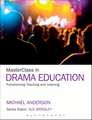
MasterClass in Drama Education: Transforming Teaching and Learning: MasterClass
Autor Professor Michael Anderson Sue Brindleyen Limba Engleză Hardback – dec 2011
Topics covered include:
- The foundations of drama learning
- Planning
- Knowledge and skills
- Assessment
MasterClass in Drama Education will be essential reading for all studying the teaching and learning of drama on PGCE and Education MEd/MA courses.
| Toate formatele și edițiile | Preț | Express |
|---|---|---|
| Paperback (1) | 266.43 lei 6-8 săpt. | |
| Bloomsbury Publishing – dec 2011 | 266.43 lei 6-8 săpt. | |
| Hardback (1) | 853.04 lei 6-8 săpt. | |
| Bloomsbury Publishing – dec 2011 | 853.04 lei 6-8 săpt. |


Preț: 853.04 lei
Preț vechi: 991.91 lei
-14%
Puncte Express: 1280
Preț estimativ în valută:
150.83€ • 177.98$ • 132.09£
150.83€ • 177.98$ • 132.09£
Carte tipărită la comandă
Livrare economică 13-27 aprilie
Specificații
ISBN-13: 9781441167002
ISBN-10: 1441167005
Pagini: 184
Ilustrații: 10
Dimensiuni: 189 x 246 x 18 mm
Greutate: 0.33 kg
Ediția:New.
Editura: Bloomsbury Publishing
Colecția Continuum
Seria MasterClass
Locul publicării:London, United Kingdom
ISBN-10: 1441167005
Pagini: 184
Ilustrații: 10
Dimensiuni: 189 x 246 x 18 mm
Greutate: 0.33 kg
Ediția:New.
Editura: Bloomsbury Publishing
Colecția Continuum
Seria MasterClass
Locul publicării:London, United Kingdom
V-ar putea interesa
-
 Preț: 288.03 lei
 -
 Brilliant Secondary School TeacherDavid TornPreț: 109.27 lei
 -
 Debates in Religious EducationL. Philip BarnesPreț: 312.75 lei
 -
 Global Learning and Sustainable DevelopmentHelen GadsbyPreț: 373.98 lei
 -
 -15%Preț: 502.35 lei591.01 lei
 -
 Debates in Citizenship EducationJames Arthur-15%Preț: 402.12 lei473.08 lei
 -
 -15%Preț: 426.24 lei501.46 lei
 -
 Preț: 335.40 lei
 -
 Preț: 336.17 lei
 -
 Teaching Psychology 14-19: Issues and TechniquesMatt JarvisPreț: 356.39 lei
 -
 How to be a Brilliant English TeacherTrevor WrightPreț: 400.33 lei
 -
 How Schools Do Policy: Policy Enactments in Secondary SchoolsStephen J. BallPreț: 375.91 lei
 -
 To Miss with LoveKatharine BirbalsinghPreț: 110.15 lei
 -
 Teaching English Texts 11-18Dr Sue Dymoke-17%Preț: 271.85 lei327.81 lei
 -
 14-18 - A New Vision for Secondary EducationLord Kenneth Baker-43%Preț: 118.53 lei206.44 lei
 -
 Successful Business Plans: Get Brilliant Results FastMichael Anderson-37%Preț: 50.05 lei79.11 lei
Cuprins
Series Editor's Foreword Sue Brindley
Acknowledgements
Introduction
Part I: Drama Education for Generation Next: Foundations for Effective Pedagogy
1. Teaching Drama in the Twenty-First Century
2. The Challenge of Technology
3. A History of Drama Education
4. Drama and Aesthetic Education
5. Collaborative Understanding: Ensemble Approaches in Drama Education
Part II: Teaching Drama with Generation Next: Pedagogy in Practice
6. Planning Drama Learning
7. Teaching Knowledge and Skills in Drama Education
8. Assessing Drama Learning
9. Researching Drama Education
Epilogue
References
Index
Acknowledgements
Introduction
Part I: Drama Education for Generation Next: Foundations for Effective Pedagogy
1. Teaching Drama in the Twenty-First Century
2. The Challenge of Technology
3. A History of Drama Education
4. Drama and Aesthetic Education
5. Collaborative Understanding: Ensemble Approaches in Drama Education
Part II: Teaching Drama with Generation Next: Pedagogy in Practice
6. Planning Drama Learning
7. Teaching Knowledge and Skills in Drama Education
8. Assessing Drama Learning
9. Researching Drama Education
Epilogue
References
Index
Recenzii
MasterClass in Drama Education weaves history, practice and research in drama education in a comprehensive, reader friendly and sophisticated manner. Anderson brings breadth as well as depth to drama research and practice, creating a timely book that speaks to scholars and educators. A must-read for all involved in drama/theatre education.
This volume will provide an invaluable guide and overview to those new to, and experienced in, the practice of drama teaching, and particularly those beginning research in the area. Anderson successfully manages to weave a narrative that is always engaging and accessible, and he skilfully contextualises both the positioning and key issues of drama education. He directly addresses some of the important challenges facing the community, and seamlessly mainstreams some of the heretofore somewhat peripheral discussions around aesthetics, drama knowledge, creativity and technology. In identifying five guiding principles for the future of drama education at the outset, Anderson puts his own stamp on this work and makes clear his views for the future of drama education. However, he doesn't burden the reader with solely his own philosophy and is generous in acknowledging the contribution of others as well as the lacunae in our collective knowledge and wisdom.
MasterClass in Drama Education provides an excellent insight into teaching drama in the twenty-first century. It considers the challenges and offers pragmatic solutions for educating the young people of today who face an unknown and unimaginable future. This text looks back over the history of drama education with a superb summary of the field to date, comprehensively covering the development of the field with references to practitioners and academics in Australia, America, Canada and the UK. In part two, Anderson discusses drama as a productive pedagogy for democratic learning in a long overdue reconsideration of both the aesthetics and power of drama in the classroom. This text is a significant addition to the literature of drama education both for experienced teachers and those new to the field.
Anderson wears his teacher/learner credentials on his sleeve, often recounting his own student and teacher experiences. He communicates with an accessible written style, informed and engaging.
This volume will provide an invaluable guide and overview to those new to, and experienced in, the practice of drama teaching, and particularly those beginning research in the area. Anderson successfully manages to weave a narrative that is always engaging and accessible, and he skilfully contextualises both the positioning and key issues of drama education. He directly addresses some of the important challenges facing the community, and seamlessly mainstreams some of the heretofore somewhat peripheral discussions around aesthetics, drama knowledge, creativity and technology. In identifying five guiding principles for the future of drama education at the outset, Anderson puts his own stamp on this work and makes clear his views for the future of drama education. However, he doesn't burden the reader with solely his own philosophy and is generous in acknowledging the contribution of others as well as the lacunae in our collective knowledge and wisdom.
MasterClass in Drama Education provides an excellent insight into teaching drama in the twenty-first century. It considers the challenges and offers pragmatic solutions for educating the young people of today who face an unknown and unimaginable future. This text looks back over the history of drama education with a superb summary of the field to date, comprehensively covering the development of the field with references to practitioners and academics in Australia, America, Canada and the UK. In part two, Anderson discusses drama as a productive pedagogy for democratic learning in a long overdue reconsideration of both the aesthetics and power of drama in the classroom. This text is a significant addition to the literature of drama education both for experienced teachers and those new to the field.
Anderson wears his teacher/learner credentials on his sleeve, often recounting his own student and teacher experiences. He communicates with an accessible written style, informed and engaging.